The moment I dropped a piece of shredded cheddar into the run, my hens fought over it like it was a diamond. Wings flapping, beaks snapping, feathers flying. It was gone in seconds.
Then I Googled it and got whiplash. Half the internet says “cheese is toxic to chickens” and the other half says “it is perfectly fine.” So which is it?
After digging into the actual lactase science, discovering that the world’s most expensive chicken has been finished on dairy for over 400 years, and feeding various cheeses to my flock for two years, I finally have the nuanced answer. It is not “yes” and it is not “no.” It is “yes, but the type of cheese matters enormously, and here is exactly why.”
Can Chickens Eat Cheese? Yes, in Small Amounts, and the Type Matters
Yes, chickens can eat cheese as an occasional treat in small amounts. Cheese is not toxic to chickens. However, it is high in fat and sodium, so it requires strict moderation and careful selection of the right type.
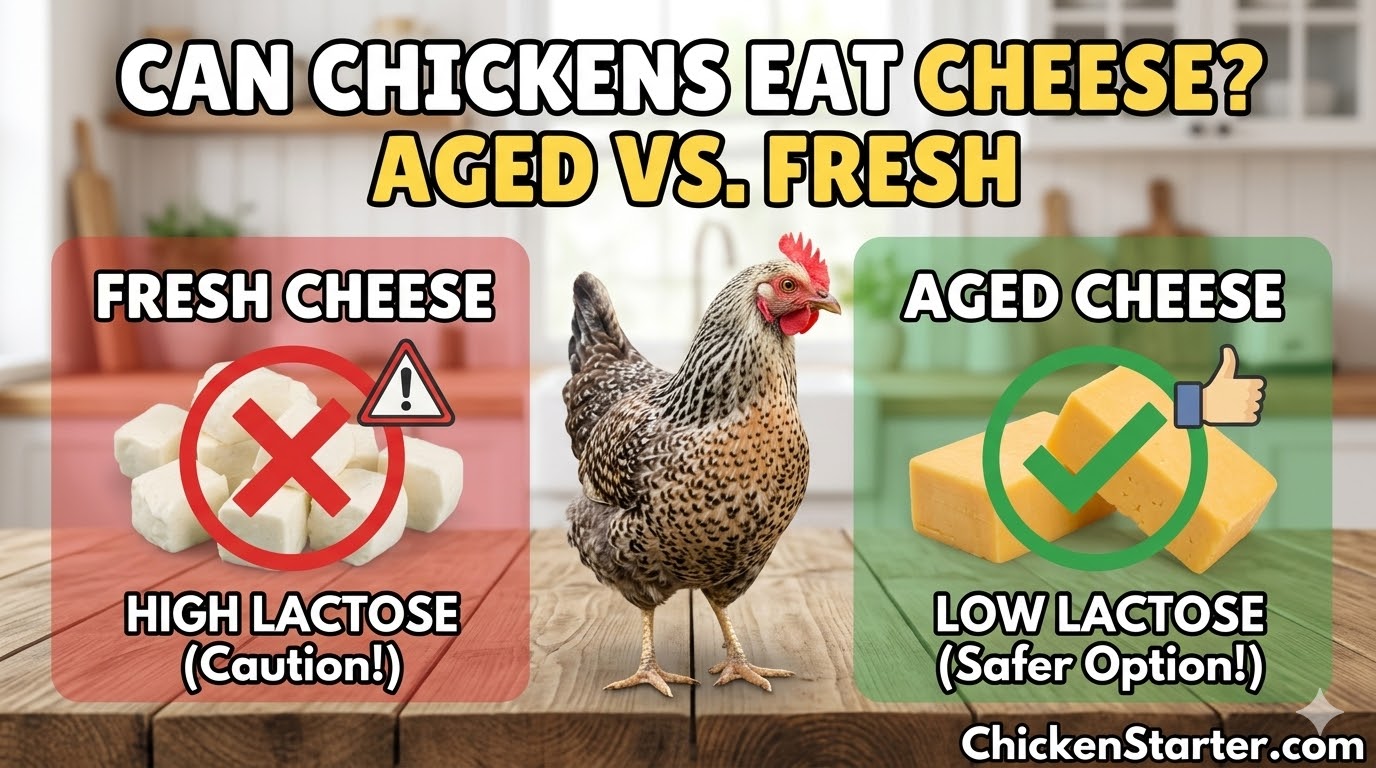
Quick Answer: Chickens can safely eat cheese, but not all cheeses are equal. Chickens produce a limited amount of lactase enzyme and can tolerate small quantities of lactose. Aged hard cheeses like cheddar, parmesan, and Swiss are the safest options because they contain virtually zero lactose after the aging process. Fresh soft cheeses like mozzarella and cottage cheese contain higher lactose (2 to 3%) and should be given more sparingly. Feed 1 to 2 small cubes (roughly 1 ounce) per chicken, once or twice per week maximum. Cheese provides complete protein (casein), calcium (200 to 300mg per ounce of hard cheese), vitamin A, and probiotics in fermented varieties. Never feed processed cheese products, cheese-flavored snacks, or moldy cheese. Never feed Lactaid or lactose-free products to chickens because galactose is toxic at high doses. Baby chicks should not receive cheese until at least 8 to 12 weeks old.
For a complete overview of everything chickens eat, see our comprehensive diet guide.
The Lactose Science: Are Chickens Actually Lactose Intolerant?
This is the question at the heart of the entire debate, and it is the question that almost every competitor gets wrong. The answer is more nuanced than a simple yes or no.
What Most Sites Get Wrong
Most chicken-care websites say one of two things: either “chickens are completely lactose intolerant, never feed dairy” or “cheese is fine, go ahead.” Neither is accurate.
According to a detailed analysis published by Backyard Poultry, chickens are not mammals. Although they are omnivorous, in their natural environment they would not normally encounter mammalian milk or products derived from it. Oddly, however, their bodies still produce some lactase. They can, therefore, tolerate small amounts of lactose.
A study published in The Journal of Nutrition (Rutter et al.) and a subsequent study from North Carolina State University, both indexed on ScienceDirect, provide more precise detail. Lactase activity has been shown to be at low levels in the enterocytes isolated from the small intestine of broiler chickens. The birds are not completely devoid of lactase activity, but it is significantly lower than in mammals. When chickens consume more lactose than their limited lactase can process, the undigested sugar passes through the gut, draws in water osmotically, and causes diarrhea.
The inclusion of 20% lactose in poultry diets results in growth impairment and diarrhea. But small amounts pass through without issue.
The Galactose Danger: A Critical Safety Warning
Here is a warning that zero competitors cover, and it could save your chickens’ lives.
You might think, “If my chickens are lactose intolerant, I will just buy Lactaid or lactose-free milk and cheese.” Do not do this.
As explained by Backyard Poultry magazine, these products are simply a lactase substitute. They work by breaking down lactose into glucose and galactose. A large amount of galactose is toxic to chickens. Giving your chickens Lactaid so you can increase the number of dairy products you feed them is decidedly a bad idea.
Research published in Poultry Science (October 2003) and conducted at the University of Illinois found that feeding galactose to broilers at the rate of 10 percent or more of the total diet resulted in increased deaths. But galactose fed at the rate of 2 to 4 percent actually improved the broilers’ growth rate.
The practical takeaway: stick to naturally low-lactose aged cheeses rather than artificially lactose-free products. The aging process converts lactose into lactic acid naturally, which is safe. Lactaid-type products create galactose, which is dangerous at high concentrations.
The Bresse Tradition: The World’s Best Chicken Has Been Finished on Dairy for Over 400 Years
If cheese and dairy were genuinely dangerous for chickens, someone should tell the French.
According to Wikipedia’s entry on the Bresse chicken and confirmed by the official Taste France designation, the Poulet de Bresse holds AOC (Appellation d’Origine Contrôlée) status, the same certification used to protect regional specialties like Champagne wine and Roquefort cheese. It is widely considered the best quality table chicken in the world.
The birds are kept free-range for at least four months. From about 35 days they are fed cereals and dairy products. They are then “finished” in an épinette, a cage in a darkened fattening shed, where they are intensively fed on maize and milk.
According to detailed breed history from Bryant’s Roost, farmers perfected a specialized feeding method that included corn, wheat, and dairy (often buttermilk or whey) to enhance the flavor and tenderness of the meat. The finishing process became a science: mature birds were placed in épinettes, small wooden cages, where their diet and exercise were carefully controlled for the last 2 to 4 weeks before slaughter. This method, still used today, produces the Bresse chicken’s famous marbled, tender meat. The first written record of these birds dates back to 1591.
The famous gastronome Jean Anthelme Brillat-Savarin described Bresse as “the queen of poultry, the poultry of kings.”
The key insight: the Bresse tradition uses whey and buttermilk, not fresh whole milk. Whey is the liquid left over from cheesemaking, and it contains significantly less lactose than whole milk. Buttermilk is fermented, meaning much of its lactose has already been converted to lactic acid. French farmers, through centuries of practice, naturally gravitated toward the lowest-lactose dairy forms. For more on this remarkable breed, see our American Bresse chicken guide.
How Cheese Provides Calcium for Stronger Eggshells
Beyond the historical tradition, there is published research supporting dairy supplementation in laying hens. According to information from The Peasant’s Daughter, a research trial was carried out at a commercial egg farm on 2,400 laying hens fed a diet of 3% or 4% skim milk powder. Against the control group not fed the skim milk powder, the hens eating the milk powder laid eggs that had considerably thicker shells, likely from the increase in calcium and protein.
A single ounce of hard cheese provides approximately 200 to 300mg of calcium. According to data from Kalmbach Feeds, calcium is one of the most essential nutrients chickens need for overall health and egg production. An eggshell is made of approximately 90% calcium carbonate, and a laying hen needs to consume at least 4 grams of calcium per day to meet her needs.
Cheese alone cannot and should not replace proper calcium supplementation through oyster shell or a quality calcium program. But as an occasional treat, aged cheese contributes meaningful calcium alongside protein and fat. If you are dealing with soft-shelled eggs, adding cheese to your treat rotation alongside proper supplementation can help.
Every Cheese Type Ranked: From Safest to Riskiest for Chickens
This is where the practical guidance lives. Not all cheeses are created equal when it comes to lactose content, and the difference between aged cheddar and fresh mozzarella is enormous.
According to The Cheese Professor, ninety percent or more of the lactose in milk is removed along with the water and whey during the cheesemaking process. The remaining lactose is fermented into lactic acid by beneficial bacteria. According to Cabot Creamery, all of their aged cheddar cheeses as well as Pepper, Colby, Monterey Jack, Gouda, and Muenster contain 0 grams of lactose per serving and are considered to be nearly lactose-free.
| Cheese Type | Lactose Content | Sodium | Safe for Chickens? | Notes |
|---|---|---|---|---|
| Aged Parmesan (12+ months) | Virtually 0 (less than 0.1g/100g) | High | ✅ Best aged option | Give tiny amounts due to high sodium. ~10g protein per ounce |
| Aged Cheddar (6+ months) | Less than 0.1g/serving | Moderate | ✅ Best all-round choice | Virtually lactose-free. Good calcium. Widely available |
| Swiss/Emmental | Very low | Low (50 to 100mg/serving) | ✅ Excellent | Lowest sodium option among hard cheeses |
| Aged Gouda | Very low | Moderate | ✅ Good | Increasingly lactose-free as it ages |
| Cottage Cheese | 2 to 3g/serving | Moderate | ⚠️ Occasional only | Higher lactose than hard cheese, but very high protein (~14g/100g) |
| Fresh Mozzarella | 2 to 3% | Low | ⚠️ Small amounts | Soft, bland, chickens find it easy to eat. But higher lactose |
| Feta | Moderate | High | ⚠️ Sparingly | Sodium is the primary concern |
| Cream Cheese | Moderate | Moderate | ⚠️ Very sparingly | Very high fat (33 to 35%). Low protein |
| Blue Cheese | Low to moderate | Very High | ❌ Avoid | Very high sodium. Contains intentional mold cultures |
| American/Processed | Added lactose | Very High | ❌ Avoid | Processed cheeses often have lactose added back during production |
| Moldy or expired cheese | Varies | Varies | ❌ Never | Mycotoxins are potentially fatal |
Benefits of Cheese for Chickens
When fed in moderation, cheese offers several genuine nutritional benefits:
Complete protein. Cheese is packed with casein protein, a slow-digesting complete protein source containing all the essential amino acids needed for muscle growth and repair. In chickens, protein contributes to proper fluid levels, a healthy immune system, and feather growth. A protein boost from cheese can be particularly beneficial during molting season when chickens lose feathers and require extra nutrients to grow them back.
Calcium for eggshells. As covered above, a single ounce of hard cheese provides 200 to 300mg of calcium. This supports the 4 grams per day that laying hens need.
Probiotics in fermented varieties. Certain aged cheeses like cheddar, parmesan, and gouda contain live probiotic bacteria that can support gut health. According to published poultry nutrition research, probiotics act as novel feed supplements which improve the health and immunity of poultry flocks, and the inclusion of probiotics into the diets of laying hens improves laying production. See our guide on fermented feed for more on probiotic-rich feeding strategies.
Conjugated linoleic acid (CLA). A healthy form of fat commonly found in cheese, CLA is known to help reduce inflammation and support overall health.
Risks of Feeding Too Much Cheese
Cheese is a treat, not a staple, and overfeeding creates real problems:
Diarrhea. This is the most immediate risk. Excess lactose from too much cheese (especially soft varieties) overwhelms the chicken’s limited lactase production. Undigested lactose draws water into the gut and causes watery droppings. If you notice loose droppings after cheese feeding, reduce the amount or switch to a harder, more aged variety. See our guide on chicken diarrhea and health problems.
Obesity and fatty liver. Cheese is high in fat. Too much cheese makes chickens fat, and fat hens are more prone to health issues, poor laying, and fatty liver hemorrhagic syndrome, a potentially fatal condition.
Sodium overload. Cheese is high in sodium. Excess salt causes dehydration and kidney strain in chickens. This is why Swiss cheese (50 to 100mg sodium per serving) is preferable to parmesan (330mg+) or feta (260mg+) when sodium is a concern.
Rapid spoilage. Dairy products left out in the coop can spoil quickly, especially in warm weather, leading to bacterial growth. Always remove uneaten cheese within one hour.
Can Chickens Eat Mozzarella Cheese?
Yes, but with more caution than aged cheeses. Fresh mozzarella usually contains around 2 to 3 percent lactose, which means roughly 2 to 3 grams of lactose per 100 grams of cheese. That is significantly more than aged cheddar or parmesan (which contain virtually none).
Low-moisture mozzarella (the kind sold in blocks for shredding) has less lactose than fresh balls of mozzarella, because it has been aged slightly longer. Keep portions very small due to the higher lactose content. If your flock tolerates it without loose droppings, a few small pieces once a week is fine.
Can Chickens Eat Cheese Every Day?
No. It is best not to feed cheese to chickens daily. Cheese should be limited to once or twice per week at most. When chickens eat cheese every day, they are more likely to become overweight and encounter digestive issues. The high amounts of fat and sodium become problematic over time.
Their main diet should consist of a quality complete layer feed and fresh treats like fruits, vegetables, and greens. Cheese is a supplement, not a food group.
Can Chickens Eat Cheese in Winter?
Winter is actually the best time to offer cheese. The extra calories and fat provide energy for thermogenesis, the metabolic process of heat generation that keeps birds warm through cold nights.
The Bresse finishing tradition historically uses dairy during cold months, which aligns with this practical benefit. A warm mash of plain oatmeal mixed with a small amount of shredded aged cheddar creates a comforting, calorie-dense winter treat my flock absolutely loves.
An added advantage: the risk of spoilage is significantly lower in cold temperatures, giving you a wider window to leave cheese treats in the run. For more cold-weather nutrition strategies, see our winter feeding guide.
Cheese Products: What Is Safe and What Is Not
| Product | Safe? | Notes |
|---|---|---|
| Aged cheddar (cubed or shredded) | ✅ Best option | Low lactose, high calcium, good protein |
| Swiss cheese | ✅ Good | Lowest sodium option among hard cheeses |
| Cottage cheese | ✅ Occasional | High protein (~14g/100g), but higher lactose |
| String cheese or cheese sticks | ✅ OK | Cut into small pieces; usually low-moisture mozzarella |
| Plain yogurt (unsweetened) | ✅ Small amounts | Fermentation removes most lactose. Provides probiotics |
| Cheese rind (natural) | ⚠️ Hard to eat | Most chickens will ignore it. Not harmful if pecked |
| Cheese curds | ⚠️ Sparingly | Fresh curds have higher lactose than aged blocks |
| Cheese grits | ⚠️ Sparingly | Often contains butter and salt. Plain is better |
| Cheese bread | ⚠️ Very sparingly | Double carbohydrate load plus dairy |
| Cheesecake | ❌ Never | Sugar, cream cheese, graham cracker. Far too much fat and sugar |
| Cheese pizza | ❌ Never | Salt, oil, processed ingredients |
| Cheese puffs/Cheetos | ❌ Never | Artificial flavoring, extreme sodium, no real cheese |
| Cheese crackers | ❌ Never | High sodium, processed, artificial ingredients |
| Cheese popcorn | ❌ Never | Artificial flavoring, sodium, butter |
| Cheeseburgers | ❌ Never | Processed meat, bun, condiments, sodium |
| Moldy cheese | ❌ Never | Mycotoxins are potentially fatal |
For a full list of safe and unsafe foods, see our comprehensive feeding guide.
Can Baby Chickens Eat Cheese?
No dairy for young chicks. According to multiple poultry nutrition sources, chicks should only drink clean, fresh water. Milk and dairy can interfere with their developing digestive systems and cause health problems. Their limited (or nonexistent) lactase production makes them especially vulnerable to digestive upset from lactose.
| Age | Can They Eat Cheese? | Notes |
|---|---|---|
| 0 to 8 weeks | ❌ No | Starter/grower feed only. See must-haves for new chicks |
| 8 to 12 weeks | ⚠️ Tiny amounts | Aged cheese only. Watch closely for loose droppings |
| 12 to 16 weeks | ✅ Small amounts | Introduce gradually. See when to switch from starter to grower |
| 16+ weeks (adult) | ✅ Moderate | 1 to 2 small cubes, 1 to 2 times per week |
How to Safely Feed Cheese to Chickens (Step by Step)
Step 1: Choose aged, hard cheese. Aged cheddar, parmesan, Swiss, or aged gouda. These have the lowest lactose and the highest calcium.
Step 2: Cut into small cubes or shred. An entire brick of cheese will be awfully hard for them to consume. Scattered shredded cheese is much easier and prevents dominant hens from hoarding.
Step 3: Feed after layer feed. Never offer cheese before their complete feed. It is calorie-dense and will fill them up, displacing essential nutrition.
Step 4: Portion control. 1 to 2 small cubes per hen, maximum. That is roughly 1 ounce per bird per treat session.
Step 5: Scatter, do not pile. This prevents dominant hens from monopolizing the supply.
Step 6: Provide fresh water. The sodium in cheese increases thirst. Make sure clean water is readily available.
Step 7: Clean up quickly. Dairy spoils fast, especially in warm weather. Remove uneaten cheese within one hour to prevent bacterial growth.
Step 8: Monitor droppings. Loose or watery droppings after cheese feeding means you gave too much or chose a cheese with too much lactose. Reduce the amount or switch to a harder, more aged variety.
Better High-Protein Treats Than Cheese
Cheese is a convenient protein treat, but it is not the best option available. Here is how it compares:
| Treat | Protein | Calcium | Lactose Risk? | Better Than Cheese? |
|---|---|---|---|---|
| Mealworms | Very High | Moderate | ❌ None | ✅ Best protein treat overall |
| Scrambled eggs (from your flock) | Very High | High (especially with shell) | ❌ None | ✅ Excellent, no digestive risk |
| Black Soldier Fly Larvae | Very High | Very High | ❌ None | ✅ Best all-round supplement |
| Sunflower Seeds (BOSS) | High | Moderate | ❌ None | ✅ No digestive risk |
| Cooked Lentils | High | Moderate | ❌ None | ✅ Much cheaper |
| Aged Cheddar | High (7g/oz) | Very High (200mg+) | ⚠️ Minimal | Good, but not best |
For more on protein-rich treats, see our treats that boost egg laying.
Frequently Asked Questions
Are chickens lactose intolerant?
Not fully. According to information from Backyard Poultry, chickens’ bodies still produce some lactase. They can tolerate small amounts of lactose. However, too much dairy can cause severe and possibly bloody diarrhea as well as stomach pains and cramps. The key is choosing low-lactose aged cheeses and feeding sparingly.
What is the best cheese for chickens?
Aged cheddar (6+ months) is the best all-round option. It is virtually lactose-free, high in calcium and protein, moderate in sodium, widely available, and affordable. Aged parmesan and Swiss are also excellent choices, though parmesan is higher in sodium.
Can chickens eat cheese rinds?
Natural cheese rinds are not toxic but are very hard. Most chickens will ignore them. Wax rinds (the colored coating on some cheeses like Gouda) should never be fed, as they are not food.
Can I use cheese to give my chicken medicine?
Yes. Wrapping a pill in a small piece of soft cheese is an effective administration method. The cheese flavor masks the medicine taste, and most chickens will gulp it down.
Will cheese change my eggs’ taste?
In small treat quantities, no. However, the Bresse tradition of finishing chickens on dairy for 2 to 4 weeks is specifically designed to produce richer, creamier meat. So dairy can affect flavor at significantly higher intake levels than what you would feed as a treat.
Can I feed my chickens Lactaid or lactose-free cheese?
Be very careful with this. Lactose-free products break down lactose into glucose and galactose. According to research published in Poultry Science, galactose at 10% or more of the diet caused increased deaths in broilers. A small amount of naturally produced galactose from regular dairy digestion is fine, but deliberately increasing galactose intake through Lactaid products is not recommended. Stick to naturally low-lactose aged cheeses instead.
Can chickens eat yogurt?
Yes, in very small amounts. The fermentation process in yogurt consumes most of the lactose, and it provides beneficial probiotics. Choose plain, unsweetened yogurt only. A teaspoon or two per bird, once or twice a week, is the appropriate amount.
Can Silkie chickens eat cheese?
Yes, Silkies can eat cheese in the same moderation as other breeds. Cut into tiny pieces due to their smaller beaks and body size.
The Bottom Line on Cheese for Chickens
After two years of feeding various cheeses to my flock and researching the actual science, here are the four things to remember:
First, chickens produce limited lactase. They are not fully lactose intolerant, but they can only handle small amounts of dairy. Choose your cheese type wisely.
Second, aged hard cheeses (cheddar, parmesan, Swiss) are the safest option. They contain virtually zero lactose after the aging process naturally converts it to lactic acid. Fresh soft cheeses contain significantly more lactose and should be given more sparingly.
Third, the Bresse tradition proves dairy has been fed to chickens for over 400 years. The world’s most prestigious chicken breed is finished on corn and milk, with AOC certification mandating this practice. The key is moderation and using lower-lactose dairy forms like whey and buttermilk.
Fourth, never feed Lactaid or lactose-free products to chickens. They create galactose, which is toxic to poultry at high doses. And never feed processed cheese products, cheese-flavored snacks, or moldy cheese.
Want to explore more treats for your flock? Check out our guides to strawberries, cucumbers, blueberries, carrots, or our complete guide to what chickens can eat from your kitchen.

Oladepo Babatunde is the founder of ChickenStarter.com. He is a backyard chicken keeper and educator who specializes in helping beginners raise healthy flocks, particularly in warm climates. His expertise comes from years of hands-on experience building coops, treating common chicken ailments, and solving flock management issues. His own happy hens are a testament to his methods, laying 25-30 eggs weekly.