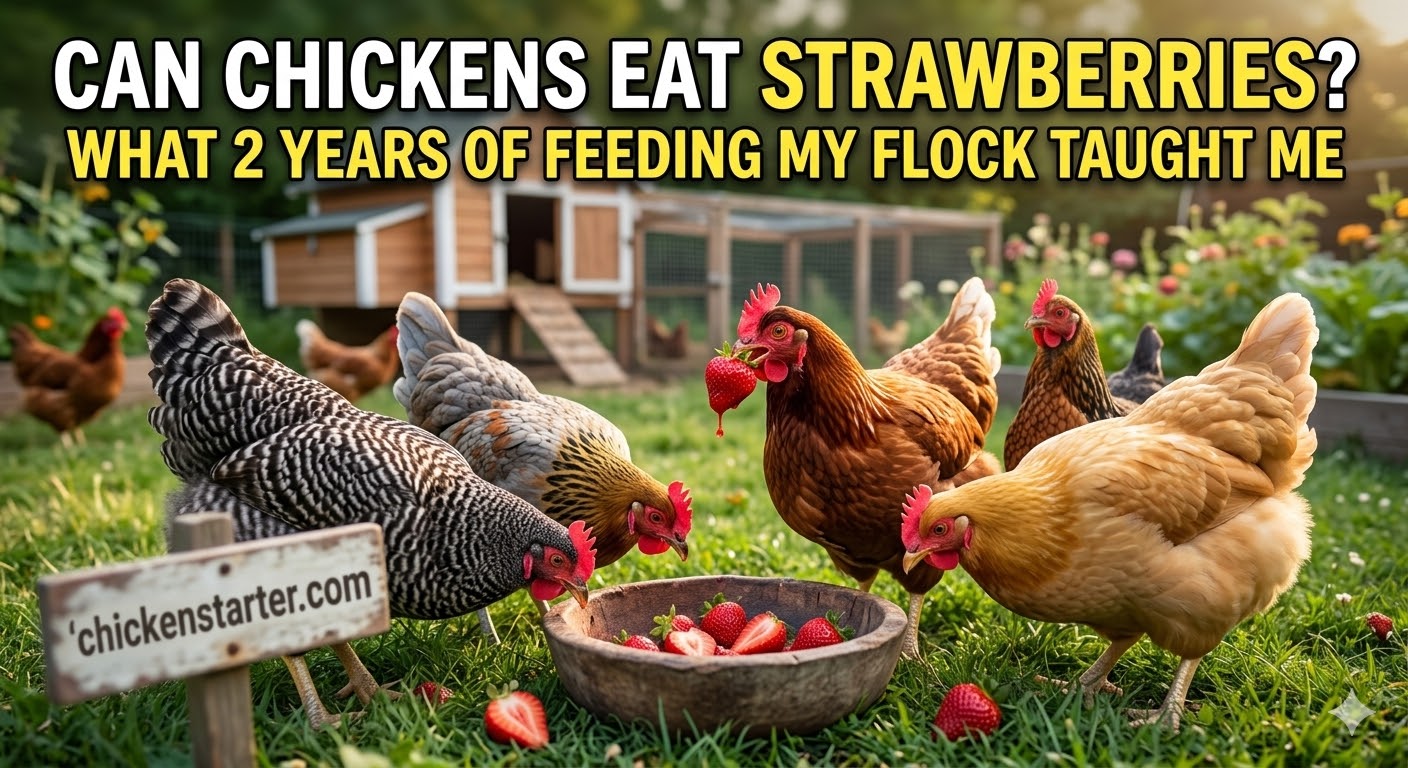
Every June, my strawberry patch goes into overdrive and produces way more than my family can eat. That first summer with chickens, I had a full flat of overripe strawberries sitting on the counter and twelve hens giving me the “treat me” stare through the run fence. Before I tossed them over, I paused. Are strawberries actually safe for chickens? What about the leaves? And would the pesticides on store-bought berries end up in my eggs?
So I did what I always do: I dug into the science. After two full growing seasons of feeding strawberries to chickens, including homegrown organic berries from my garden and store-bought conventional berries, and tracking their droppings, egg production, and behavior the entire time, I’ve learned exactly what works, what doesn’t, and the one mistake I will not make again.
Can Chickens Eat Strawberries? The Straight Answer
Yes, chickens can safely eat strawberries, and they’re one of the healthiest fruit treats you can offer. According to veterinarians interviewed by Chewy, strawberries are a healthy food choice for chickens, with key nutrients including vitamin C, fiber, potassium, folate, and manganese, all of which can be beneficial to a chicken’s health.
Quick Answer: Yes, chickens can safely eat strawberries. The fruit, seeds, and even the tops/leaves are safe in moderation. Strawberries are non-toxic, 91% water, and rich in vitamin C (59mg per 100g), antioxidants, and fiber. Limit to one full strawberry per hen per day, offered 2 to 3 times per week. Treats should make up no more than 10% of a chicken’s diet. Always wash conventional strawberries thoroughly as they rank near the top of the 2025 Dirty Dozen for pesticide contamination. Never feed moldy strawberries. Baby chicks should be at least 6 weeks old before introduction.
The potential risks of strawberries for chickens aren’t from the strawberry itself but from how it’s fed. Treats, including fruits, should be fed in moderation, making up no more than 10% of your chicken’s daily diet. The rest should come from a high-quality, balanced layer feed.
My flock goes absolutely wild for strawberries. They’re the only treat where all twelve hens come running before I even reach the run. But I learned quickly that tossing them a whole flat of berries was a mistake. The next morning, red-stained droppings everywhere and two hens that completely skipped their layer feed. Lesson learned: moderation is everything.
Why Strawberries Are Actually Good for Chickens (The Vitamin C Science Most Sites Miss)
Here’s where this article goes deeper than anything else you’ll find online. Most chicken websites say “strawberries have vitamin C” and move on. But there’s published poultry science that explains why vitamin C specifically matters for your flock, especially during summer.
The Heat Stress Connection
Vitamin C (ascorbic acid) is normally synthesized in a chicken’s kidneys. However, according to research published in World’s Poultry Science Journal through Cambridge University Press, during heat stress, endogenous ascorbic acid becomes insufficient to meet the bird’s requirements. Heat stress diminishes immunity, feed intake, weight gain, egg production, hatchability of fertile eggs, egg and carcass quality, and mineral balance.
A comprehensive review published in Veterinary Medicine International through the National Institutes of Health confirms that ascorbic acid supplementation positively affects the stress response, especially during hot seasons. It enhances the laying rate, egg hatch performance, and higher poultry productivity. For layers at the end of the laying period, it helps increase the quality of the eggshell and reduces the proportion of broken eggs.
Research published in Frontiers in Veterinary Science in 2025 found that supplementing diets with 50 and 100 mg/kg of vitamin C increases the fertility and hen-day egg production of broiler breeders. Supplementing 200 mg/kg vitamin C in the diets of heat-stressed laying hens improved feed intake, egg production, and egg quality.
What This Means for Your Backyard Flock
Strawberries are one of the highest natural vitamin C sources among common fruits, providing 59mg per 100g according to USDA FoodData Central. That’s actually higher than oranges by weight. During summer heat (above 86°F/30°C), your chickens’ bodies can’t produce enough vitamin C on their own. Feeding vitamin C-rich treats like strawberries during heat waves isn’t just “fun.” There’s published science supporting improved egg production, shell quality, and immune function.
This doesn’t mean strawberries replace proper supplementation for commercial flocks. But for backyard keepers, it’s a science-backed reason to offer them during hot weather.
During a brutal July heat wave last summer, five straight days above 100°F, I noticed my egg production dropped by about 30%. I started offering frozen strawberry halves as an afternoon treat (more on freezing them below). Within a week, production crept back up. Was it the vitamin C, the hydration, the cooling effect, or all three? I can’t isolate one factor, but the research suggests all of them likely played a role. For more summer strategies, check out my guides on what to feed chickens during a heatwave and keeping chickens cool in Australian summers.
Nutritional Breakdown: What’s Actually in a Strawberry?
Based on data from the USDA FoodData Central database, here’s how strawberries compare to what your laying hens actually need:
| Nutrient | Strawberries (per 100g) | Layer Feed (per 100g) | What Hens Need |
|---|---|---|---|
| Calories | 32 kcal | ~280 kcal | Energy for egg production |
| Protein | 0.67g | 16 to 18g | 16 to 18% of diet |
| Carbohydrates | 7.68g | ~55 to 60g | Energy source |
| Fiber | 2g | ~3 to 5g | Digestive health |
| Calcium | 16mg | ~3,500 to 4,000mg | 2.5 to 4% for layers |
| Potassium | 153mg | ~600mg | Electrolyte balance |
| Vitamin C | 59mg (65% DV) | Minimal | Immune support, heat stress management |
| Water content | 91% | ~10 to 12% | Hydration |
| Sugar | 4.9g | Minimal | Quick energy (limit!) |
The takeaway is clear. Strawberries are excellent for vitamin C and hydration, making them ideal summer treats. But they are very low in protein and calcium, the two nutrients laying hens need most. A protein-deficient diet can result in a reduction in egg laying and reduced hatchability of their eggs. That’s why strawberries should always be a supplement to their regular layer feed, never a replacement.
Strawberries also contain beneficial antioxidants including anthocyanins (which give them their red color and offer anti-inflammatory benefits), ellagic acid (which helps protect cells from damage), and quercetin (which supports heart health and may help reduce inflammation).
The Pesticide Warning: Why You Should WASH Strawberries Before Feeding Your Flock
This is the section that no other chicken website covers properly, and it’s arguably the most important one.
According to the Environmental Working Group’s 2025 Dirty Dozen report, after holding the top spot for nine straight years, strawberries dropped to second place on the list. Spinach now ranks first. But strawberries remain one of the most pesticide-contaminated fruits you can buy. USDA tests found that strawberries were the fresh produce item most likely to be contaminated with pesticide residues, even after they are picked, rinsed in the field, and washed before eating.
In total, 203 pesticides were detected on samples of the Dirty Dozen produce, with pesticides found on 96 percent of Dirty Dozen samples. The EWG specifically highlights that another concerning pesticide found on strawberries is bifenthrin, a pyrethroid insecticide that the Environmental Protection Agency and California regulators have designated a “possible human carcinogen,” found on more than 29 percent of samples.
Why This Matters for Your Chickens
Pesticide residues can accumulate in a chicken’s body and potentially transfer to their eggs. If you are feeding them conventional store-bought strawberries, be especially wary of feeding them the calyx (the green top). This part of the strawberry can hold onto pesticides that were used while it was growing more readily than the smooth fruit surface. If the chickens ingest concentrated pesticide residue, it can make them sick.
My Safety Recommendations
- Best option: Feed homegrown or certified organic strawberries. You control what goes on them.
- Second best: Wash conventional strawberries thoroughly under running water for at least 30 seconds, rubbing the surface of each berry individually.
- Remove the tops from store-bought conventional strawberries. The calyx traps the most residue.
- If growing your own, never use pesticides on plants your chickens will access.
After learning about the Dirty Dozen data, I switched to only feeding homegrown strawberries from my pesticide-free garden patch. When I do buy conventional strawberries from the store for my family, I give the chickens only the fruit (not the tops) after a thorough rinse. It takes 30 extra seconds and gives me peace of mind. For tips on growing chicken-safe plants, check out my guide on plants to grow around your coop.
Can Chickens Eat Every Part of the Strawberry? Fruit, Seeds, Tops, Leaves, and Stems
Let’s go through every part of the strawberry plant individually.
| Part | Safe? | Notes |
|---|---|---|
| Fruit (red flesh) | ✅ Yes | The safest, most nutritious part. Always the best choice. |
| Seeds | ✅ Yes | Completely safe. The tiny seeds pose no choking hazard whatsoever. |
| Tops/Calyx (green cap) | ⚠️ Caution | Safe if organic or homegrown. Remove from store-bought conventional berries due to pesticide concentration. |
| Leaves | ⚠️ Debated | Generally safe, but offer in small quantities since high tannin levels can sometimes cause mild digestive upset. |
| Stems | ⚠️ Debated | Same compounds as leaves. Some keepers report loose droppings. |
| Strawberry plant (whole) | ⚠️ Moderation | One homesteader reported their flock demolished hundreds of strawberry plants in one afternoon with no ill effects. But moderation is still wise. |
The Leaf and Stem Controversy
Depending on who you ask, you may get conflicting opinions about strawberry leaves and stems. Some owners swear that strawberry stems and leaves cause diarrhea and upset stomachs in chickens. However, most scientific research is either silent about it, or says the opposite. One study showed that these greens have significant antimicrobial properties for chickens. At worst, scientists consider them harmless: the PoultryDVM database shows strawberries listed on their index of safe plants for poultry.
The fruit, tops, and leaves are generally safe, but it’s wise to offer leaves in small quantities since high tannin levels can sometimes cause mild digestive upset.
My balanced recommendation: start with a tiny sample and keep a close eye on your birds for any issues. If you notice a connection between leaf consumption and digestive changes, stick with the berries only.
I’ve fed my flock both the fruit and the tops from my organic garden strawberries for two full seasons. Zero digestive issues from the leaves or tops on homegrown berries. However, when I gave them store-bought strawberry tops, two hens had noticeably looser droppings the next day. Was it the tops themselves or the pesticide residue? I can’t be sure, so now I only feed store-bought fruit without the tops.
How to Prepare Strawberries for Chickens: Step by Step
Step 1: Inspect for mold. It is never safe for chickens to eat moldy or spoiled strawberries. Don’t feed berries that are fuzzy, smell off, or feel excessively soft. If you’re unsure, throw them out.
Step 2: Wash thoroughly. Even if organic, rinse under running water for 30 seconds. For conventional berries, rub each berry while rinsing to remove surface pesticide residues.
Step 3: Remove tops from store-bought (optional). If using conventional strawberries, remove the green calyx to reduce pesticide exposure. If using homegrown organic, the tops are fine to include.
Step 4: Chop into bite-sized pieces. Chop strawberries into bite-size pieces or mash them to make it safe and easy for your chicken to eat. This prevents choking, reduces bullying (dominant hens can’t hoard whole berries), and ensures every hen gets some.
Step 5: Serve on a clean surface. Feed strawberries on a clean plate or board to prevent them from rolling in dirt and picking up bacteria.
Step 6: Practice portion control. According to Dr. Susan Tyson, VMD, a veterinarian specializing in avian medicine, adult chickens can safely have approximately one full strawberry per day as a treat, or two to three strawberry tops with a little bit of fruit attached.
Step 7: Scatter for foraging. Scatter pieces around the run for a fun foraging activity, or mix them with other treats. This provides environmental enrichment and encourages natural foraging behavior.
Step 8: Provide fresh water. The sugar in strawberries increases thirst. Always have clean water available.
Step 9: Clean up leftovers. Strawberries decompose quickly, and their fragrant aroma will quickly attract pests, insects, and rodents. Remove uneaten pieces within 2 hours. My guide on keeping rats out of the chicken coop covers why leftover food is one of the biggest attractors.
Fun Feeding Methods
- Frozen strawberry halves in summer: keeps them cool and entertained for longer
- Strawberry and oat mash: mash berries with plain rolled oats for morning enrichment
- Hanging strawberry kebab: thread pieces on a string and hang in the run for pecking entertainment
- Frozen berry ice block: freeze strawberry pieces in a shallow pan of water for a summer boredom buster that lasts over an hour
Can Chickens Eat Frozen Strawberries?
Yes, and this is my favorite way to serve them in summer. Research has found that frozen strawberries retain the same nutritional components as fresh strawberries. This is great news because frozen berries make an excellent cooling treat during the hot months.
You can serve them still frozen (for maximum cooling benefit) or thawed. Frozen strawberries also tend to be cheaper than fresh, especially during the off-season. Just make sure you buy the no added sugar variety. Always check the label on store-bought frozen bags, as some brands add sugar or syrup.
Frozen strawberries are my go-to summer treat. I buy the large bags of frozen organic strawberries from Costco for about $10. At 3 to 4 berries per treat session, one bag lasts my flock of 12 hens about six weeks. During heat waves, I freeze strawberry pieces in a shallow pan of water to create a “berry ice block.” It keeps the girls entertained and cool for over an hour on the hottest days. For more hot-weather strategies, check out my guide on the best heat-tolerant chicken breeds.
Can Chickens Eat Strawberry Jam, Jelly, or Preserved Strawberries?
No to jam and jelly. Extreme caution for dried.
No, chickens cannot eat strawberry jam or jelly. Both are loaded with sugar and offer zero nutritional benefit. One tablespoon of strawberry jam can contain over 12 grams of sugar, which is far too much for a chicken and can lead to weight gain, digestive upset, and potentially Fatty Liver Hemorrhagic Syndrome over time.
As Dr. Cauble, a veterinarian interviewed by Chewy, puts it: the less healthy a form of strawberry is for humans, the less healthy it is for birds. Fresh strawberries are always the better option.
| Strawberry Product | Safe? | Notes |
|---|---|---|
| Fresh raw strawberries | ✅ Best option | Maximum nutrition, best hydration |
| Frozen strawberries (no sugar added) | ✅ Excellent | Great summer treat, retains nutrition |
| Overripe strawberries (not moldy) | ✅ OK | Softer and easier to eat. Just not moldy. |
| Dried strawberries (unsweetened) | ⚠️ Rarely | Concentrated sugar, low moisture |
| Dried strawberries (sweetened) | ❌ No | Added sugar and preservatives |
| Strawberry jam or jelly | ❌ No | 12g+ sugar per tablespoon |
| Strawberry preserves | ❌ No | Sugar, possible preservatives |
| Strawberry ice cream | ❌ No | Dairy, sugar, artificial ingredients |
| Strawberry yogurt | ⚠️ Tiny amount | Plain yogurt with fresh strawberry is better |
| Strawberry cake or pie | ❌ No | Sugar, butter, flour, zero nutritional value |
| Moldy or spoiled strawberries | ❌ NEVER | Mycotoxins, potentially fatal |
Can Chickens Eat Moldy Strawberries? ⚠️ Critical Safety Warning
Never feed moldy strawberries to chickens.
It is never safe for chickens to eat moldy or spoiled strawberries. Mold can produce harmful mycotoxins that stress the liver, lower the quality of eggs, and can make your flock seriously ill. For safety reasons, don’t feed berries that are fuzzy, smell bad, or feel excessively soft.
Strawberries are particularly susceptible to mold because of their high moisture content (91% water) and soft, porous surface. Even a small amount of visible mold means the entire berry is likely compromised. Mold threads (hyphae) penetrate deep into soft fruits long before they’re visible on the surface.
I made this mistake once in my first year. I had a container of strawberries that looked mostly fine. Only one had a fuzzy spot. I picked out the moldy one and gave the rest to my hens. The next day, three of them had watery droppings. Lesson learned: if one berry in the container is moldy, I now inspect every single one carefully before feeding, or I toss the whole batch. For more on recognizing digestive issues, read my guide on chicken diarrhea and health problems.
How Old Do Chickens Need to Be to Eat Strawberries?
There’s genuine disagreement among sources about the exact age, so let me present the range honestly with my own recommendation.
Some sources, like the experienced poultry keepers at Backyard Chickens forum, have given strawberry tops to chicks as young as 2 to 3 weeks with chick grit available. Others, like the veterinarians and poultry experts at A-Z Animals, recommend not feeding strawberries to baby chicks until they’re older than six weeks.
According to Dr. Cauble, baby chicks can eat strawberries as a snack in reasonable amounts and in moderation. However, feeding too many strawberries to a young chick could cause diarrhea, leading to dehydration, which can be dangerous for such small birds.
| Age | Can They Eat Strawberries? | How to Serve | Important Notes |
|---|---|---|---|
| 0 to 2 weeks | ❌ No | N/A | Starter feed only (18 to 22% protein) |
| 2 to 4 weeks | ⚠️ Most experts say wait | N/A | Digestive system still very immature |
| 4 to 6 weeks | ⚠️ Very tiny amounts only | Mashed or squashed only | Must have chick grit available |
| 6 to 12 weeks | ✅ Small amounts | Finely chopped | Grower feed should still be the primary diet |
| 12 to 16 weeks | ✅ Moderate | Chopped or halved | Gradually increase treat variety |
| 16+ weeks (adult) | ✅ Full treat amounts | Chopped, whole, or frozen | Layer feed equals 90% of diet |
My recommendation: wait until 6 weeks to be safe. Even then, start with a quarter of a berry for the entire group of chicks and make sure chick grit is available. For a complete breakdown of feed transitions, read my guide on when to switch from starter to grower feed.
Can Chickens Eat Strawberries Every Day?
No. Feed them occasionally as a treat, not daily. Feeding chickens strawberries should be a special treat, not a daily habit.
It’s important that strawberries and other treats are given in moderation. Generally, treats like strawberries should make up no more than 10% of your chickens’ daily food intake. This ensures they still get all their essential nutrients from their primary feed while enjoying a delicious fruity snack. Too much fruit can lead to digestive issues and obesity in chickens due to its high sugar content.
Recommended frequency: 2 to 3 times per week, not daily.
According to Dr. Cauble, if chickens eat too many strawberries, they may experience diarrhea, which might appear red due to the natural pigment in the strawberries. This is an important note, because red-stained droppings from strawberries can mimic bloody droppings and cause panic in new chicken keepers. If droppings remain red for more than 24 hours after you’ve stopped feeding strawberries, consult a vet, as it could indicate coccidiosis or internal bleeding rather than berry pigment.
I feed strawberries 2 to 3 times per week during strawberry season (June through August here), and not at all during winter when they’re expensive and out of season. On strawberry days, I always make sure the layer feed goes in first thing in the morning, and strawberries come as a 10 AM treat after they’ve already eaten their fill.
Can Chickens Eat Strawberries and Cucumbers Together?
Yes, and this is an excellent combination, especially in summer. Cucumbers are 96% water (even more hydrating than strawberries) and appear on the EWG’s Clean Fifteen list, meaning they carry very low pesticide residue. Together, strawberries and cucumbers provide hydration, vitamin C, vitamin K, potassium, and enrichment.
A strawberry and cucumber mix is one of the best summer cooling treats you can offer. Chop both into small pieces, mix together, and scatter in the run.
Other great strawberry combinations:
- Strawberry plus watermelon: ultimate hydration mix for extreme heat
- Strawberry plus blueberry: antioxidant powerhouse
- Strawberry plus plain oats: morning mash treat
- Strawberry plus pumpkin seeds: vitamin C plus natural dewormer
What Is the Healthiest Fruit for Chickens?
After two years of testing different fruits with my flock and tracking the results, here’s how the most common fruit treats compare:
| Fruit | Vitamin C | Protein | Water | Sugar | Key Benefit | Verdict |
|---|---|---|---|---|---|---|
| Strawberries | Very high (59mg) | Very low | 91% | 4.9g | Immune support plus hydration | 🏆 Best for summer and heat stress |
| Watermelon | Moderate (8mg) | Very low | 92% | 6.2g | Maximum hydration | Best for extreme heat |
| Blueberries | Moderate (10mg) | Low | 84% | 10g | Highest antioxidants | Best for immune health |
| Pumpkin | Low (9mg) | Low | 92% | 2.8g | Seeds act as natural dewormer | Best all-round superfood |
| Bananas | Low (9mg) | Low | 75% | 12g | Potassium, quick energy | High sugar, use sparingly |
| Grapes | Low (3mg) | Low | 81% | 16g | Quick energy, hydration | Very high sugar, limit strictly |
| Apples | Low (5mg) | Low | 86% | 10g | Fiber, pectin | Remove seeds (contain amygdalin) |
For detailed guides on each of these, check out my articles on chickens eating pumpkins, bananas and peels, grapes, watermelon, tomatoes, and lettuce. For a full overview of treats that support egg production, visit best chicken treats that boost egg laying.
Fruits Chickens Should NEVER Eat
While strawberries are perfectly safe, not all fruits are. Here are the ones that should never reach your flock:
- ❌ Avocado pits and skin. These contain persin, which is toxic to chickens and can cause respiratory failure.
- ❌ Apple seeds. Contain amygdalin, which converts to hydrogen cyanide. Always remove the core and seeds before feeding apple slices.
- ❌ Cherry, peach, and plum pits. Same cyanide-producing compounds as apple seeds.
- ❌ Rhubarb leaves. Contain oxalic acid, which is toxic to chickens.
- ❌ Unripe green tomatoes. Contain solanine (the same toxin found in green potatoes).
- ❌ Citrus fruit in large amounts. Debated, but some evidence suggests it can interfere with calcium absorption and reduce egg production. Small amounts are likely fine, but avoid making it a regular treat.
- ❌ Moldy fruit of any kind. Mycotoxins can cause liver damage and are potentially fatal.
For the comprehensive list of safe and dangerous foods, read my complete feeding guide and the full overview of what chickens eat.
Frequently Asked Questions About Chickens and Strawberries
Can chickens eat raw strawberries?
Yes, and raw is the preferred way to serve them. Raw strawberries are juicy, provide maximum hydration, and maintain their complete nutritional profile. Always wash them first and chop into bite-sized pieces.
Are strawberry seeds safe for chickens?
Yes, the tiny seeds on the surface of strawberries are completely safe for chickens and cause no harm. You don’t need to remove them. They’re soft, small, and pose no choking hazard.
How many strawberries can I give my chicken?
According to Dr. Susan Tyson, VMD, adult chickens can safely have approximately one full strawberry per day as a treat, or two to three strawberry tops with a little bit of fruit attached. Keep total treats under 10% of their daily diet, and offer 2 to 3 times per week.
Can frozen strawberries be fed to chickens?
Yes. Research has confirmed that frozen strawberries retain the same nutritional components as fresh. They make an excellent summer cooling treat and are often cheaper than fresh, especially off-season. Buy the no-added-sugar variety only.
Should I buy organic strawberries for my chickens?
Ideally, yes. According to the EWG, USDA tests found that strawberries were the fresh produce item most likely to be contaminated with pesticide residues, even after washing. If buying conventional, wash thoroughly and consider removing the green tops. Homegrown without pesticides is always the best option.
Why are my chickens’ droppings red after eating strawberries?
According to Dr. Cauble, if chickens eat too many strawberries, they may experience diarrhea, which might appear red due to the natural pigment in the strawberries. Mild red-staining is normal. However, if droppings remain red for more than 24 hours after stopping strawberries, consult a vet as it could indicate coccidiosis or internal bleeding.
Can chickens eat strawberries from my garden?
Yes. Homegrown strawberries are the best option because you control what goes on them. If your chickens break into your strawberry patch and eat too many in one afternoon, there’s likely no long-term harm, but they might end up with some intense diarrhea. Consider fencing your patch during peak season.
Can roosters eat strawberries?
Yes, roosters can eat strawberries with the same moderation guidelines as hens. Since roosters don’t produce eggs, the calcium concern is less relevant, but the sugar and calorie limits still apply.
What fruits can I give baby chickens?
Baby chicks love fruit, especially strawberries, which contain many minerals and vitamins such as potassium, vitamin B, copper, iron, and magnesium. Wait until chicks are at least 6 weeks old, offer tiny mashed pieces, and always ensure chick grit is available. Their starter feed should remain the primary diet.
Final Thoughts From My Strawberry Patch to Yours
After two full growing seasons of testing, here are the four things I want you to remember about feeding strawberries to chickens:
First, strawberries are one of the healthiest fruit treats you can offer your flock, especially during hot weather. The vitamin C and heat stress connection isn’t just anecdotal, it’s backed by peer-reviewed poultry science.
Second, pesticides are a real concern. Strawberries consistently rank near the top of the Dirty Dozen list. Wash thoroughly, remove the tops from conventional berries, or grow your own.
Third, the leaves, tops, and seeds are all safe, but the fruit itself is the best and safest part to offer, especially if you’re using store-bought berries.
Fourth, moderation is everything. One berry per hen, 2 to 3 times per week, always after they’ve eaten their regular layer feed. Treats should never exceed 10% of their diet.
Growing your own strawberries for your flock? Check out my guide to safe plants to grow around your coop or learn what your chickens can eat from your kitchen.
Happy feeding, and enjoy strawberry season with your flock.

Oladepo Babatunde is the founder of ChickenStarter.com. He is a backyard chicken keeper and educator who specializes in helping beginners raise healthy flocks, particularly in warm climates. His expertise comes from years of hands-on experience building coops, treating common chicken ailments, and solving flock management issues. His own happy hens are a testament to his methods, laying 25-30 eggs weekly.