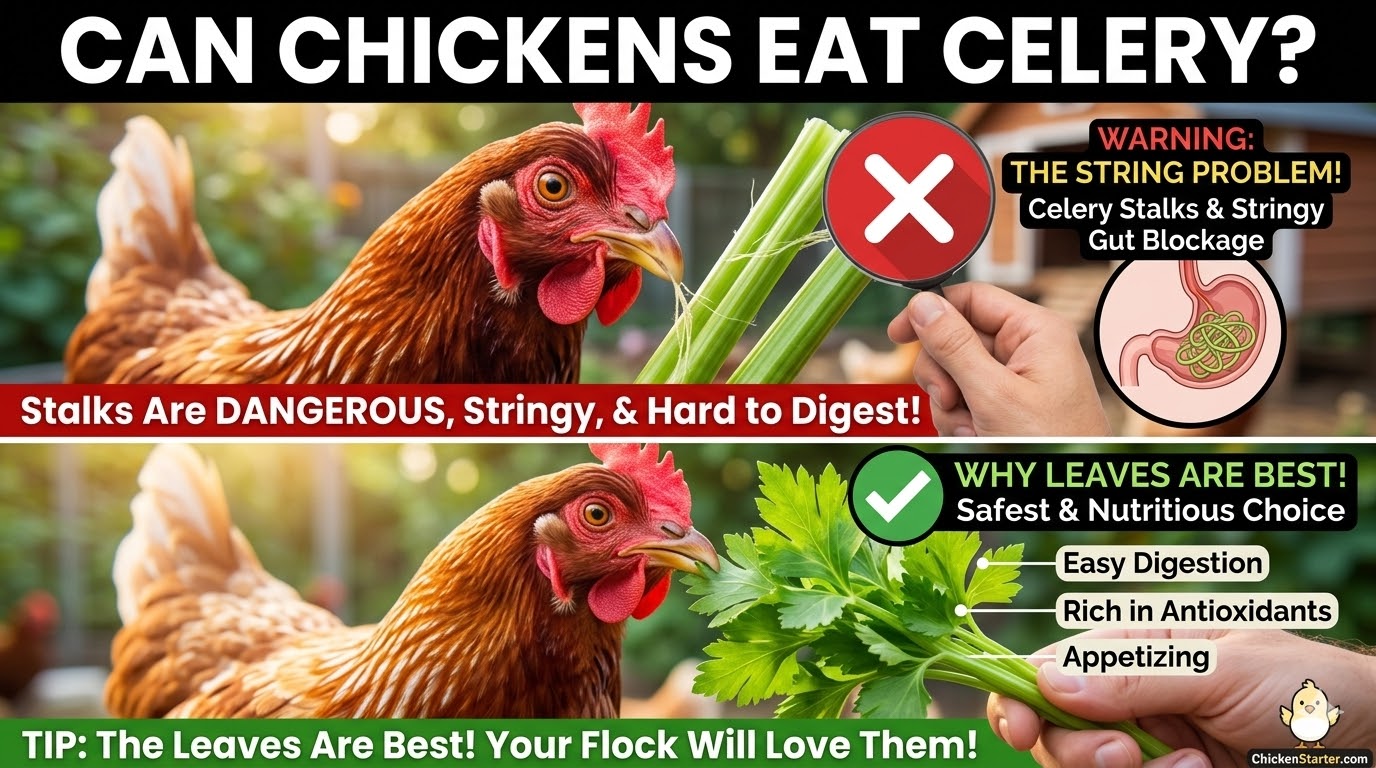
I almost learned the hard way about celery and chickens. One afternoon I tossed a few long celery stalks into the run, thinking it was a healthy, low-calorie treat. My Buff Orpington grabbed a whole stalk and started swallowing it.
I watched in slow motion as a long string of celery fiber trailed from her beak into her throat. That evening, she refused her layer feed and stood with her neck stretched out awkwardly.
Thankfully, the string passed by morning. But I had gotten lucky.
After that scare, I researched everything about celery and chickens. The crop anatomy, the fiber science, the preparation methods, and an incredible discovery: celery contains a compound called apigenin that published research shows has genuine anticoccidial activity in broilers. And the leaves, which I had always thrown away, turned out to be the safest AND most nutritious part. Here is the complete guide I wish I had before that first feeding.
Can Chickens Eat Celery? Yes, But ONLY When Properly Prepared
Yes, chickens can eat celery, but unlike most treats, celery requires genuine preparation before it is safe to serve. The long stringy fibers in the stalks can wrap around the tongue, get tangled in the crop, and cause crop impaction, a potentially fatal condition.
Quick Answer: Chickens can eat all parts of celery, including stalks, leaves, tops, and root (celeriac). Always chop stalks into pieces no longer than half an inch to break the dangerous strings into safe lengths. The leaves are the safest and most nutritious part. They contain more calcium, potassium, vitamin C, and vitamin A than the stalks, and they have no stringy fiber problem. According to USDA FoodData Central, 100 grams of raw celery provides just 16 calories, 3g carbohydrates, 1.6g fiber, 0.69g protein, 29.6µg vitamin K (25% DV), 260mg potassium, 3.1mg vitamin C, and 95% water. Celery also contains apigenin, a flavonoid studied for anti-inflammatory and anticoccidial properties in poultry. Feed 2 to 3 times per week, treats under 10% of diet. Baby chicks should wait until at least 8 weeks, and should receive leaves only.
The String Problem: Why Celery Requires Preparation (Crop Impaction Risk)
This is the one section that could save your chickens’ lives. Most treat articles skip over this with “just chop it small.” That is not enough information.
Why Celery Strings Are Dangerous for Chickens
Celery is one of the stringiest vegetables. According to New Life on a Homestead, these strings can get caught in their throats and cause them to choke, or in a worst-case scenario cause crop impaction, particularly likely if they are not eating enough grit.
The strings are composed of collenchyma cells, thick-walled plant cells that provide structural support to the celery stalk. They are remarkably tough. They do not break down easily in the crop or gizzard.
Chickens do not have teeth and do not chew with their mouths, meaning they will not be breaking down those fibers before swallowing. Everything goes straight to the crop, a food storage pouch located on the right side of the neck. According to PoultryDVM, crop impactions occur when there is an interference with the normal functioning of the crop, resulting in a partial or complete blockage of food passage.
What Crop Impaction Looks Like
According to information from Kalmbach Feeds, here are the signs to watch for:
A crop that feels hard, distended, or full first thing in the morning when it should be empty. The chicken may stop eating, stretch its neck repeatedly, or stand hunched. Foul-smelling breath can indicate sour crop, a secondary yeast infection that develops when food sits in the crop too long. In more serious cases, the discomfort can throw off the chicken’s balance, making it difficult to hop onto roosts or move normally.
As Hobby Farms explains, the only sure way to know if your chicken has an impacted crop is to feel the crop first thing in the morning, before your chickens eat or drink anything. Every healthy chicken should have a flat, empty crop when they come out of the coop in the morning.
The Preparation Solution (Simple but Critical)
You should always cut celery into small pieces before feeding. Chop stalks into pieces no longer than half an inch (roughly 1 cm). This ensures any remaining string fragments are too short to tangle in the crop.
You can also peel the strings off before chopping. Grip the base end of the stalk and pull the outer strings downward. They peel off like pulling thread from fabric.
Or simply chop small enough that the strings cannot form a long tangled mass. Either method works.
After my Buff Orpington’s scare, I developed a strict protocol. I never toss whole celery stalks into the run anymore. Every stalk gets chopped into half-inch pieces on a cutting board. It takes about 30 seconds per stalk. In the two years since, zero crop issues.
Important: If you suspect your chicken has crop impaction, do not attempt to treat it yourself without guidance. Contact a poultry veterinarian. Early intervention is critical. See our guides on how to tell if a chicken is sick and our chicken health check for more information.
Why Celery Leaves Are the Best Part (The Secret Most Keepers Miss)
Here is the counterintuitive insight that most chicken-keeping websites completely overlook. Most people chop off the green tops and throw them straight in the bin.
That is a waste of the most nutritious part of the vegetable.
The Leaves Are More Nutritious Than the Stalks
According to Healthline, celery leaves are where celery has the most calcium, potassium, and vitamin C. Information from Experience Life confirms that celery leaves are more nutritionally dense than the stalks, especially in vitamin C, vitamin A, and potassium. Data from Sage Mountain Farm indicates that celery leaves provide up to 500% more calcium, magnesium, vitamin C, and phenolic compounds than the stalks alone.
Celery leaves also contain higher concentrations of apigenin, luteolin, and other beneficial flavonoids compared to the stalks.
The Leaves Are SAFER Than the Stalks
This is the part that makes the leaves a game-changer for chicken keepers.
| Factor | Celery Stalks | Celery Leaves |
|---|---|---|
| Stringy fiber risk | ⚠️ High. Must chop to half an inch | ✅ None. Soft and safe |
| Preparation needed | Chopping required, string removal | None. Toss directly to the flock |
| Calcium | Lower | Higher |
| Vitamin C | Lower | Higher |
| Vitamin A | Lower | Higher |
| Potassium | Lower | Higher |
| Apigenin content | Present | Higher concentration |
| Chickens’ preference | Mixed. Some ignore raw stalks | Usually enthusiastic |
| Choking risk | Higher if not chopped | Very low |
The day I stopped throwing celery leaves in the compost was a game-changer. My flock devours them within minutes. No chopping, no preparation, no risk. Now when I buy celery, the stalks go to my family’s dinner and the leaves go straight to the chickens. It is the perfect zero-waste arrangement. This mirrors what we found with carrot tops, where the greens most people discard contain six times more vitamin C than the root.
The Apigenin Science: Why Celery Is More Than Just Water
Every competitor says “celery has vitamins.” That is true but unhelpfully vague. What makes celery genuinely interesting for poultry keepers is a specific flavonoid compound called apigenin.
What Is Apigenin?
Celery is one of the richest dietary sources of apigenin, a flavonoid with remarkable biological properties. According to Healthline, celery contains vitamin C, beta carotene, and flavonoids, and there are at least 12 additional kinds of antioxidant nutrients found in a single stalk. It is also a source of phytonutrients, which have been shown to reduce instances of inflammation in the digestive tract, cells, blood vessels, and organs. Celery and celery seeds contain approximately 25 anti-inflammatory compounds.
Apigenin Research in Poultry
A 2024 study published in Parasites & Vectors (Geng et al.) and indexed on PubMed tested a natural plant product combination formulation containing eucalyptus oil, apigenin, and eugenol essential oil against Eimeria tenella in broilers. A total of 350 day-old Arbor Acres broilers were used. The combination formulation showed a moderate anticoccidial effect with an ACI (anticoccidial index) of 169.3, and the safety evaluation showed that concentrations at one, three, and sixfold the recommended dose were non-toxic to broilers.
This research is significant because chicken coccidiosis is one of the most economically devastating parasitic diseases in the global poultry industry. Natural plant compounds like apigenin that show anticoccidial activity are increasingly studied as alternatives to conventional drugs, which face growing resistance problems. If you deal with coccidiosis in your flock, see our guide on treating internal parasites and worms.
An Important Caveat
These studies used concentrated apigenin extracts at specific dosages, not whole celery stalks tossed into a chicken run. A few pieces of celery 2 to 3 times per week will not deliver therapeutic doses.
However, the science demonstrates that the key compound inside celery actively benefits poultry health. That makes celery a more scientifically supported treat than most keepers realize. It is not “just water with vitamins.” It contains compounds that published research shows fight inflammation and support immune function in chickens.
Nutritional Breakdown: What Is Actually in Celery?
According to USDA FoodData Central and confirmed by Live Science and Cleveland Clinic, here is what celery provides:
| Nutrient | Celery (100g raw) | Typical Layer Feed (100g) | Why It Matters for Hens |
|---|---|---|---|
| Calories | 16 kcal | ~280 kcal | Extremely low calorie |
| Protein | 0.69g | 16 to 18g | Negligible. Cannot replace feed |
| Carbohydrates | 3g | ~55 to 60g | Very low |
| Sugar | 1.3g | Minimal | Very low. Safer than most fruit treats |
| Fiber | 1.6g | ~3 to 5g | Supports digestive health |
| Water | 95% | ~10 to 12% | Excellent hydration |
| Vitamin K | 29.6µg (25% DV) | Variable | Blood clotting, bone health |
| Vitamin A | 449 IU (10% DV) | Variable | Vision, immune function |
| Vitamin C | 3.1mg (15% DV for 2 stalks) | Minimal | Immune support during stress |
| Potassium | 260mg | ~600mg | Electrolyte balance |
| Folate | 36µg (9% DV) | Variable | Cell development |
| Calcium | 40mg | ~3,500 to 4,000mg | Modest contribution to eggshells |
| Sodium | 80mg | Variable | Moderate. Monitor quantities |
As WebMD notes, celery is about 95% water. According to the Mayo Clinic, celery contains dietary fiber, vitamin K, and small amounts of vitamins A and C, calcium, and iron.
The standout numbers: celery is one of the lowest calorie treats you can offer (only 16 calories per 100g), has the highest vitamin K content of common chicken treats (25% DV), and contains very little sugar (just 1.3g per 100g), making it far safer than fruits like blueberries (10g sugar) or apples (10.4g sugar).
Can Chickens Eat Celery Raw or Cooked?
Unlike most treats where raw versus cooked is straightforward, celery presents a genuine trade-off, particularly because of the string safety factor.
| Factor | Raw Celery | Cooked Celery (Steamed/Boiled) | Winner |
|---|---|---|---|
| Nutrients retained | Maximum vitamins and minerals | Some vitamin C lost | Raw |
| String danger | Higher. Strings are tough and intact | Lower. Cooking softens fibers significantly | Cooked |
| Water content | 95% | Slightly lower | Raw |
| Texture | Hard, crunchy. Difficult for some chickens | Soft, easy to peck and swallow | Cooked |
| Preparation effort | Must chop finely and destring | Cooking softens strings. Less chopping needed | Cooked |
| Apigenin retention | Maximum | Some loss during cooking | Raw |
| Enrichment value | Higher. Takes effort to eat | Lower. Consumed quickly | Raw |
According to Live Science, unlike some vegetables, celery retains most of its nutrients even if it is steamed. This means that lightly steaming celery softens the dangerous strings while preserving the majority of its nutritional value.
My recommendation: both forms are excellent. Raw grated or finely chopped celery for maximum vitamin K and enrichment. Lightly steamed celery for maximum safety (softened strings) and palatability.
Half my flock ignores raw celery chunks completely. They just stare at it. But lightly steamed celery? Gone in minutes. The texture softening makes a huge difference. In summer I serve raw (finely chopped, for hydration). In winter I add lightly steamed celery to a warm oatmeal mash.
Can Chickens Eat Every Part of Celery? Stalks, Leaves, Seeds, and Root
| Part | Safe? | Nutritional Value | String Risk | Notes |
|---|---|---|---|---|
| Leaves | ✅ Best part | Highest in vitamins, calcium, apigenin | ❌ None | Toss directly. No prep needed |
| Inner tops (pale yellow leaves) | ✅ Excellent | Tender, flavorful, high nutrients | ❌ None | Often the most eagerly eaten part |
| Stalks (outer) | ✅ With preparation | Good hydration, moderate vitamins | ⚠️ High | Must chop to half-inch pieces |
| Stalks (inner/heart) | ✅ With preparation | Tender, lighter strings | ⚠️ Moderate | Easier than outer stalks |
| Celery root (celeriac) | ✅ Cooked only | Low calorie, high in fiber and vitamin K | ❌ None | Raw celeriac is too hard. Must be cooked first |
| Seeds | ⚠️ Very tiny amounts | High in volatile oils, iron, manganese | ❌ None | Extremely concentrated. Feed only in trace amounts |
| Celery strings (fibers) | ❌ Remove | No nutritional value | ⚠️ Danger | The actual cause of crop impaction risk |
The Pesticide Story: Celery’s Improving Track Record
Here is some context that matters if you follow the pesticide discussion across our other treat articles.
Historically, celery was one of the worst offenders for pesticide contamination, ranking as high as #2 on the EWG Dirty Dozen in previous years. However, celery has improved significantly in recent USDA testing and is no longer on the 2025 Dirty Dozen. This is good news, but given celery’s long history of contamination, I still recommend thorough washing.
Celery has a particular challenge with pesticide residue because the stalks have deep grooves that trap dirt and chemicals. Cut the base off, separate the stalks, and wash each one individually under running water, scrubbing the inner groove with a vegetable brush.
| Treat | 2025 EWG Status | Recommendation |
|---|---|---|
| Strawberries | #2 Dirty Dozen (worst) | Buy organic or homegrown |
| Apples | #9 Dirty Dozen | Buy organic or wash/peel |
| Blueberries | #11 Dirty Dozen | Buy organic or frozen organic |
| Celery | Improved. Off Dirty Dozen | Wash thoroughly, organic preferred |
| Carrots | Clean Fifteen ✅ | Conventional is fine |
| Cucumbers | Middle | Wash and scrub |
Can Chickens Eat Celery Every Day?
No. Daily celery feeding is not recommended. Like all treats, celery should be fed in moderation. Limit celery to about 10% of their diet. Their primary food should be a high-quality layer feed.
Celery is 95% water and only 16 calories per 100g. It provides almost no caloric substance. It is essentially flavored water with vitamins. Daily feeding can lead to chickens filling up on water-heavy celery and skipping their nutrient-dense feed.
Celery also contains moderate natural sodium (80mg per 100g), higher than most vegetables. In treat quantities this is fine, but daily feeding could add up. Feed 2 to 3 times per week at most.
What Age Can Chickens Eat Celery?
| Age | Can They Eat Celery? | How to Serve | Notes |
|---|---|---|---|
| 0 to 4 weeks | ❌ No | Not applicable | Starter feed only. See must-haves for new chicks |
| 4 to 8 weeks | ⚠️ Leaves only | Finely chopped leaves only. No stalks | Must have chick grit available. Absolutely no strings |
| 8 to 12 weeks | ✅ Small amounts | Very finely chopped stalks plus leaves | Grower feed = 90%+ of diet. See when to switch from starter to grower |
| 12 to 16 weeks | ✅ Moderate | Chopped or lightly steamed | Gradually increase treat amounts |
| 16+ weeks (adult) | ✅ Full treat amounts | Chopped, steamed, or leaves whole | Layer feed = 90% of diet; treats = 10% maximum |
Chicks are particularly vulnerable to crop impaction, and the stringiness of celery makes it especially risky for young birds. If in doubt, stick to leaves only for chicks. They are soft, small, and completely safe.
How to Safely Prepare Celery for Chickens (Step by Step)
Step 1: Wash thoroughly. Separate the stalks and scrub the inner groove with a vegetable brush under running water. Celery’s ridged structure traps dirt and pesticide residue.
Step 2: Separate the leaves from the stalks. Set the leaves aside. These go directly to the flock with no further preparation needed.
Step 3: Peel the strings (optional but recommended). Grip the base end of the stalk and pull the outer strings downward. They peel off like pulling thread from fabric. This eliminates the crop impaction risk at the source.
Step 4: Chop stalks to half an inch or smaller. This is non-negotiable. This ensures any remaining string fragments are too short to tangle in the crop.
Step 5: Or lightly steam first. Steaming for 3 to 4 minutes significantly softens the strings, making them safer even in slightly larger pieces.
Step 6: Scatter or serve in a dish. Do not pile. Scatter the chopped pieces to encourage foraging behavior and prevent dominant hens from hoarding.
Step 7: Feed after layer feed. Never before their complete feed.
Step 8: Clean up leftovers. Remove uneaten celery within 2 hours, especially in warm weather, to prevent attracting rodents or flies.
The lazy-but-safe method: If you do not want to chop stalks, just feed the leaves. They are the most nutritious part with zero string risk. The stalks can go in your family’s stir fry.
Creative Serving Ideas
Frozen celery bites. Finely chop celery and freeze the pieces in ice cube trays with water. Pop out the cubes on hot summer days. They melt slowly and release treats while keeping hens cool. See our heatwave feeding guide for more summer strategies.
Warm winter celery mash. Mix small bits of steamed celery into a warm oatmeal mash with grated carrots. This is a comforting winter treat. See our winter feeding guide for more cold-weather nutrition ideas.
Leaf scatter. Simply tear the leaves into rough pieces and scatter across the run. This provides foraging enrichment with zero effort and zero risk. See our DIY treat dispenser guide for more enrichment ideas.
Can Chickens Eat Celery and Carrots Together?
Yes, and this is actually an excellent combination. Celery provides hydration, vitamin K, and apigenin. Carrots provide beta-carotene, vitamin A, and prebiotic fiber. Together they cover a broader nutritional spectrum than either alone.
Preparation: grate the carrots, finely chop the celery stalks, and toss the celery leaves in whole.
| Combo | Why It Works |
|---|---|
| Celery + Carrots | Hydration + beta-carotene + vitamin K |
| Celery + Cucumbers | Maximum hydration duo (95% + 96% water) |
| Celery + Blueberries | Apigenin + anthocyanin antioxidant powerhouse |
| Celery + Oatmeal | Hydration + fiber + energy (winter mash) |
| Celery leaves + Lettuce | Vitamin-dense green salad mix |
Celery vs. Other Hydrating Treats: How It Compares
| Treat | Water % | Calories/100g | Vitamin K | Key Unique Benefit | String Risk? |
|---|---|---|---|---|---|
| Cucumbers | 96% | 15 | 6% DV | Maximum hydration | ❌ None |
| Celery | 95% | 16 | 25% DV | Apigenin (anti-inflammatory) | ⚠️ Yes. Must chop |
| Lettuce | 96% | 14 | 18% DV | Easy to feed, low risk | ❌ None |
| Watermelon | 92% | 30 | Negligible | Lycopene, summer cooling | ❌ None |
| Strawberries | 91% | 32 | 1% DV | Highest vitamin C (59mg) | ❌ None |
Celery is the lowest calorie treat on this list (tied with lettuce), has the highest vitamin K content, and is the only one with significant apigenin. The trade-off is the string preparation requirement.
Vegetables Chickens Should NEVER Eat
| Dangerous Vegetable | Why It Is Toxic |
|---|---|
| Green/raw potatoes and skins | Contain solanine, a toxic glycoalkaloid. This is critically important because “celery and potatoes” is a common kitchen combination |
| Raw or dried beans | Phytohaemagglutinin can be fatal to chickens even in small amounts |
| Rhubarb leaves | Oxalic acid at levels toxic to poultry |
| Onions (large amounts) | Thiosulphates damage red blood cells and lead to hemolytic anemia |
| Green tomatoes, leaves, and vines | Solanine. Only ripe red tomatoes are safe |
| Avocado pits and skin | Persin is toxic to most birds |
| Moldy vegetables of any kind | Mycotoxins can cause severe illness or death |
If your chicken has eaten any of these in significant quantities and shows signs of distress, including lethargy, diarrhea, loss of coordination, or difficulty breathing, contact a poultry veterinarian immediately. For a complete breakdown, see our comprehensive feeding guide.
Frequently Asked Questions
Can you feed raw celery to chickens?
Yes, but you must chop it into pieces no longer than half an inch. The stringy fibers in raw celery stalks can cause crop impaction if swallowed in long pieces. Celery leaves can be fed raw without any chopping at all. They are the safest and easiest way to serve raw celery.
Can chickens eat celery leaves?
Yes, and they are the best part. According to information from Healthline, celery leaves are where celery has the most calcium, potassium, and vitamin C. They also have no stringy fiber problem, so they can be fed directly to the flock with no preparation needed. My hens eat them faster than any other part of the vegetable.
Are celery strings dangerous for chickens?
Yes. The stringy fibers are the major concern with feeding celery to chickens. They can get caught in the throat and cause choking, or tangle in the crop and cause crop impaction, a serious condition that can lead to malnutrition and even death if left untreated. Always chop stalks finely or peel the strings off before feeding.
Can Silkie chickens eat celery?
Yes, but extra care is needed for Silkies due to their smaller crops and beaks. Feed only the leaves or very finely chopped steamed stalks. Avoid raw stalk pieces entirely for bantam breeds.
How much celery can I give my chickens?
A few tablespoons of finely chopped celery per hen, 2 to 3 times per week. Since celery is 95% water and only 16 calories per 100g, it provides almost no caloric substance. It should never replace actual feed.
Can celery help with heat stress in chickens?
Yes, in two ways. First, the 95% water content provides excellent hydration. Second, celery contains apigenin, which published research shows has antioxidant and anti-inflammatory properties relevant to heat-stressed poultry. Serve chilled or frozen chopped celery on hot days.
Can chickens eat celery root (celeriac)?
Yes, but only cooked. Raw celeriac is extremely hard and difficult for chickens to eat. Boil, steam, or roast it without seasoning, then chop into small pieces. It has much the same nutritional benefits as celery proper but does not contain quite as much water.
What should I do if my chicken ate a long celery string?
Monitor the chicken closely for 24 to 48 hours. Watch for signs of crop impaction: a hard, distended crop first thing in the morning, refusal to eat, neck stretching, or hunched posture. Most small amounts will pass naturally. If the crop feels hard and full after 12 or more hours, contact a poultry veterinarian. For related health guidance, see our chicken diarrhea and health problems guide.
The Bottom Line on Celery for Chickens
After two years of feeding celery to my flock (and one early scare that I never want to repeat), here are the four things to remember:
First, celery is safe and nutritious, but the stringy fibers require proper preparation. Chop stalks to half an inch or smaller, or peel the strings off before serving. This is non-negotiable.
Second, the leaves are the safest and most nutritious part. Stop throwing them away. They contain more calcium, vitamin C, vitamin A, and potassium than the stalks, they have no string risk, and they require zero preparation.
Third, celery contains apigenin, a flavonoid with published anti-inflammatory and anticoccidial benefits in poultry research. A few pieces of celery will not deliver therapeutic doses, but the science confirms that celery is a more beneficial treat than most keepers realize.
Fourth, feed 2 to 3 times per week, always after layer feed, and clean up within 2 hours. At 95% water and only 16 calories per 100g, celery is essentially flavored water with vitamins. It supplements your flock’s diet but must never replace it.
Want to pair celery with other hydrating treats? Check out our guides to cucumbers, watermelon, corn, or explore what your chickens can eat from your kitchen.

Oladepo Babatunde is the founder of ChickenStarter.com. He is a backyard chicken keeper and educator who specializes in helping beginners raise healthy flocks, particularly in warm climates. His expertise comes from years of hands-on experience building coops, treating common chicken ailments, and solving flock management issues. His own happy hens are a testament to his methods, laying 25-30 eggs weekly.