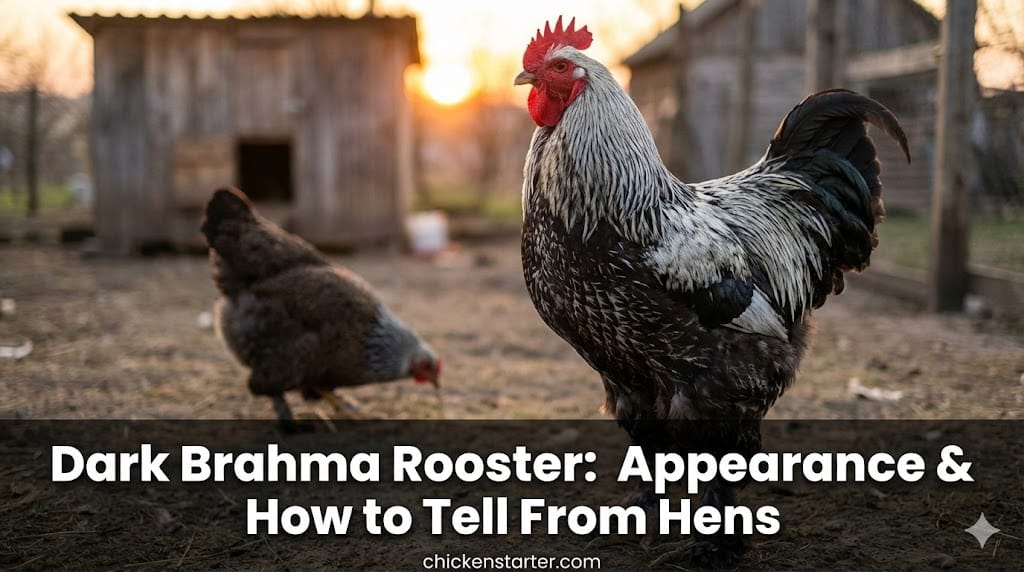
The Dark Brahma rooster is one of the most visually striking birds you will ever see in a backyard flock. Unlike Light Brahmas where roosters and hens share nearly identical coloring, the Dark Brahma variety displays dramatic sexual dimorphism that makes telling males from females remarkably straightforward, even from a distance.
When I first encountered a Dark Brahma rooster at a poultry show in Caboolture, Queensland in 2021, I stood there genuinely mesmerized. The silver and black contrast on his hackle feathers caught the light in a way that made him look almost metallic. Standing next to his hens with their intricate gray penciling, he appeared to be an entirely different breed. That visual contrast is precisely what makes Dark Brahmas so popular among keepers who want both beautiful birds and easy sexing.
This guide focuses specifically on understanding what a Dark Brahma rooster looks like, how his appearance differs from the Dark Brahma hen, and how to use these visual differences to identify males in your flock at various ages. Whether you are considering adding Dark Brahmas to your flock, trying to sex young birds, or simply want to appreciate the remarkable plumage of this variety, you will find detailed descriptions and practical identification tips throughout.
Understanding Dark Brahma Coloring: Why Roosters and Hens Look So Different
The Dark Brahma variety exists because of specific breeding for a distinctive penciled pattern in females and contrasting silver-laced pattern in males. This deliberate color difference between sexes makes Dark Brahmas one of the easiest Brahma varieties to sex visually.
In technical poultry terminology, Dark Brahmas are classified as silver penciled, a term that describes the specific combination of silver ground color with black patterning. According to Feather and Fern Farmstead, “while the word ‘dark’ sounds pretty vague, in Brahma lingo it refers to one very specific thing: silver penciled. In other countries, this variety is often simply called ‘silver’ rather than ‘dark.'” The ground color is silver and the pattern color is black.
According to breed documentation from Backyard Chicken Coops Australia, “the Dark Brahma chicken is a striking chicken featuring exquisite penciling on their plumage. The penciling means that their feathers are decorated with concentric lines almost resembling a ‘magic eye’ work of art.” This penciling appears only on hens. Roosters display an entirely different pattern.
The reason for this dramatic difference lies in how color genetics express differently based on sex hormones. In Dark Brahmas, testosterone causes males to develop silver hackles and saddles with bold black striping, while estrogen in females produces the characteristic penciled pattern throughout their plumage.
This sexual dimorphism means you can often identify Dark Brahma cockerels from pullets much earlier than with Light or Buff Brahmas, sometimes as young as 6 to 8 weeks when feather patterns begin emerging.
Historical Significance of the Dark Brahma
The Dark Brahma holds a unique place in poultry history. According to the Heritage Poultry Conservancy, “until the Silver Penciled Wyandottes and Plymouth Rocks were developed, the Dark Brahma was the only breed of chicken with the ‘silver penciled’ color pattern, and consequently was a favorite with fanciers of that color.”
This historical exclusivity made Dark Brahmas highly prized among exhibition breeders, though the difficulty of breeding the precise penciled pattern in females while maintaining the silver striping in males limited widespread popularity. The Heritage Poultry Conservancy notes that “the difficulty of breeding the pattern limited its popularity” and “the triple penciled pattern can be more easily obtained on large birds with broad feathers.”
Interestingly, Dark Brahmas were generally considered better layers than Light Brahmas historically. According to the Heritage Poultry Conservancy, “the difference was the result of the Darks not being selected as heavily for flesh quality.” While modern breeding has largely equalized laying performance between varieties, this historical context explains why some keepers still report slightly better production from their Dark Brahma hens.
The breed takes its name from the Brahmaputra River in India. According to Hoover’s Hatchery, “this perfect backyard chicken breed is named after India’s Brahmaputra River. The breed probably came to the U.S. on 19th Century sailing ships.” The name was originally “Brahma Pootra” before being shortened to simply “Brahma.
Conservation success story: The Brahma breed graduated from The Livestock Conservancy’s Conservation Priority List in 2023 due to significantly improved population numbers. The breed is now considered a sustainable heritage chicken breed in recovering status, thanks to dedicated breeders and conservation efforts.
For comprehensive information about all Brahma varieties, our complete guide to Brahma chickens covers history, care requirements, and detailed breed characteristics.
Dark Brahma Rooster Appearance: A Complete Visual Guide
The Dark Brahma rooster presents a stunning combination of silver, white, and black that creates an almost regal appearance. Understanding each feather region helps you appreciate the complexity of his plumage and identify males accurately.
Hackle Feathers (Neck)
The hackle feathers on a Dark Brahma rooster are his most distinctive feature. These long, flowing feathers cover the neck and upper chest area, cascading down toward the shoulders.
Dark Brahma rooster hackle characteristics:
- Base color of silvery white
- Each feather has a bold black stripe running down the center
- Black striping creates a dramatic laced or striped appearance
- Feathers are long and pointed at the tips
- The overall effect resembles silver chainmail
The black striping on hackle feathers should be clear and well-defined in quality birds. Muddy or indistinct striping indicates poor breeding or mixed heritage.
Saddle Feathers (Lower Back)
The saddle feathers sit on the lower back, just in front of the tail, and drape down over the sides of the body toward the thighs. On a Dark Brahma rooster, these feathers mirror the hackle pattern.
Dark Brahma rooster saddle characteristics:
- Silvery white base color matching the hackles
- Black center stripe through each feather
- Long, pointed feathers that flow downward
- Creates a cape-like appearance over the back
- Highly iridescent in good lighting
When I examined my friend’s Dark Brahma rooster closely during a visit to his farm outside Brisbane in 2022, the saddle feathers caught the afternoon sun and showed hints of green and purple iridescence in the black striping. That metallic quality is something photographs rarely capture.
Body and Breast Feathers
The body of a Dark Brahma rooster contrasts sharply with his silver hackles and saddle.
Dark Brahma rooster body characteristics:
- Predominantly black or very dark gray
- Breast feathers are solid black
- Underfluff is dark gray
- Creates dramatic contrast against silver upper feathers
This black body serves as the backdrop that makes the silver hackles and saddles so visually striking. The darker the body color, the more dramatic the overall appearance.
Wing Feathers
The wings of a Dark Brahma rooster display multiple colors in distinct zones.
Dark Brahma rooster wing characteristics:
- Wing bow (shoulder area): Solid silver or silvery white
- Primary feathers: Black
- Secondary feathers: Black with some white edging
- Wing coverts: Black with white lacing in some areas
The white-shouldered appearance is distinctive to Dark Brahma roosters. When the bird stands at rest with wings folded, you see white shoulders transitioning into black wing feathers below. The Heritage Poultry Conservancy describes the standard as having “wing bow and shoulders being solid silver.”
Tail Feathers
The tail of a Dark Brahma rooster is predominantly black with the characteristic sickle feathers that distinguish roosters from hens.
Dark Brahma rooster tail characteristics:
- Main tail feathers: Solid black
- Sickle feathers: Long, curved, black with possible greenish iridescence
- Tail coverts: Black, sometimes with slight white edging
- Overall tail carriage: Held at moderate angle, not extremely upright
The sickle feathers are the long, curved feathers that arch over the main tail. These are absent in hens and serve as one of the definitive markers of a mature rooster.
Head, Comb, and Wattles
Like all Brahmas, Dark Brahma roosters have pea combs, which are smaller and sit closer to the head than single combs.
Dark Brahma rooster head characteristics:
- Pea comb: Three rows of small rounded bumps, larger and redder than hens
- Wattles: Medium-sized, bright red, symmetrical
- Earlobes: Red
- Beak: Yellow with possible dark shading
- Eyes: Reddish bay color
- Face: Red
- Characteristic “beetle brow”: Large, broad head with prominent forehead
The comb and wattle development in roosters is noticeably larger and redder than in hens, especially once birds reach maturity around 6 to 8 months.
Legs and Feet
Dark Brahma roosters share the heavily feathered legs characteristic of all Brahmas.
Dark Brahma rooster leg characteristics:
- Shanks: Yellow, though may appear darker due to feathering
- Toes: Four toes, middle and outer toes feathered
- Leg feathering: Heavy, extending down the outer toes
- Spurs: Develop on backs of legs (may take 6+ months to become prominent)
The feathered legs require specific care regardless of sex. Our guide on how to spot and treat bumblefoot in chickens covers foot health issues that are particularly relevant for feather-footed breeds like Brahmas.
Dark Brahma Rooster vs Hen: Understanding the Penciled Pattern Difference
To fully appreciate what makes the Dark Brahma rooster distinctive, you need to understand how dramatically the hen differs in appearance.
The Penciling Pattern in Hens
Dark Brahma hens display what poultry experts call “penciling,” which refers to concentric lines of color on each feather. This triple penciled pattern appears throughout the hen’s body and is one of the most intricate feather patterns in poultry.
Dark Brahma hen penciling characteristics:
- Base color: Gray or steel gray (silver ground color)
- Penciling: Multiple concentric black lines on each feather
- Pattern creates a layered, almost striped appearance across the body
- Hackle feathers: Gray with black penciling (not silver with black striping)
- Body feathers: Heavily penciled throughout
- Breast: Penciled pattern continues onto breast
The penciling should be sharp and well-defined in quality hens. Each feather shows multiple parallel black lines following the feather’s contour. According to Backyard Chicken Coops Australia, “the hens are predominantly grey with penciling on their body feathers and black lacing on their hackle, or neck, feathers. Their heads are lighter than their bodies almost approaching white and their tailfeathers are inky black.”
Head Features in Hens
Dark Brahma hen head characteristics:
- Pea comb: Smaller than rooster, lighter red or pink
- Wattles: Smaller, less developed
- Dewlap: Females display a dewlap between the wattles
- Face: Less intensely red than roosters
- Overall appearance: More subdued head coloring
Why Hens Look Completely Different
The visual difference between Dark Brahma roosters and hens is so pronounced that first-time observers often assume they are looking at two different breeds. This is intentional, as breeders selected for maximum contrast between sexes.
| Feature | Dark Brahma Rooster | Dark Brahma Hen |
|---|---|---|
| Hackle color | Silver with black striping | Gray with black penciling |
| Saddle feathers | Silver with black striping, long and pointed | Gray penciled, shorter and rounded |
| Body color | Black | Gray with penciling throughout |
| Wing bow | Solid silver/white | Gray penciled |
| Tail | Black with sickle feathers | Black, shorter, no sickles |
| Comb/wattles | Large, bright red | Smaller, lighter red |
| Head color | White/silver | Light gray approaching white |
As Murray McMurray Hatchery describes: “Dark Brahma roosters have striking silvery white and black feathers, and hens are a beautiful silver-penciled steel gray.”
Dark Brahma Rooster Feather Anatomy: Complete Visual Guide
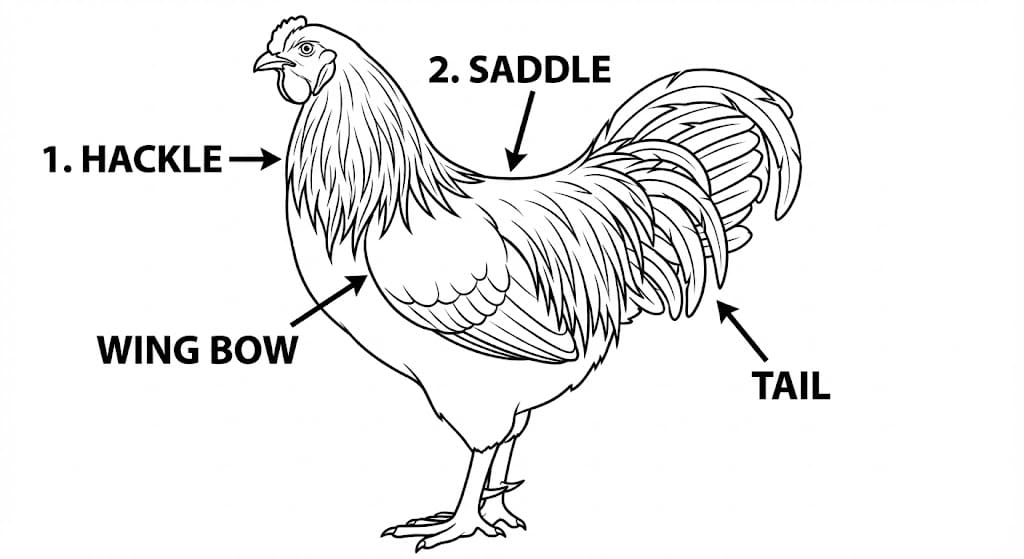
When describing or evaluating a Dark Brahma rooster, knowing the correct terminology for each feather region helps communicate precisely.
Key feather regions on a Dark Brahma rooster:
Hackle: The long feathers covering the neck, flowing down toward the shoulders. On Dark Brahma roosters, these are silver with black center stripes.
Cape: The area where hackle feathers meet the back, creating a transitional zone between neck and body.
Saddle: The feathers on the lower back, in front of the tail, that drape down over the sides. Dark Brahma roosters show silver feathers with black striping here.
Wing bow: The shoulder area of the wing, visible when wings are folded. Dark Brahma roosters display solid silver coloring in this region.
Wing bar: The row of feathers across the middle of the folded wing.
Primaries (flight feathers): The long feathers at the wing tip, mostly hidden when wings are folded.
Secondaries: The inner flight feathers, partially visible when wings are at rest.
Coverts: The smaller feathers covering the base of the flight feathers.
Tail coverts: The feathers covering the base of the tail.
Main tail: The stiff central tail feathers.
Sickle feathers: The long, curved feathers that arch over the main tail in roosters. These are absent in hens.
Understanding these terms helps when discussing birds with breeders, evaluating quality, or describing your flock to veterinarians.
Dark Brahma Rooster Size and Weight
Dark Brahma roosters are impressive in size, reflecting the breed’s heritage as one of the largest chicken breeds globally.
Dark Brahma rooster size specifications:
| Classification | Weight |
|---|---|
| Cock (mature male) | 11 lbs (5 kg) |
| Cockerel (young male) | 9 lbs (4 kg) |
| Hen (mature female) | 8.5 lbs (3.9 kg) |
| Pullet (young female) | 7 lbs (3.2 kg) |
According to Oklahoma State University’s breed documentation, the standard weights for Dark and Buff Brahmas are: “Cock: 11 lbs, Hen: 8.5 lbs, Cockerel: 9 lbs, Pullet: 7 lbs.” This is slightly less than Light Brahmas, which have a standard cock weight of 12 lbs.
Brahma chickens are often called the “Gentle Giants” of the poultry world, and this description fits Dark Brahma roosters perfectly. Their substantial size combined with docile temperament makes them imposing yet approachable birds. Roosters can reach heights of up to 30 inches (76 cm), though 18 inches (45 cm) is more typical.
The size difference between roosters and hens becomes apparent relatively early, with cockerels often outpacing pullets in growth rate by 10 to 12 weeks.
Sexing Dark Brahma Chicks and Juveniles
One significant advantage of the Dark Brahma variety is the ability to sex birds earlier than Light or Buff Brahmas based on emerging feather patterns.
Day-Old Chicks
At hatching, Dark Brahma chicks are difficult to sex visually. Both males and females display similar dark down coloring. Professional vent sexing or DNA testing would be required for reliable identification at this stage.
Wing Feather Sexing Method (3 to 7 Days)
According to Backyard Chicken Coops Australia, wing feather sexing can work for Brahma chicks: “While gently, yet securely holding your chick, spread out their little wing tips. Male chicks will have a neat ‘all one length’ feather pattern, while the females will show an alternating pattern of long and short feather sprouts.”
This method is more reliable for Dark Brahmas than Light Brahmas because you can combine wing feather observation with emerging color differences as chicks age.
4 to 6 Weeks
Feather patterns begin emerging, and observant keepers may notice early differences:
Potential cockerel indicators:
- Lighter coloring emerging on neck feathers
- Early hints of silver rather than gray
- Slightly larger comb development
- Even feather length on wing tips
Potential pullet indicators:
- Gray feathers with early penciling visible
- Overall darker appearance
- Smaller, paler comb
- Alternating long and short wing feather sprouts
8 to 12 Weeks
By this age, the feather pattern differences become much clearer:
Cockerel indicators:
- Silver hackle feathers with visible black striping developing
- Lighter overall neck and shoulder coloring
- Larger, redder comb and wattles
- Thicker legs
Pullet indicators:
- Gray hackle feathers with penciling pattern
- Consistent gray coloring throughout
- Smaller, paler comb
- More delicate build
12 to 16 Weeks
Gender should be obvious to most observers:
Cockerel indicators:
- Clear silver hackles with black striping
- Saddle feathers emerging with silver/black pattern
- White wing bow visible
- Comb and wattles well-developed and red
- May begin attempting to crow
Pullet indicators:
- Full penciled pattern visible throughout plumage
- No silver coloring anywhere
- Rounded feathers without pointed tips
- Smaller head features
For detailed information on sexing the Light variety, which is considerably more challenging, see our guide on Light Brahma chicken rooster sexing.
Dark Brahma Rooster Temperament
The Dark Brahma rooster shares the calm, docile temperament that makes all Brahmas popular with backyard keepers.
Typical Dark Brahma rooster behavior:
- Calm and non-aggressive toward humans
- Tolerant of handling
- Protective of hens without excessive aggression
- Relatively quiet compared to other breeds
- Poor fliers due to large size
This temperament extends to Dark Brahma roosters specifically. While individual variation exists, the breed standard favors docile birds, and aggressive individuals are typically not used for breeding by reputable breeders.
Important consideration: While Dark Brahma roosters are generally gentle, their large size means accidental injuries are possible, especially with young children. Supervision is recommended during interactions.
For guidance on whether you need a rooster at all, our article on do I need a rooster to get eggs clarifies common misconceptions.
Preventing Feather Pecking in Dark Brahma Flocks
The distinctive silver hackle feathers on Dark Brahma roosters can sometimes attract unwanted attention from flock mates, particularly in confined spaces or during stress periods.
Risk factors specific to Dark Brahmas:
- Contrasting silver feathers may attract curious pecking from other birds
- Dense plumage can hide early damage until it becomes severe
- Large size means injuries from pecking can be significant
- Adolescent cockerels grouped together during sexing may develop pecking behaviors
Prevention strategies:
- Provide minimum 5 to 6 square feet per bird, doubling for bachelor cockerel groups
- Ensure adequate feeder and waterer space to prevent competition
- Add enrichment like hanging vegetables and straw bales for foraging
- Use dim lighting (5 to 10 lux) to reduce visibility of contrasting feathers
- Separate birds showing aggressive pecking immediately
- Monitor silver hackle feathers during regular health checks for early damage signs
If pecking occurs:
- Isolate injured birds for healing immediately
- Apply Blue Kote or pine tar to wounds (blood attracts further pecking)
- Address underlying stressors (overcrowding, nutritional deficiencies, boredom)
- Consider temporary separation of aggressive individuals
For comprehensive intervention strategies, see our guide on pecking order problems and stopping bully hens.
Housing Requirements for Dark Brahma Roosters
The substantial size of Dark Brahma roosters necessitates specific housing considerations.
Coop Space
Brahma chickens need plenty of room to accommodate their large size, with at least 5 square feet per bird in the coop. For Dark Brahma roosters specifically, erring toward the higher end of space requirements prevents stress and potential behavioral issues.
Roost Height and Strength
Dark Brahma roosters cannot fly well due to their weight. Roosts should be positioned only 2 to 4 feet above the ground to prevent leg injuries from jumping down. According to Backyard Chicken Coops Australia, “because Brahmas are heavy birds, their roosts should not be too far from the ground. This is because, when jumping down, their weight could cause injury to their feet.”
Use sturdy 2 x 4 boards placed flat-side up for roosting to provide adequate foot support. Flimsy or narrow roosts will not accommodate these large birds safely.
Pop Door Size
Standard pop doors may be too small for Dark Brahma roosters. Ensure doorways are large enough that birds do not scrape their backs or feathers when entering and exiting.
Nesting Boxes
If keeping hens with your rooster, nesting boxes should be at least 20 inches (50 cm) deep with an opening of 14 x 14 inches (35 x 35 cm) minimum to accommodate Brahma hens comfortably.
For detailed coop sizing guidance, our article on how big your chicken coop should be provides calculations for various flock sizes.
Foot Care for Dark Brahma Roosters
The heavily feathered legs that make Dark Brahmas so distinctive also create unique care requirements.
Mud Ball Prevention
Feathered feet collect mud easily, especially in wet conditions. According to Backyard Chicken Coops Australia, “wet and muddy conditions can cause caking on their foot feathers which are called mud balls. You should inspect their leg feathers for accumulation of dirt and mud regularly and gently wash it off should there be dirt or debris caught in the plumage.”
During my first wet season keeping Brahmas in tropical Queensland, I learned this lesson after finding dried mud caked into my hens’ leg feathers. The mud had hardened and was pulling at the feather follicles. I had to soak their feet in warm water for 20 minutes to soften it for safe removal.
Frostbite Risk
In cold climates, wet leg feathers can freeze and cause frostbite on toes. The Backyard Chicken Coops Australia guide warns that “wet conditions during the winter season can allow ice and cold water to accumulate on the foot feathers and cause the Brahma chicken to suffer frostbite in near-freezing temperatures.”
For cold weather management, our winterizing chicken coop guide covers frostbite prevention strategies.
Bumblefoot Susceptibility
Brahmas are prone to bumblefoot due to their substantial weight and the potential for foreign objects in bedding to puncture their foot pads when landing from roosts. Regular foot inspections are essential.
For coop flooring that helps prevent foot issues, see our guide on best chicken coop flooring for mud.
Parasite Prevention in Dark Brahma Roosters
The dense plumage of Dark Brahma roosters, while beautiful, creates hiding places for external parasites.
According to Backyard Chicken Coops Australia, Brahmas’ “dense feathering also makes the Brahma quite susceptible to mites and lice which can be difficult to spot due to their plumage.”
Parasite prevention strategies:
- Provide dust bathing areas with sand, diatomaceous earth, and wood ash
- Inspect feathers regularly by parting them to see the skin
- Check around the vent area and under wings where parasites often concentrate
- Sprinkle diatomaceous earth in coop bedding regularly
- Treat infestations promptly before they spread
The intricate feather patterns on Dark Brahmas can make spotting parasites challenging. Get in the habit of thorough inspections during regular handling. Our chicken health check guide provides a systematic approach to examining your birds.
Our article on mites and lice on chickens provides comprehensive treatment protocols.
Dark Brahma Rooster vs Other Brahma Varieties
Understanding how Dark Brahma roosters compare to other Brahma varieties helps with breed selection.
Dark Brahma vs Light Brahma Roosters
| Feature | Dark Brahma Rooster | Light Brahma Rooster |
|---|---|---|
| Hackle color | Silver with black striping | White with black lacing |
| Body color | Black | White |
| Standard weight | 11 lbs | 12 lbs |
| Sexing difficulty | Easier (clear pattern difference from hens) | Harder (similar pattern to hens) |
| Overall appearance | High contrast silver/black | Softer white/black contrast |
| Popularity | Less common | Most common variety |
| Historical laying | Better layers historically | Selected more for flesh quality |
Dark Brahma vs Buff Brahma Roosters
| Feature | Dark Brahma Rooster | Buff Brahma Rooster |
|---|---|---|
| Base color | Silver and black | Golden buff |
| Pattern | Striped hackles/saddle | Solid buff with black accents |
| Standard weight | 11 lbs | 11 lbs |
| Sexing difficulty | Easy (color difference emerges) | Easiest (autosexing possible at hatch) |
| Overall appearance | Dramatic contrast | Warm golden tones |
The Dark Brahma variety appeals to keepers who appreciate dramatic coloring and want easier sexing than Light Brahmas offer.
Health Considerations Specific to Dark Brahma Roosters
Dark Brahma roosters share health characteristics with all Brahmas, plus some considerations specific to roosters.
Weight Management
Brahmas are prone to obesity, so regularly check their weight. This applies especially to roosters who may be less active than hens.
Mating Challenges
Large Brahma roosters may struggle with mating due to their size. The substantial weight can make mounting difficult and may cause back feather damage to hens. A mating ratio of 8 females to 1 male is recommended.
Heat Tolerance
Despite their heavy feathering, Brahmas adapt better to heat than many keepers expect. However, providing shade and cool water remains essential during hot weather. For keepers in warm climates, our guide on raising chickens in hot humid climates provides practical management strategies.
Feather Assessment During Molt
Dark Brahma roosters will temporarily lose their striking silver feathers during annual molt. This is normal and not cause for concern. Our guide on chicken molting season explains what to expect and how to support birds through this process.
Lifespan
With proper care, Dark Brahma roosters can live 5 to 8 years or more. Their calm temperament often contributes to longevity, as stress-related health issues are less common in docile birds.
Breeding Dark Brahmas: Selecting Quality Roosters
If you plan to breed Dark Brahmas, rooster selection significantly impacts offspring quality.
What to Look For
Ideal Dark Brahma rooster breeding characteristics:
- Clear, well-defined silver on hackles and saddle
- Sharp black striping without muddy or indistinct edges
- Solid silver wing bow without gray contamination
- Solid black body without excessive white
- Correct pea comb shape
- Well-feathered legs and feet
- Docile temperament
- Good size and body conformation
What to Avoid
Disqualifying characteristics:
- Yellow or straw-colored hackles (should be silver)
- Incomplete or washed-out black striping
- Excessive white in body feathers
- Single comb (should be pea comb)
- Poorly feathered legs
- Aggressive temperament
Breeding Pattern Challenges
The Dark Brahma pattern is notoriously difficult to breed correctly. According to the Heritage Poultry Conservancy, “the difficulty of breeding the pattern limited its popularity.” Producing hens with sharp, well-defined triple penciling while maintaining proper silver hackles in males requires careful selection over multiple generations.
For those interested in hatching, our guide on best chicken egg incubators for beginners covers equipment selection.
Frequently Asked Questions About Dark Brahma Roosters
How can you tell a Dark Brahma rooster from a hen?
Dark Brahma roosters have silver hackle and saddle feathers with bold black striping, a black body, and solid silver wing bows. Hens display gray penciled feathers throughout their bodies with no silver coloring. The difference is dramatic and visible from a distance.
At what age can you sex Dark Brahma chicks?
Feather pattern differences begin emerging around 6 to 8 weeks, with reliable visual sexing possible by 8 to 12 weeks for most birds. This is earlier than Light Brahmas, which may take 16 weeks or longer.
Are Dark Brahma roosters aggressive?
No. Dark Brahma roosters share the calm, docile temperament characteristic of all Brahmas. They are typically gentle with humans and protective of hens without excessive aggression. Individual variation exists, but the breed is known for good temperament.
How big do Dark Brahma roosters get?
Mature Dark Brahma roosters typically weigh 11 pounds (5 kg) according to breed standards and can reach heights of up to 30 inches (76 cm). They are among the largest chicken breeds.
Do Dark Brahma roosters crow loudly?
Brahmas are generally quieter than many other breeds. While roosters do crow, their vocalizations tend to be less frequent and slightly softer than breeds known for loud crowing.
How much space does a Dark Brahma rooster need?
Minimum 5 square feet per bird in the coop, with more space preferred. Roosts should be sturdy (2 x 4 boards) and positioned only 2 to 4 feet off the ground to prevent leg injuries.
What is the difference between “Dark Brahma” and “silver penciled”?
They refer to the same variety. “Silver penciled” is the technical poultry term describing the color genetics, while “Dark Brahma” is the variety name used in the United States. Some other countries simply call this variety “silver.”
Were Dark Brahmas better layers than Light Brahmas?
Historically, yes. According to the Heritage Poultry Conservancy, Dark Brahmas were generally considered better layers because they were not selected as heavily for flesh quality as Light Brahmas. Modern breeding has largely equalized laying performance between varieties.
What color eggs do Dark Brahma hens lay?
Dark Brahma hens lay brown eggs, typically medium to large in size. Like all Brahmas, they are excellent winter layers, producing the majority of their eggs from October to May.
My Experience With Dark Brahma Color Patterns
When I first started keeping chickens in Queensland over six years ago, I focused primarily on heat-tolerant breeds like Australorps and local varieties. Brahmas seemed too heavily feathered for tropical conditions. But after speaking with a breeder at the Caboolture poultry show in 2021 who kept Brahmas successfully in similar conditions, I decided to try a small group.
What struck me most about the Dark Brahmas was how the rooster looked like an entirely different species standing next to his hens. The silver and black contrast on his hackles caught every beam of light, while the hens’ gray penciling created an almost hypnotic pattern when they moved. That visual diversity within a single variety is something you do not get with most breeds.
I made one significant mistake early on: I did not account for their foot feathering during our wet season. After three days of heavy rain, I found dried mud caked into the leg feathers of multiple birds. The cleanup process taught me to provide covered areas in the run and check feet daily during wet weather.
The Dark Brahma rooster I kept, whom my nephew named “Storm” due to his gray and silver coloring, turned out to be one of the calmest roosters I have ever raised. He would eat from my hand, tolerate being picked up, and never showed aggression even when I needed to handle his hens. That temperament, combined with the striking appearance, made him a favorite despite my initial concerns about keeping such a heavily feathered breed in warm conditions. Storm lived with us for three years before I rehomed him to a breeder friend. During that time, he successfully bred with four Dark Brahma hens, producing chicks with excellent silver coloring in the males.
If you have ever felt overwhelmed by conflicting chicken advice that does not fit your reality, Dark Brahmas might surprise you with their adaptability. Just prepare for the extra foot care their feathered legs require.
Where to Find Dark Brahma Roosters
Dark Brahmas are less common than Light Brahmas but available through multiple sources:
Hatcheries: Major hatcheries stock Dark Brahmas, though availability varies seasonally. Ordering sexed birds helps ensure you get roosters if that is your goal, though hatchery sexing runs 85 to 90 percent accurate.
Breeders: Specialty Brahma breeders often produce higher quality birds with better-defined color patterns than hatchery stock. Look for breeders who show their birds or maintain breeding programs focused on standard qualities.
Poultry swaps and shows: These events offer opportunities to see birds in person before purchasing and speak directly with knowledgeable keepers.
Local agricultural groups: Many areas have poultry clubs or Facebook groups where keepers sell or rehome birds.
For guidance on evaluating chick quality, our article on identifying and avoiding poor quality day-old chicks provides practical assessment tips.
Final Thoughts on Dark Brahma Rooster Identification
The Dark Brahma rooster stands out as one of the most visually striking birds available to backyard keepers. His silver hackles and saddles with bold black striping, black body, and solid silver wing bows create a dramatic appearance that contrasts sharply with the penciled hens he accompanies.
Understanding the specific coloring of each feather region (hackle, saddle, wing bow, tail) enables accurate identification and appreciation of this beautiful variety. The dramatic difference between rooster and hen coloring also makes Dark Brahmas one of the easiest varieties to sex visually, with gender often apparent by 8 to 12 weeks.
For comprehensive information about all aspects of this breed, including care requirements, feeding, and health management, our main Brahma chicken rooster guide provides detailed coverage.
Whether you are adding Dark Brahmas to your flock for their beauty, their gentle temperament, or the ease of sexing, these impressive birds reward keepers with years of visual enjoyment and calm companionship.

Oladepo Babatunde is the founder of ChickenStarter.com. He is a backyard chicken keeper and educator who specializes in helping beginners raise healthy flocks, particularly in warm climates. His expertise comes from years of hands-on experience building coops, treating common chicken ailments, and solving flock management issues. His own happy hens are a testament to his methods, laying 25-30 eggs weekly.