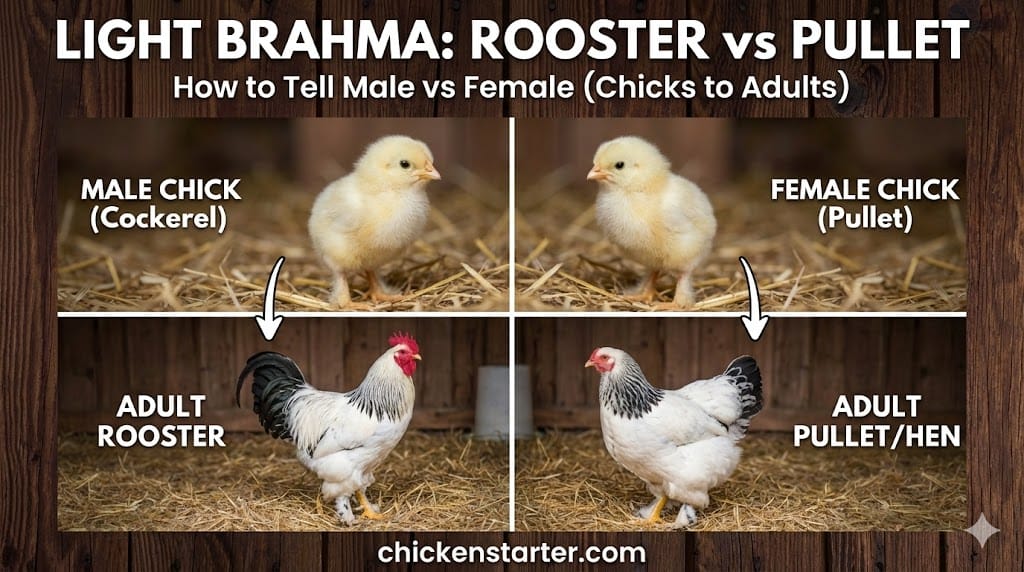
If you have ever stared at a brooder full of fluffy Light Brahma chicks and wondered which ones will grow into majestic roosters and which will become your gentle laying hens, you are not alone. Light Brahmas present a unique sexing challenge that trips up even experienced chicken keepers. Unlike breeds where males and females display dramatically different coloring from an early age, Light Brahma roosters and hens share the same striking columbian pattern of white feathers accented with black hackles and tails.
When I first added Light Brahmas to my tropical Queensland flock in March 2022, I made nearly every mistake described in this article. I purchased six sexed pullets from a local hatchery, and by 8 weeks, I was convinced one bird was male based on slightly larger comb development. I even started planning to rehome “him.” But then another bird in the group started developing a larger comb too. And then another.
I consulted with a more experienced keeper at a Brisbane poultry meetup who looked at my photos and said something I still repeat to newer keepers: “Stop looking at combs. Look at the feathers growing on their backs.” She was right. By 14 weeks, the saddle feathers told the real story. The bird I had mentally labeled as my rooster turned out to have rounded saddle feathers with no striping, making her clearly female. Meanwhile, one of the birds I had assumed was a pullet started showing distinctly pointed, striped saddle feathers.
This guide walks you through every reliable method for distinguishing Light Brahma roosters from hens at each stage of development. Whether you are working with day-old chicks, awkward teenagers, or nearly mature birds, you will find practical techniques backed by what actually works in real flocks. I have also included the timeline you can realistically expect, because Brahmas mature more slowly than most breeds, and anyone who promises you easy answers at three weeks is oversimplifying.
Understanding Light Brahma Basics Before Sexing
Before diving into sexing techniques, understanding what makes Light Brahmas unique helps explain why telling males from females proves challenging with this breed.
Light Brahmas originated from birds imported to the United States from the Chinese port of Shanghai during the mid-1800s. According to The Livestock Conservancy, these impressive birds were often referred to as the “King of All Poultry” due to their remarkable size, strength, and vigor. The breed gained recognition in the American Poultry Association’s Standard of Perfection in 1874, making it one of the earliest standardized American breeds.
Light Brahmas belong to the Asiatic class of chickens, which includes Cochins and Langshans. Birds in this class share traits like feathered shanks, slow maturation, and calm temperaments that make them popular with backyard keepers worldwide.
Both Light Brahma roosters and hens display what poultry experts call a columbian plumage pattern. This means both sexes have a white body with black hackle feathers (neck feathers) that are edged or laced with white, plus black tail feathers. The similarity in base coloring is precisely why so many keepers struggle to distinguish young males from females.
Size Expectations for Light Brahma Roosters vs Hens
Understanding mature sizes helps calibrate your expectations:
| Characteristic | Roosters | Hens |
|---|---|---|
| Mature Weight | 12 lbs (5.5 kg) | 9.5 to 10 lbs (4.5 kg) |
| Height | Up to 30 inches | 20 to 24 inches |
| Cockerel/Pullet Weight | 10 lbs | 8 lbs |
These weights represent typical standards, though historical records document some males reaching 18 to 19 pounds and females hitting 13 to 14 pounds. The world record for tallest chicken was actually held by a Light Brahma rooster named “Little John” who measured 26 inches tall. While your birds likely will not break records, understanding that Light Brahmas are genuinely massive helps you appreciate why size differences between young males and females can be subtle until birds approach maturity.
For comprehensive information about managing these gentle giants beyond sexing, our complete guide to Brahma chicken roosters covers temperament, care requirements, and flock dynamics in detail.
Why Light Brahmas Are Harder to Sex Than Other Breeds
Three factors combine to make Light Brahma sexing particularly challenging:
Identical juvenile coloring. Light Brahma chicks hatch with gray backs, yellow heads, and yellow wing tips and chests. Males and females look virtually identical at this stage. There is no color-based autosexing feature like you find in certain hybrid or sex-linked breeds.
Slow maturation rate. This is the factor that catches most keepers off guard. Light Brahmas take significantly longer to develop secondary sex characteristics (male and female traits) compared to faster-maturing breeds. While a Rhode Island Red cockerel might show obvious comb development by 6 weeks, a Light Brahma male of the same age often looks nearly identical to his sisters.
Feathered legs complicate leg thickness assessment. Many keepers use leg thickness as an early sexing indicator, but Light Brahmas have heavily feathered shanks and toes that obscure this trait. The distinctive beetle brow (prominent forehead) gives Light Brahmas their characteristic serious expression, though this feature appears in both genders and does not help with sexing.
I remember a conversation with a fellow keeper at that Brisbane poultry swap who had been raising Light Brahmas for over a decade. She told me something that stuck: “With Brahmas, you have to be patient. The birds will tell you what they are, but they tell you on their schedule, not yours.” That advice saved me considerable frustration with subsequent batches.
How Light Brahmas Compare to Other Brahma Varieties for Sexing
If you are considering which Brahma variety to raise, sexing difficulty varies significantly:
Sexing difficulty by variety:
- Dark Brahmas: Easier to sex than Lights because male and female feathering patterns differ from an early age. Females display penciling pattern all over their bodies, while males show different markings.
- Light Brahmas: Most challenging due to identical columbian pattern in both sexes during early development.
- Buff Brahmas: Easiest for day-old sexing due to autosexing down color. Buff Brahma chicks can be sexed at day old by examining chick fluff coloring.
For those still deciding whether to start with chicks or adult birds, the article on chicks vs adult hens for beginners discusses how slow-maturing breeds factor into that decision.
At What Age Can You Tell If a Light Brahma Is Male or Female?
This question deserves a direct answer with honest caveats.
The experienced breeder timeline: According to seasoned Brahma keepers, the sex of Brahma chickens can in nine cases out of ten be easily distinguished from 4 to 6 weeks old when using multiple methods together. This represents an optimistic scenario requiring practice and careful observation of tail feathers, comb development, and body stance simultaneously.
The realistic backyard keeper timeline: Most newcomers to Light Brahmas cannot reliably sex these birds until 10 to 16 weeks at the earliest, and many individuals require 16 to 20 weeks before gender becomes obvious. This stands in stark contrast to breeds like Leghorns or Production Reds where cockerels often reveal themselves by 4 to 6 weeks.
General timeline for Light Brahma sexing:
| Age | What You Can Observe | Confidence Level |
|---|---|---|
| 0 to 3 weeks | Very limited indicators; vent sexing only reliable method | Low (unless professionally vent sexed) |
| 4 to 6 weeks | Tail feather differences, slight comb variations (requires experience) | Low to moderate |
| 6 to 10 weeks | Comb and wattle development differences become clearer; early feather shape hints | Moderate |
| 10 to 16 weeks | Saddle feathers begin showing on males; hackle feather shape diverges | Moderate to high |
| 16 to 24 weeks | Clear saddle striping on males; pointed hackles vs rounded on females; behavioral differences | High |
| 24+ weeks | Crowing, mounting behavior; hens may begin laying | Very high |
Customer reviews from major hatcheries like Meyer Hatchery and Cackle Hatchery consistently note this delayed development. One keeper reported their Light Brahma rooster did not start crowing until approximately 7 months old, while their hens did not begin laying until just after 6 months. This slow development extends to all secondary sex characteristics.
Light Brahma Chick Sexing: Identifying Males vs Females (0 to 6 Weeks)
Let me be direct: sexing Light Brahma chicks in the first few weeks is difficult and often unreliable without professional vent sexing. However, there are a few methods worth understanding.
Vent Sexing (Professional Method)
Vent sexing, or cloacal sexing, involves examining the chick’s vent to identify the presence of a small male genital eminence. This technique requires significant training and practice to perform accurately and safely.
Cost considerations: Professional vent sexing typically costs $0.05 to $0.10 per chick at hatcheries, making it practical for larger operations. For backyard keepers ordering small quantities, the per-chick fee gets absorbed into overall chick pricing.
Important considerations:
- Hatcheries that offer sexed chicks typically quote 85 to 90 percent accuracy for Light Brahmas
- Attempting vent sexing without proper training risks injuring chicks
- Even professionals make errors, which is why hatcheries often include extra chicks to compensate for sexing mistakes
If you are purchasing from a hatchery, ordering sexed chicks provides your best chance of getting the gender ratio you want, understanding that some errors are inevitable.
Cost implications of gender:
- Sexed pullet chicks: $5 to 8 each
- Straight-run chicks: $3 to 5 each
- Potential savings buying straight-run: $20 to 40 per 10 chicks
- Risk: Need plan for 50 percent roosters (5 roosters from 10 chicks)
Critical timing window: Vent sexing is only possible for chicks between 24 hours and 3 days old. According to experienced poultry sexers, if your chicks are older than 72 hours, vent sexing becomes unreliable and other techniques must be used. This narrow window is why most backyard keepers cannot perform vent sexing themselves and must rely on hatchery sexing or wait for physical characteristics to develop.
DNA Sexing Option
Modern laboratories offer DNA sexing from blood or feather samples with near 100 percent accuracy. However, costs of $20 to 30 per bird make this impractical for most backyard keepers. DNA sexing makes sense primarily for rare or expensive breeding stock where knowing gender early justifies the expense.
Wing Feather Sexing (Limited Reliability)
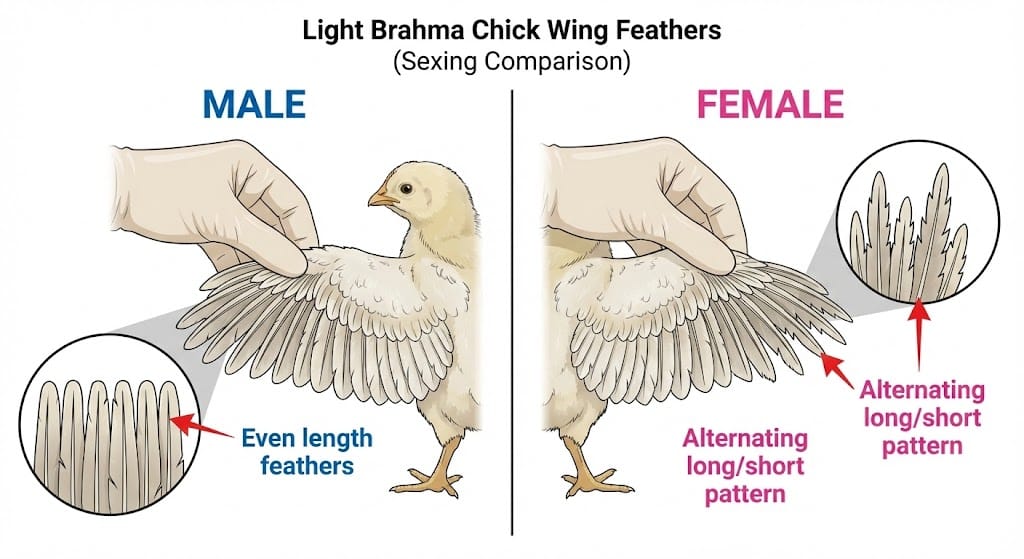
Some keepers attempt wing feather sexing in the first few days after hatching. This method examines the relative length of primary and covert feathers on the wing. In theory, female chicks show two distinct rows of feathers at different lengths, while male chicks display feathers of more uniform length.
My experience: I have tried this method with Light Brahmas and found it unreliable. The technique works better with specific breeds that have been selected for feather-sexing traits. Light Brahmas were not developed with this characteristic, so wing feather differences often prove inconsistent. Some sources note the method actually works “opposite” for Light Brahmas compared to other breeds, adding to the confusion.
Tail Feather Observation (4 to 6 Weeks)
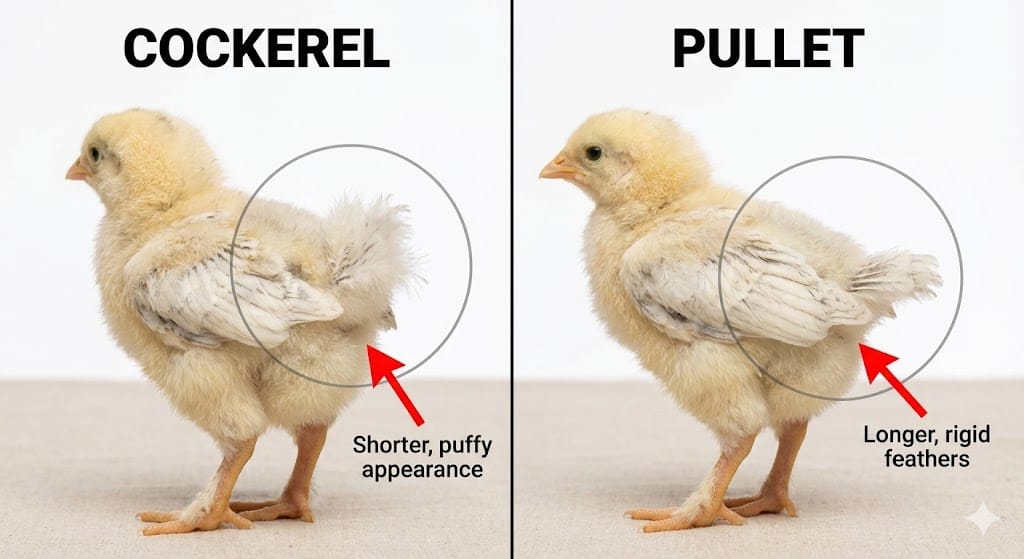
While I emphasize patience with Light Brahma sexing, some experienced keepers report reliable results as early as 4 to 6 weeks using tail feather development combined with other indicators.
Tail feather characteristics:
- Cockerel indicators: Longer, thinner tail feathers that appear more defined and structured
- Pullet indicators: Shorter, rounder, fluffier tail appearance with softer edges
My experience: I have had mixed results with this method. In my most recent hatch of eight Light Brahmas in October 2023, tail feather differences at 5 weeks correctly predicted gender for six birds but missed two. The method seems to work better when combined with comb development and overall body stance rather than used in isolation.
Important breed-specific note: According to experienced Brahma breeders on the Beemaster forum, wing feather sexing works “opposite to what the book says” for Light Brahmas. Chicks that appear female by standard wing feather sexing methods may actually be males. One breeder noted: “the ones that I thought were girls, turned out to be boys.”
However, examining wing feathers at 10 days old (rather than at hatch) reportedly shows 100 percent accuracy for some experienced keepers. This inconsistency is why I recommend against relying on wing feather sexing for Light Brahmas.
Important caveat: This timeline represents the optimistic scenario. Many backyard keepers, myself included, find 10 to 16 weeks provides more consistent accuracy, especially for those newer to the breed. Do not feel discouraged if you cannot see clear differences at 4 to 6 weeks. The birds will reveal themselves given time.
Early Behavioral Observations
While not definitive, certain behavioral patterns may hint at gender even in young chicks:
Potential male indicators:
- More assertive when competing for food
- Chest bumping with other chicks
- Standing taller and more alert
- More curious and bold when approaching human hands
Potential female indicators:
- Slightly more submissive in group dynamics
- Less inclined to chest bump
- May feather out slightly faster in early weeks
I want to emphasize that these behavioral differences are subtle and overlap significantly. I have had bold pullets and shy cockerels. Use behavioral observations as supporting evidence rather than primary indicators.
For those hatching their own Light Brahma eggs, the guide on best chicken egg incubators for beginners covers equipment selection for successful hatching.
Light Brahma Cockerel vs Pullet: Sexing Adolescents (6 to 16 Weeks)
This developmental stage is where sexing Light Brahmas becomes more practical. Several physical differences begin emerging, though the timeline varies between individuals.
Comb and Wattle Development
Light Brahmas have pea combs, which are smaller and closer to the head than single combs found on breeds like Leghorns. Despite the smaller size, comb development still provides useful sexing information.
Cockerel indicators (6 to 16 weeks):
- Pea comb grows larger and becomes more prominent
- Comb develops deeper red coloring earlier
- Wattles begin developing and turn red by 10 to 12 weeks
- Earlobes show red coloring sooner
- Face may show redder tones overall
Pullet indicators (6 to 16 weeks):
- Pea comb remains small and close to the head
- Comb stays pale pink or light red longer
- Wattles develop later and remain smaller
- Face stays paler overall
One technique I use is photographing each bird weekly from the same angle. I take photos every Saturday morning using my phone, always from the same distance and lighting. Comparing photos over time makes comb growth progression much clearer than trying to assess changes day to day. I keep these photos organized in a folder labeled with each bird’s leg band color.
Leg Thickness and Stance
Even with feathered legs, differences in stance and overall leg structure become visible during adolescence.
Cockerel indicators:
- Legs appear thicker and more robust
- Stance becomes more upright and alert
- Feet grow larger relative to body size
- May stand on tiptoes more frequently
- Overall posture appears more commanding
Pullet indicators:
- Legs remain more delicate in proportion to body
- Stance stays more horizontal and relaxed
- Feet remain proportionate to body size
- More relaxed standing position
Leg Color Observation
Beyond thickness, pay attention to leg color as an additional sexing indicator. Male Light Brahmas typically develop brighter, more vivid yellow legs as they mature, while females show a slightly duller, more dusky golden-yellow coloration.
This subtle difference becomes visible around 8 to 12 weeks and provides another data point when combined with other indicators. I find leg color most useful as a tie-breaker when comb and feather development seems ambiguous. A bird with a slightly larger comb AND bright yellow legs is more likely male than one with a similar comb but duller leg coloring.
Feathering Rate Differences
Light Brahma pullets typically feather out faster than cockerels, a trait documented by experienced breeders. Cockerels generally take longer to develop their feathers than hens, resulting in hens being more fully feathered with shorter, tighter plumage during the adolescent period.
What this looks like in practice:
- By 8 to 10 weeks: Pullets often appear more fully covered with tight, neat plumage
- By 8 to 10 weeks: Cockerels may look slightly scruffy or patchy as their larger, longer feathers develop more slowly
- By 12 weeks: The difference becomes more obvious, with cockerels showing emerging pointed feathers while still developing full coverage
I noticed this difference most clearly when comparing my Light Brahmas to my faster-maturing Easter Eggers. The Brahma pullets feathered faster than Brahma cockerels, but both genders feathered more slowly than other breeds of the same age. By week 10, my Brahma pullets looked polished while the cockerels still had that awkward teenage appearance with gaps in feather coverage.
Early Feather Shape Differences
This is where Light Brahma sexing gets interesting, because feather shape provides one of the most reliable indicators once birds reach 10 to 12 weeks.
Hackle feathers (neck feathers):
- Cockerels develop hackle feathers that are pointed at the tips
- Pullets develop hackle feathers with rounded tips
The pointed versus rounded distinction comes from how hormones affect feather growth. Testosterone in males produces pointed feathers, while estrogen in females creates rounded tips.
Saddle feathers (lower back, in front of tail):
- Cockerels begin showing longer, pointed saddle feathers by 12 to 16 weeks
- Pullets have shorter, rounded feathers in the saddle area
The saddle feather difference is particularly useful for Light Brahmas because males develop distinctive striping on these feathers. Light Brahma roosters show black striping through their white saddle feathers, creating a pattern that hens do not display.
Beyond the pointed versus rounded distinction, experienced breeders note differences in pattern definition between sexes. Males develop more distinct patterns with darker, thicker lines and more defined markings in their columbian coloring. Females display softer, more muted patterns with lighter, thinner lines and less sharply defined markings. This distinction becomes useful around 12 to 16 weeks when examining hackle feathers closely.
I learned to check saddle feathers by gently lifting the wing and examining the feathers on the lower back. Even before the feathers fully develop, you can often see the pointed tips emerging on cockerels while pullet feathers maintain rounded edges.
Light Brahma Rooster vs Hen: Physical Differences in Adults
By 16 to 24 weeks, most Light Brahmas reveal their gender through multiple unmistakable characteristics. This is when even beginners can confidently identify roosters from hens.
Definitive Rooster Characteristics
Physical traits of mature Light Brahma roosters:
| Feature | Description |
|---|---|
| Hackle feathers | Long, pointed, flowing feathers with greenish-black coloring laced with silvery white |
| Saddle feathers | Pronounced pointed feathers striped with black, draping over the back |
| Tail | Black main tail feathers with sickle feathers (long, curved feathers) |
| Comb and wattles | Large red pea comb; developed red wattles and earlobes |
| Spurs | Begin developing on backs of legs (may take 6+ months to become prominent) |
| Overall size | Noticeably larger than hens; can reach 12 lbs or more |
| Posture | Upright, proud stance; chest forward |
Behavioral traits:
- Crowing (typically begins around 5 to 7 months, sometimes later)
- Tidbitting (finding food and calling hens over with distinctive calls)
- Mounting or attempting to mount hens
- Protective behavior toward the flock
- May become more assertive with keepers (though Light Brahmas are known for docility)
My rooster Goliath did not crow until he was nearly 7 months old, and when he finally did, even that was quieter than my Rhode Island Red rooster had been. His first attempts at crowing sounded more like a strangled cough than a proper crow, which had me laughing for days.
Definitive Hen Characteristics
Physical traits of mature Light Brahma hens:
| Feature | Description |
|---|---|
| Hackle feathers | Shorter, rounded feathers with similar black and white lacing |
| Saddle area | Rounded feathers without striping or pointed tips |
| Tail | Black tail feathers without sickle feathers; shorter and more compact |
| Comb and wattles | Smaller pea comb; smaller wattles; may redden before laying begins |
| Body shape | Rounder, especially in abdomen area as laying approaches |
| Overall size | Large but noticeably smaller than roosters; typically 9.5 to 10 lbs |
Behavioral traits:
- Submissive squat when approached (indicates laying readiness)
- Nest box exploration
- Egg song (loud vocalizing after laying)
- Generally calmer movement patterns
For more on recognizing when your pullets are ready to start laying, the article on chicken behavior before laying their first egg covers the signs in detail.
Light Brahma Rooster Feathers vs Hen Feathers: Visual Guide
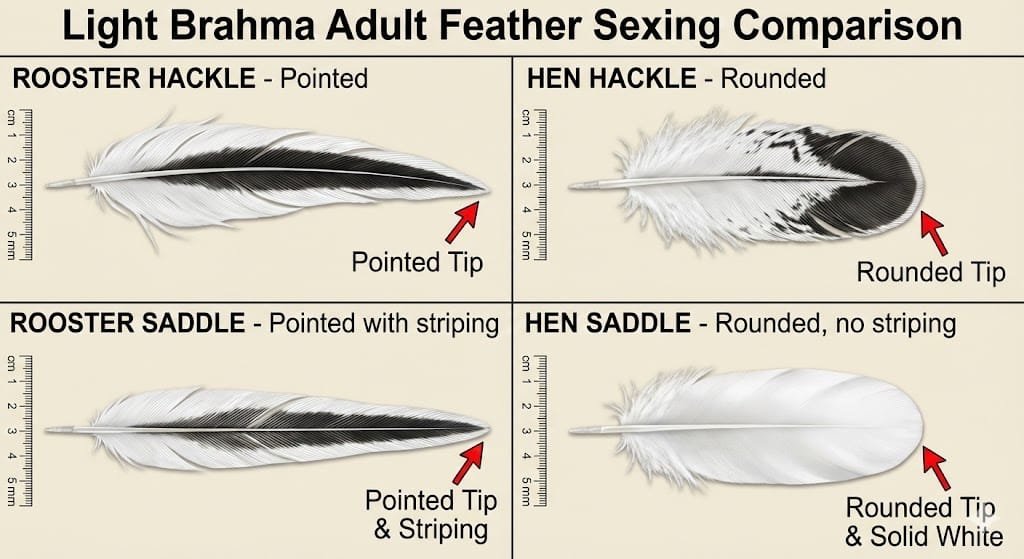
Understanding feather morphology is essential for accurate sexing. Here is a detailed comparison:
| Feather Type | Rooster Shape | Hen Shape | When Visible |
|---|---|---|---|
| Hackle (neck) | Long, pointed, flowing | Shorter, rounded tips | 10 to 14 weeks |
| Saddle (lower back) | Long, pointed, striped | Short, rounded, no striping | 12 to 18 weeks |
| Sickle (tail) | Present: long, curved | Absent | 16 to 24 weeks |
| Wing bow | May show iridescence | Less iridescent | 14+ weeks |
| Breast | Broader, fuller | Rounder, softer | 12+ weeks |
The key principle: male chicken feathers across most breeds develop pointed tips because testosterone influences feather growth, while female feathers maintain rounded tips due to estrogen influence. This biological difference provides a reliable sexing method once feathers mature sufficiently.
The Saddle Striping Test (Most Reliable Visual Method)
If I could only use one method to sex adult Light Brahmas, I would choose the saddle feather examination.
How to perform this test:
- Gently restrain your Light Brahma or have a helper hold the bird
- Lift one wing to expose the lower back area in front of the tail
- Examine the feathers in this saddle region closely
- Look for both shape and pattern
Rooster saddle feathers: Long, pointed feathers with visible black striping running through the white. These feathers often have a glossy sheen and drape downward toward the tail.
Hen saddle feathers: Shorter, rounded feathers that are primarily white without black striping. The feathers lay flat against the body without the flowing quality seen in roosters.
This test becomes reliable around 14 to 18 weeks for most Light Brahmas, though some slower-developing individuals may require waiting until 20 weeks or beyond.
Common Mistakes When Sexing Light Brahmas
After years of working with this breed and discussing experiences with other keepers, I have identified mistakes that lead to incorrect gender assessments.
Mistake 1: Expecting Early Certainty
The most common mistake is trying to definitively sex Light Brahmas too early. I have seen keepers confidently declare gender at 4 weeks based on comb size, only to reverse their assessment two months later.
Better approach: Make tentative assessments starting around 8 to 10 weeks, but remain open to revising your conclusions as birds develop further. Keep notes and photos to track changes over time.
I recommend keeping a simple sexing journal:
- Bird ID (leg band color or number)
- Hatch or purchase date
- Weekly comb development notes
- Weekly feather observations
- Photos with timestamps
- Final gender determination date
Mistake 2: Relying Solely on Size
While roosters ultimately grow larger than hens, size differences during adolescence can be misleading. Growth rates vary between individuals, and a large pullet may temporarily outsize a smaller cockerel.
Better approach: Use size as one factor among many rather than a primary indicator. Combine size observations with feather shape, comb development, and behavior.
Mistake 3: Confusing Assertive Pullets for Cockerels
Some Light Brahma pullets display bold, assertive personalities that keepers interpret as rooster behavior. These “alpha hens” may chest bump, stand tall, and even attempt mounting other birds.
Better approach: Focus on physical characteristics rather than behavior alone. Physical traits like feather shape and saddle striping are more reliable than behavioral observations.
Mistake 4: Not Accounting for Individual Variation
Light Brahmas from different bloodlines develop at different rates. Production-type birds from hatcheries may mature slightly faster than exhibition-type birds from specialty breeders.
Better approach: Compare birds within your own flock rather than against absolute timelines. If one bird consistently shows more comb development and pointed feathers than its siblings, that individual is more likely male regardless of exact age.
Mistake 5: Ignoring the Pecking Order Impact
Changes in flock hierarchy can affect behavior in ways that mimic gender characteristics. A dominant hen may display behaviors that seem rooster-like.
Better approach: Observe physical traits first, then consider behavior as supporting evidence. Our guide on pecking order problems and stopping bully hens explains how flock hierarchy affects behavior.
What If My Light Brahma Does Not Match These Descriptions?
Sometimes individual birds develop differently than expected. Here is how to handle uncertain cases:
Delayed development in some individuals: Some Light Brahmas simply mature later than others. If your 16-week-old bird shows no clear gender indicators, wait another 4 to 6 weeks before making determinations.
Mixed characteristics: Occasionally you will see a bird with some male traits (larger comb) and some female traits (rounded feathers). In these cases, wait for saddle feather development, which rarely lies.
When to seek expert opinions: If you remain uncertain after 20 weeks, post clear photos to forums like BackYard Chickens or seek advice from experienced Brahma breeders in your area. Include photos of the bird’s head, hackle feathers, saddle area, and full body stance.
Online resources for photo-based sexing help: The BackYard Chickens forum has dedicated sections for breed-specific sexing questions where experienced keepers can provide assessments based on your photos.
Preventing Feather Pecking When Managing Sexed Groups
Once you have successfully separated cockerels from pullets, understanding feather pecking prevention becomes essential for maintaining flock health during this transition period.
Changes in flock composition create stress that can trigger feather pecking and cannibalism. Stress is usually the main factor behind cannibalism outbreaks, no matter how slight the disruption. Chickens are attracted to blood, so outbreaks can be initiated by the injury of one bird and subsequent pecking of that injury by flock mates.
Common triggers when separating Light Brahma cockerels:
- Overcrowding in bachelor pens while awaiting rehoming
- Competition for resources with fewer birds
- Boredom in confined spaces
- Nutritional stress during rapid adolescent growth (particularly protein, sodium, and phosphorus deficiencies)
- Excessive heat (Light Brahmas are already heat-sensitive)
- Bright lighting in coops
Prevention strategies specific to Light Brahmas:
Space management: These large birds need extra room. Provide minimum 5 to 6 square feet per bird in coops, doubling this for bachelor cockerel groups. Adequate feeder space for all birds to eat simultaneously helps prevent underweight birds that are frequently victims of cannibalism.
Multiple feed and water stations: Place at least two feeding areas and two waterers to prevent competition and dominance issues. If birds have to fight for food and water, or if birds are always hungry, they will increase pecking behavior.
Nutritional support: Feed a complete ration to meet nutrient needs for age and type of flock. Cannibalism has been linked to deficiencies in protein, sodium, and phosphorus. For temporary salt supplementation if pecking begins, add 1 tablespoon of salt per gallon of water in the drinker for one morning, then repeat 3 days later. Provide plenty of fresh, unsalted water at all other times.
Enrichment for large breeds: Light Brahmas cannot fly to high perches for entertainment. Instead, provide:
- Low-hanging treat dispensers or shiny aluminum pie tins at head height
- Straw bales for exploration (they attract insects for chickens to peck at)
- Cabbage or other vegetables hung at head height through wire baskets
- Shallow dust bathing areas (their feathered legs need extra dust bath access)
- Foraging opportunities such as straw, green leafy vegetables, grass clippings, or small grains in deep litter
- Protected outdoor access where they can display natural foraging behaviors
Feed a portion of the flock’s ration as grains, table scraps, or garden greens scattered around the yard. This gives chickens something to hunt and peck besides each other.
Lighting considerations: Dim lighting or red lights in coops make blood less visible if pecking starts, reducing the chance other birds will join in. Switch to red light bulbs (not white bulbs over 40 watts for brooders). Use lighting intensity between 5 and 10 lux (about enough to barely read a newspaper). This is particularly important during the stressful adolescent period when you are sorting genders.
Never light birds more than 16 hours per day, as constant light can be stressful.
Nesting provisions: Provide dark nest boxes (1 nest for every 5 hens) to prevent vent pecking during oviposition. The everted cloaca during egg laying is highly attractive for pecking, so some outbreaks of cannibalism begin during this vulnerable time. Dark nesting areas prevent exposure to potentially cannibalistic flock mates.
Managing mash versus pellets: A mash diet, rather than pelleted feed, may help prevent outbreaks of cannibalism because chickens sift through the variety of ground particles and take longer to consume their feed. High fiber diets keep birds’ crops full and make them more content.
Immediate intervention if pecking starts:
- Separate injured birds immediately for healing
- Remove aggressive birds doing severe feather pecking
- Apply Blue Kote, Pick-No-More, or pine tar to wounds (note that Blue Kote can cause stinging)
- Lower pen temperature if possible
- Increase enrichment immediately
- Add additional perches at various heights
No measure for controlling cannibalism will work until the conditions that led to the problem are first eliminated. Prevention is always more effective than treatment.
For comprehensive flock management strategies, our guide on pecking order problems and stopping bully hens covers intervention techniques, while managing parasites and mites addresses health stressors that can trigger aggressive behavior.
What If You End Up With More Roosters Than Expected?
Even with careful sexing or purchasing from hatcheries, you may find yourself with more roosters than your flock can accommodate. This is particularly relevant if local regulations limit rooster numbers or your neighbors have concerns about crowing.
Final count from my “six sexed pullets” purchased in March 2022: five hens and one rooster. That 83 percent accuracy aligned with what hatcheries quote. The rooster, whom I named Goliath, turned out to be one of the calmest birds I have ever raised.
Light Brahma roosters are generally known for their calm and docile temperament. They display low aggression levels, and multiple roosters can sometimes be kept together more easily than with other breeds. However, this depends on individual personalities and flock dynamics.
Options for excess roosters:
- Rehoming through local poultry groups, agricultural networks, or online marketplaces
- Processing for meat (Light Brahmas were historically valued as dual-purpose birds)
- Keeping in a bachelor flock separate from hens (requires adequate space and management)
- Finding farms that need flock protection roosters
For guidance on whether you need a rooster at all, the article on do I need a rooster to get eggs clarifies the common misconception about rooster requirements for egg production.
Light Brahma Rooster Temperament vs Hen Temperament
Understanding temperament differences helps you prepare for managing either gender.
Rooster Temperament
Light Brahma roosters are consistently described as gentle giants. According to breed standards and keeper experiences documented by The Livestock Conservancy, these roosters are:
- Calm and non-aggressive toward humans
- Tolerant of handling
- Protective of hens without excessive aggression
- Generally quiet compared to more vocal breeds
- Less proficient at mating than some breeds due to their size
One important note from experienced breeders: Light Brahma roosters may be less effective at mating compared to lighter, more agile breeds. Their substantial size can make mounting difficult, potentially affecting fertility rates if breeding is your goal. When breeding Light Brahmas, use a mating ratio of 8 females to 1 male.
Hen Temperament
Light Brahma hens share the gentle disposition of roosters:
- Extremely docile and easy to handle
- Tolerant of children (making them excellent family birds)
- Not flighty or nervous
- Social with other chickens and typically non-aggressive in the pecking order
- Content in confinement but also enjoy foraging
Both genders do well in mixed flocks and rarely bully other breeds. Their size actually works as a social advantage because other chickens typically do not try to intimidate such large birds.
For those considering Light Brahmas as a beginner breed, the guide on easiest chicken breeds for beginners discusses how temperament factors into breed selection.
Egg Production: What to Expect From Light Brahma Hens
Once you have successfully identified your pullets, understanding their laying patterns helps set realistic expectations.
Light Brahma egg production facts:
| Characteristic | Details |
|---|---|
| Annual production | 150 to 200 eggs (varies by source and individual) |
| Egg size | Medium to large |
| Egg color | Brown (medium brown, sometimes described as terracotta) |
| Age at first egg | 6 to 7 months (later than many breeds) |
| Peak laying season | October to May (winter layers) |
| Broodiness | Yes, tend to go broody; excellent mothers |
The winter laying characteristic is particularly valuable. While many breeds decrease production during shorter daylight months, Light Brahmas produce the majority of their eggs during the cooler season. This makes them an excellent complement to breeds that lay heavily in spring and summer.
One keeper in a customer review noted their Light Brahma hens began laying at 20 to 22 weeks and averaged 5 eggs per week once established. The eggs were described as medium-large with a terracotta coloring.
Light Brahma hens tend toward broodiness and make excellent mothers. However, their large size means hatchlings need monitoring to prevent accidental trampling.
If you are concerned about why chickens might stop laying, the article on why chickens stop laying eggs covers common causes and solutions. For information on molt timing and feather regrowth (which affects ability to assess feather shape for sexing), see our guide on chicken molting season.
Managing a Mixed Flock With Light Brahmas
Light Brahmas integrate well into mixed flocks, but their unique characteristics warrant some management considerations.
Space Requirements
Due to their large size, Light Brahmas need more space than standard breeds:
- Coop space: Minimum 5 to 6 square feet per bird (more than the typical 4 square feet)
- Run space: 10+ square feet per bird if not free ranging
- Roost height: 2 to 4 feet (they cannot fly to high roosts and may injure themselves jumping down from excessive heights)
- Roost width: Wider roosts (3 to 4 inches) to fit their big feet
Nesting box dimensions for Brahmas: Due to their substantial size, Light Brahma hens require larger nesting boxes than standard breeds. According to Backyard Chicken Coops Australia, choose or build nesting boxes that are at least 20 inches (50 cm) deep with an opening of 14 x 14 inches (35 x 35 cm) minimum. Standard 12 x 12 inch boxes will feel cramped and may discourage laying or cause hens to seek alternative nesting spots.
For detailed coop sizing guidance, our article on how big your chicken coop should be provides calculations for various flock sizes.
Feathered Leg Care
The heavily feathered legs that make Light Brahmas so distinctive require specific attention:
- Keep coop bedding dry to prevent mud accumulation on leg feathers
- Check feet regularly during wet seasons for debris buildup
- In freezing conditions, wet leg feathers can contribute to frostbite on toes
- Provide dry, well-drained areas in runs
During my first wet season with Brahmas in Queensland, I learned this lesson the hard way. After three days of heavy rain, I noticed one hen limping. Her leg feathers had become caked with mud that hardened and pulled at the feather follicles. I had to soak her feet in warm water for 20 minutes to soften the mud enough to remove it safely. After that, I added drainage gravel to the run entrance and placed straw mats near the coop door.
For maintaining coop conditions that prevent these issues, the guide on best chicken coop flooring for mud addresses drainage solutions. Our article on using barn lime in chicken coops covers managing moisture in bedding.
Climate Considerations
Light Brahmas excel in cold climates due to their dense feathering, pea comb (resistant to frostbite), and large body mass. They tolerate cold better than most breeds. For keepers in cold regions, our guide on raising chickens in cold climates and winterizing your chicken coop provide comprehensive cold-weather management.
However, they are not especially heat tolerant. In hot climates:
- Provide ample shade
- Ensure constant access to fresh, cool water
- Consider cooling measures during heat waves (misters, frozen treats)
- Monitor for heat stress signs (panting, holding wings away from body)
For keepers in warmer regions, the article on raising chickens in hot humid climates provides management strategies. Our guide on keeping chickens cool in summer covers heat protection techniques.
Breeding Light Brahmas: Sexing for Breeding Programs
If you plan to breed Light Brahmas, accurate sexing becomes even more important for selecting quality breeding stock.
Selecting Breeding Roosters
Look for roosters that demonstrate:
- Proper columbian pattern with clear color separation
- Good size and body conformation
- Correct pea comb shape
- Well-feathered legs and feet (four toes, middle and outer toes feathered)
- Docile temperament (aggression should be selected against)
- Alert, healthy appearance
Selecting Breeding Hens
Quality breeding hens should show:
- Proper pattern without excessive smuttiness (unwanted dark feathers in white areas)
- Good body size (hens approaching 10 lbs)
- History of reliable laying
- Proper leg feathering
- Calm disposition
Mating Ratios
The standard mating ratio for Light Brahmas is 8 females to 1 male. Due to their size, keeping fewer hens per rooster may not improve fertility and can lead to over-mating injuries to hens.
Note that Light Brahma hens tend toward broodiness and make excellent mothers. However, their large size means hatchlings need monitoring to prevent accidental trampling.
Frequently Asked Questions About Light Brahma Sexing
How accurate is hatchery sexing for Light Brahmas?
Most hatcheries report 85 to 90 percent accuracy for Light Brahma sexing. This means ordering 10 sexed pullets typically results in 1 to 2 cockerels. Hatcheries often include extra chicks to compensate for potential sexing errors and shipping losses.
Can you sex Light Brahma chicks by color?
No. Unlike some breeds that are autosexing (where males and females hatch with different colors), Light Brahma chicks of both genders display identical coloring: gray backs with yellow heads, wing tips, and chests. Color-based sexing is not reliable for this breed. However, Buff Brahma chicks can be sexed at day old by down color.
Why is my Light Brahma still not showing gender at 12 weeks?
This is normal for the breed. Light Brahmas are slow-maturing birds, and some individuals develop secondary sex characteristics later than others. Continue monitoring feather development and comb growth. Most birds will show clear gender differences by 16 to 20 weeks.
My Light Brahma pullet is mounting other chickens. Is she actually a rooster?
Not necessarily. Dominant hens sometimes display mounting behavior to establish flock hierarchy. Focus on physical characteristics like feather shape and saddle striping rather than behavior alone. If the bird has rounded feathers without saddle striping, she is likely a dominant pullet rather than a rooster.
When do Light Brahma roosters start crowing?
Light Brahma roosters typically begin crowing between 5 and 7 months of age, though some individuals start later. Customer reports indicate some roosters do not crow until 7 months or beyond. The late crowing corresponds with their overall slow maturation rate.
Do Light Brahma roosters get aggressive?
Light Brahma roosters are consistently described as docile and non-aggressive. While individual variation exists, the breed is known for gentle temperaments. They are often recommended for families with children because of their calm nature.
How long do Light Brahmas live?
Light Brahmas typically live 5 to 8 years with proper care, though some individuals reach 10 years or more. Their lifespan is average for large heritage breeds. For more on chicken longevity, see our guide on how long chickens live.
My Experience Sexing Light Brahmas: Lessons Learned
When I first added Light Brahmas to my flock in March 2022, I made nearly every mistake described in this article. I was impatient, tried to sex birds too early, and confidently declared genders that I later had to reverse.
The lesson that experience taught me: with Light Brahmas, patience is not just a virtue but a necessity. The birds reveal themselves when they are ready, and no amount of wishful interpretation of early comb development changes that timeline.
Goliath, my accidental rooster from that batch of “sexed pullets,” turned out to be one of the best birds I have ever raised. He did not crow until he was nearly 7 months old, and when he finally did, even that was quieter than my Rhode Island Red rooster had been. His first attempts at crowing sounded more like a strangled cough than a proper crow, which had me laughing for days.
He was protective without being aggressive, gentle with the hens, and tolerant of my young nephew who insisted on trying to pick him up during family visits. When I added new pullets to the flock six months later, Goliath supervised the integration process like a patient teacher, breaking up squabbles and making sure the new girls got their share of treats.
That single bird taught me more about Light Brahma temperament and sexing than any article could. He also taught me that sometimes the “mistakes” (like ending up with an unexpected rooster) turn into the best parts of keeping chickens.
Final Thoughts on Telling Light Brahma Roosters From Hens
Sexing Light Brahmas requires accepting that this breed operates on its own schedule. The same qualities that make them wonderful birds (their calm temperament, impressive size, and beautiful plumage) also mean they mature slowly and reveal gender later than faster-developing breeds.
The most reliable indicators, in order of usefulness, are:
- Saddle feather shape and striping (pointed and striped = male; rounded without striping = female)
- Hackle feather shape (pointed = male; rounded = female)
- Comb and wattle development (larger and redder earlier = male)
- Overall size and stance (larger and more upright = male)
- Behavioral cues (crowing, mounting = male; squatting, egg laying = female)
If you are ordering chicks and gender matters to your plans, purchasing sexed birds from reputable hatcheries provides your best starting point, understanding that some errors are inevitable. If you are hatching your own eggs or purchasing straight-run chicks, prepare to wait and observe.
For comprehensive information about the breed beyond sexing, our main Brahma chicken rooster guide covers housing, feeding, health, and management in detail.
Light Brahmas reward patient keepers with years of gentle companionship, reliable winter eggs, and the unique satisfaction of raising one of poultry’s most impressive heritage breeds. Whether you end up with more roosters or hens than planned, these birds make the journey worthwhile.

Oladepo Babatunde is the founder of ChickenStarter.com. He is a backyard chicken keeper and educator who specializes in helping beginners raise healthy flocks, particularly in warm climates. His expertise comes from years of hands-on experience building coops, treating common chicken ailments, and solving flock management issues. His own happy hens are a testament to his methods, laying 25-30 eggs weekly.