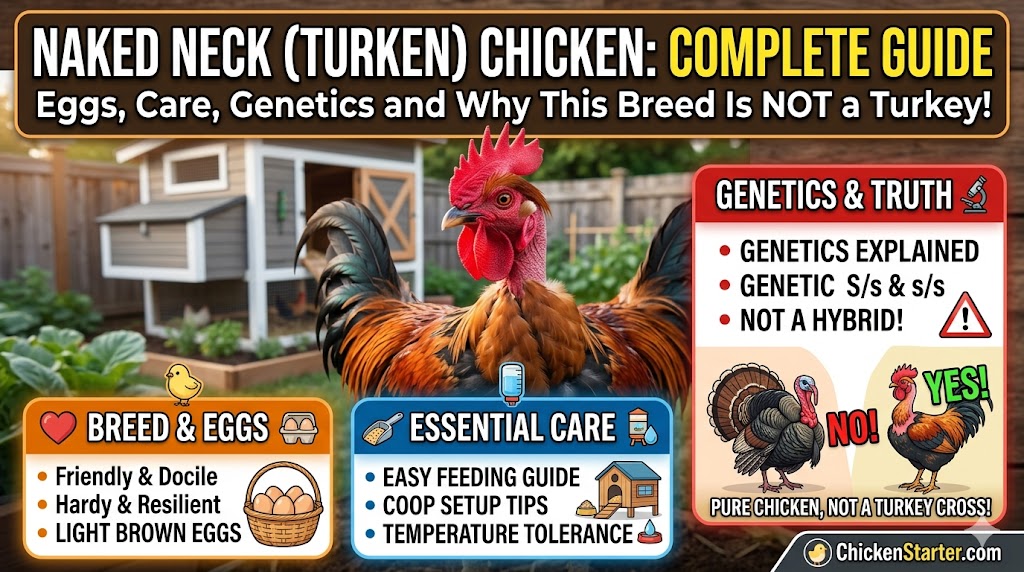
The Naked Neck chicken is one of the most misunderstood breeds in the poultry world. Also called the Turken, Transylvanian Naked Neck, or Churkey, this dual-purpose heritage breed is famous for its completely featherless neck. That bare neck is caused by a single incompletely dominant gene (Na) on Chromosome 3 that also reduces total body feathering by roughly 40 to 50 percent. Despite persistent myths that have circulated for well over a century, this bird is 100% chicken (Gallus gallus domesticus). It is not a chicken-turkey hybrid. It never was.
What makes this breed truly remarkable is its combination of exceptional heat tolerance, outstanding feed efficiency, surprisingly affectionate temperament, and a genetics story that involves a 2011 scientific breakthrough most breed guides still get wrong.
If you are looking for a hardy, low-maintenance, dual-purpose chicken that thrives in hot climates, produces 150 to 200 light brown eggs per year, and has a personality that consistently turns skeptics into devoted fans, the Naked Neck deserves your attention.
Quick Breed Snapshot
| Attribute | Details |
|---|---|
| Breed Type | Heritage, dual-purpose (eggs + meat) |
| Other Names | Turken, Transylvanian Naked Neck, Churkey, Kaalnek |
| Origin | Likely Asia; standardized in Transylvania (Romania/Hungary) |
| APA Recognized | Yes (1965) |
| Egg Color | Light brown / tinted brown |
| Egg Size | Medium to large |
| Egg Production | 150 to 200 per year (3 to 4 per week) |
| Weight (Roosters) | Approximately 8.5 lbs (standard) |
| Weight (Hens) | Approximately 6.5 lbs (standard) |
| Bantam Weight | Roosters ~2.1 lbs; Hens ~1.9 lbs |
| Lifespan | 6 to 8 years (up to 10 with excellent care) |
| Temperament | Docile, friendly, easily tamed |
| Cold Hardy | Moderate (body yes, but exposed neck and large comb create frostbite risk) |
| Heat Tolerance | Exceptional (one of the best heat-tolerant breeds) |
| Broodiness | Variable, moderate tendency; good mothers |
| Comb Type | Single, medium-large, red |
| Key Genetic Trait | Na gene on Chromosome 3, 40 to 50% fewer feathers |
| APA Recognized Colors | Black, White, Buff, Red |
| UK Recognized Colors | Black, White, Buff, Red, Cuckoo, Blue |
Naked Neck Chicken Origin: From Asian Gamecocks to Transylvanian Farmyards
The origin story of the Naked Neck chicken is more fascinating than any myth about turkey hybrids. It is also far more complicated than most breed guides bother to explain.
The True Origin: Asia, Not Transylvania
Most people assume these birds originated in Transylvania because of the name. The truth runs deeper.
According to breed profile data published by Backyard Poultry, the Na gene is present in many native chickens worldwide, particularly across Asia, Africa, and Central and South America, and it likely originated in Asia. The founding population best known to breeders in Europe and America is the Transylvanian Naked Neck from the plateau surrounded by the Carpathian Mountains in Romania.
The story stretches back millennia. Archaeological finds of small-bodied chickens in the Carpathian Basin date back to the first century BCE. Chicken keeping was already common in the region before the Magyars moved in at the turn of the tenth century. During Ottoman Empire rule (1541 to 1699), larger, red-eared Asian chickens were introduced. These may well be the source of the naked neck gene which then spread through Transylvania, Serbia, and Bosnia.
Over centuries, all of these influences blended together. European breeds arrived during the Habsburg reign of Austria-Hungary. The result was the Transylvanian breed as we know it today, a chicken shaped by Asian genetics, Ottoman-era imports, and European refinement.
The first Naked Neck chickens to appear in a public exhibition were shown at the International Agricultural Show in Vienna in 1875. German breeders quickly recognized the breed’s production value and began developing it further, distributing it widely throughout Europe by the early twentieth century.
The American Myth: Virginia Investigates in 1922
Here is a piece of history you will not find in any other Naked Neck chicken guide online.
When these birds arrived in North America in the late 1800s, Americans did not know what to make of them. The featherless neck, the turkey-like head on a chicken body, it looked impossible. So a myth was born. Many Americans genuinely believed that Turkens were a cross between a turkey and a chicken.
This was not just casual backyard speculation. According to historical accounts from the period, the belief was so widespread and persistent that the State of Virginia’s Department of Immigration and Agriculture actually investigated the rumors in 1922. Their conclusion? The Turken was not some mysterious hybrid. It was simply an ordinary European chicken called the Transylvanian Naked Neck.
Five years later, Dr. Morley Jull of the USDA declared it a breed, and the department patented the name “Bare-Neck.” Dr. Jull was adamant that no credible evidence existed for the turkey-chicken cross, noting that even if such a cross were possible, the offspring would almost certainly be sterile.
That myth persisted for decades. You can still find it floating around certain corners of the internet today. Let this be the definitive answer: Naked Neck chickens are 100% chicken. Full stop.
The German Africa Campaign and WWII Near-Extinction
The breed proved its toughness under the most extreme conditions imaginable.
According to information from Heritage Acres Market, before World War One, the Germans had troops stationed in Africa and needed a reliable food source. They sent out several chicken breeds. Only the Transylvanian Naked Necks survived in the extreme humidity and heat, supplying troops with both eggs and meat while other breeds perished.
That should tell you everything you need to know about this breed’s hardiness.
In the 1930s, native Hungarian hens including those from Transylvania were collected at the research institute at Gödöllő, Hungary. The gene bank’s goal was to protect historical breeds through standardization and improvement. These breeding lines were propagated successfully and distributed throughout the country and abroad.
Then came the Second World War. Most of the Gödöllő stocks were destroyed. Breed scientists managed to restore populations by the 1950s, rebuilding Buff, Cuckoo, and White varieties from what survived. But the threat was not over. During the 1960s, even small farms began replacing heritage stock with imported commercial hybrids.
A government breeding authority stepped in during the 1970s to ensure preservation. By the 1990s, the responsibility passed to NGOs, with university and government support continuing in the background.
Conservation Status: A Remarkable Recovery Story
Despite the Naked Neck chicken being widespread worldwide, the original Transylvanian landrace is a conservation success story that deserves more attention.
According to conservation data published by Backyard Poultry, in Romania in 1993, fewer than 100 females and 20 males of each purebred variety were registered in Constanța. Those are critically low numbers for any breed.
The recovery has been extraordinary. In Hungary, the population grew from just 566 Black, 521 Cuckoo, and 170 White birds in 1994 to over 4,000 of each variety by 2021. A network of breeders’ associations, the Gödöllő research center, two Hungarian universities, and several private farms now work together to preserve the breed.
In the United States, the American Poultry Association recognized the Naked Neck in 1965. The National Naked Neck Breeders Society now helps American breeders maintain and improve the standard. According to the Thrifty Homesteader, there are estimated to be fewer than 15 serious breeders of standard-bred Naked Necks in the United States.
That rarity is both a challenge and an opportunity. If you are interested in heritage breed conservation, raising purebred Transylvanian Naked Necks is genuinely meaningful work.
Why Do Naked Neck Chickens Have No Feathers? The Genetics Explained Simply
This is where the Naked Neck chicken story transforms from “weird-looking bird” into “genuinely fascinating genetics.”
Most breed guides mention the gene. Almost none explain the science properly. Here is the full picture.
The Na Gene: Incompletely Dominant
According to Wikipedia’s documentation on the breed, the naked-neck trait is controlled by an incompletely dominant allele (Na) located near the middle of Chromosome 3.
Here is what that means in practical terms:
Two copies of the Na gene (Na/Na) means the bird is homozygous. It will have a completely bare neck, featherless crop, featherless vent area, and the maximum reduction in body feathering. These are the true-breeding, purebred Naked Neck chickens recognized by the APA.
One copy of the Na gene (Na/na+) means the bird is heterozygous. It will show the naked neck trait, but with reduced expression. You will often see a small “bowtie” tuft of feathers partway down the neck. Body feather reduction is present but less dramatic.
Zero copies (na+/na+) means the bird is fully feathered. It looks like a normal chicken and cannot pass the trait to its offspring.
This is why the Na gene is so easy to introduce into other breeds. Cross a Naked Neck rooster with any hen, and a significant proportion of the offspring will show the bare neck. According to breeding data from PipsNChicks, a Naked Neck crossed with a non-Naked Neck produces 100% bowtie offspring, all showing the trait to some degree.
The 2011 BMP12 Discovery: The Breakthrough No One Covers Properly
In 2011, a team led by developmental biologist Dr. Denis Headon at the University of Edinburgh’s Roslin Institute published a landmark study in the journal PLoS Biology that finally explained the molecular mechanism behind the bare neck.
According to the Roslin Institute’s own announcement, the research revealed that a genetic mutation causes overproduction of a protein called BMP12 (also known as GDF7, or Growth Differentiation Factor 7). This protein suppresses feather growth.
But there is a second piece to the puzzle. As reported by National Geographic, when researchers did further analysis, they discovered that an acid derived from Vitamin A (retinoic acid) is naturally produced on chicken neck skin. This acid enhances the effects of BMP12, amplifying feather suppression specifically in the neck region.
Here is the really remarkable part. When the research team treated standard-breed chicken embryos with BMP12 in the lab, those normal chickens developed no feathers on their necks. The neck was already “primed” and more sensitive to the molecule than any other body region.
As reported in the original PLoS Biology paper, the researchers found that selective production of retinoic acid by embryonic neck skin potentiates BMP signaling, making neck skin more sensitive than body skin to feather suppression. This also has implications for understanding why other bird species, including vultures and ostriches, evolved to have featherless necks independently.
This is not some simple cosmetic quirk. It is a complex interaction between a genetic insertion on Chromosome 3, a protein (BMP12/GDF7), and a Vitamin A derivative (retinoic acid), all working together at the embryonic stage to determine feather distribution for the entire life of the bird.
A 2025 study published in Poultry Science by researchers at China Agricultural University further confirmed that the mutation in Ake chickens (a Chinese naked neck breed from Yunnan Province) involves the same 73-kb insertion at the end of Chromosome 3, identical to Naked Neck chickens from Iran, Egypt, and Europe. The naked neck trait, wherever it appears in the world, traces back to the same fundamental genetic event.
The Feed Efficiency Advantage: Why This Gene Matters Globally
The Na gene is not just a curiosity. It has serious commercial implications.
According to research reviewed in a 2023 paper published in the journal Animals (MDPI), scientific studies have indicated that the naked-neck gene improves breast size and reduces heat stress in chickens of non-broiler breeds which are homozygous for the trait. The meat of Na genotype birds was also found to have lower fat and cholesterol content.
The logic is simple. Feather production requires significant energy, protein, and amino acids. A chicken with 40 to 50 percent fewer feathers redirects that energy toward egg production, muscle growth, and body maintenance. According to breed conservation data, they save the energy normally needed for feather production in favor of growth and egg formation.
This is why the naked-neck gene has been deliberately bred into commercial production lines. It has been incorporated into both intensively-farmed hybrids and pasture-based regional types, including the famous “Label Rouge” hybrids of France and the Pirocón Negro of Venezuela.
The Naked Neck is not just a backyard novelty. It is a globally significant genetic resource for sustainable poultry production, especially as climate change pushes temperatures higher in major farming regions.
What Do Naked Neck Chickens Look Like? Size, Colors, and the Changing Neck Color
Size and Weight
According to the APA’s American Standard of Perfection, the standard weights for Naked Neck chickens are:
| Classification | Weight |
|---|---|
| Cock (adult male) | 8.5 lbs (3.9 kg) |
| Hen (adult female) | 6.5 lbs (3.0 kg) |
| Cockerel (young male) | 7.5 lbs (3.4 kg) |
| Pullet (young female) | 5.5 lbs (2.5 kg) |
| Bantam Rooster | ~2.1 lbs (965 g) |
| Bantam Hen | ~1.9 lbs (850 g) |
These are medium-to-large chickens with broad, meaty bodies. They have a fairly standard dual-purpose shape, a broad back, a full breast, and a solid frame that belies the “half-naked” appearance.
Color Varieties
The American Poultry Association recognizes four color varieties in large fowl: Black, White, Buff, and Red. The American Bantam Association adds two additional varieties for bantams: Cuckoo and Blue. In the United Kingdom, all six colors are recognized across both sizes.
Cuckoo is believed by some breed historians to be the original color of the Transylvanian Naked Neck.
The Changing Neck Color: It Is Not Always Sunburn
One of the most striking visual features of the Naked Neck is how the bare neck skin changes color.
According to RoysFarm’s breed profile, the exposed skin on their necks turns bright red in the sun, but when not exposed to sunlight, it remains pink or yellow in color. The rest of their body skin is yellow. Their legs are featherless and yellow in paler varieties or slate blue in dark-feathered varieties, with four toes.
This color change is partly related to blood flow and mood, partly to sun exposure, and partly to the natural pigmentation of the skin. A Naked Neck rooster with a bright red neck standing in sunshine looks dramatically different from the same bird on a cloudy day.
Do not confuse normal reddening with actual sunburn. The bright red coloring during sunny months is largely normal for the breed. Actual sunburn is a separate concern covered later in this guide.
Physical Features That Indicate a Purebred
True purebred Naked Neck chickens do not just have a bare neck. Their crop area is also featherless. This is one of the strongest indicators of breed purity.
Birds that have been crossbred will often retain feathers on the crop and may show additional feather patches on their necks. If you are buying birds marketed as Naked Necks, check the crop. Feathers there usually indicate crossbreeding.
They also have reddish bay eyes, red earlobes, a single medium-to-large red comb, and a small cap of feathers on top of the head.
Naked Neck Chicken Eggs: Color, Production Rate, and When They Start Laying
Egg Color
Naked Neck hens lay light brown to tinted brown eggs. The color is consistent and characteristic of many dual-purpose heritage breeds. Most hens produce eggs in the medium-to-large size range.
According to information from Backyard Poultry, their eggs range from tinted to brown and are usually somewhat large relative to body size. You will not get blue or green eggs from a Naked Neck hen, but the brown shade is reliable and appealing for market sales or personal use.
Egg Production: Honest Numbers (The Contradictions Resolved)
Egg production claims for the Turken chicken vary wildly across different sources. Here is a transparent comparison so you can see why the numbers differ:
| Source | Annual Estimate | Weekly Estimate |
|---|---|---|
| My Pet Chicken | ~104 | ~2 |
| Cackle Hatchery | 180 to 220 | 3 to 4 |
| Chicken Journal | 150 to 200 | 3 to 4 |
| A-Z Animals | 150 to 200 | 3 to 4 |
| Backyard Poultry | ~150 to 200 | 3 to 4 |
The realistic consensus is 150 to 200 eggs per year, or 3 to 4 eggs per week.
My Pet Chicken’s estimate of 2 per week appears low compared to nearly every other source and reported owner experience. On the other end, Cackle Hatchery’s 220 is likely achievable under optimal conditions with particularly productive strains, but it should not be your baseline expectation.
They are not going to match an ISA Brown or a White Leghorn. But for a dual-purpose heritage breed that also produces excellent meat, this is respectable and consistent production. According to Chicken Journal, some strains will reach up to 220 eggs per year if fed and managed properly.
They reportedly produce more reliably in warm months than cold, which makes sense given the breed’s heat-adapted genetics.
Point of Lay
Naked Neck pullets typically begin laying at around 22 weeks of age, with full maturity reached at approximately 20 weeks. This is standard for heritage dual-purpose breeds. Do not expect eggs as early as you might from production breeds that sometimes start at 16 to 18 weeks.
Broodiness and Mothering
This is another area where online sources contradict each other, so here is the honest picture.
According to Heritage Acres Market, Naked Neck hens are not overly broody, but when they do hatch chicks, they make great moms. Other sources describe their broodiness as moderate. The truth likely varies between individual hens and specific breeding lines.
There is one unique consideration. Because Naked Neck hens have significantly fewer feathers than other breeds, they may not be able to adequately cover as many eggs during incubation. If you allow a Naked Neck hen to brood, consider reducing the clutch size compared to what you would give a fully-feathered breed like a Buff Orpington.
Naked Neck Chicken Temperament: The “Ugly Duckling” That Steals Hearts
Let’s address the elephant in the room. Most people’s first reaction to a Naked Neck chicken is some variation of “what on earth is that?” Their second reaction, after spending about twenty minutes with one, is usually “I need ten of these.”
This breed has one of the most consistent “skeptic-to-superfan” conversion rates in the entire poultry world.
The personality descriptions from actual owners are remarkably uniform. According to keepers featured in Backyard Poultry magazine, these birds love sparkly things, adore rings on their keeper’s hands, and make a contented sound described as “buuurp, buuurp, buuurp” when they are happy.
Multiple owner reports describe them as birds that follow their keepers around the yard, sit in children’s laps, come running when they see their humans after an absence, and vocalize constantly as if having a conversation.
According to The Happy Chicken Coop, Naked Necks love to forage and will happily seek out the best vegetation in your yard. Given the choice, they prefer free-range life and will set out on a daylong foraging expedition through your gardens.
Heritage Acres Market notes that the roosters are generally very protective of their hens and will vocalize loudly if danger is present. Some roosters can show occasional assertiveness, but overall they are calmer than many breeds.
There is one important behavioral consideration. The exposed skin of Naked Neck chickens can make them a target for pecking by other chickens, especially in mixed flocks with more aggressive breeds. If you are integrating Naked Necks into an existing flock, pair them with docile breeds and monitor for bullying. Our guide on pecking order problems covers strategies for managing this.
For more about how chickens bond with their humans, see our article on whether chickens recognize their owners.
Naked Neck Rooster: Temperament, Size, and Protectiveness
The Naked Neck rooster is an impressive bird. At 8.5 lbs, he is solidly built with a broad back and a completely bare neck that glows bright red in sunlight. The single comb is medium to large, which means it catches attention, and unfortunately, catches frostbite too.
Temperament in Naked Neck roosters is generally calm compared to many heritage breeds. They are protective without being overly aggressive toward humans in most cases. Owner reports describe roosters that “go at it with one another” occasionally but rarely inflict real damage, mostly posturing with raised necks and flapping wings.
That said, individual temperament always varies. Some Naked Neck roosters can be assertive, and one memorable account from Backyard Poultry includes a rooster that “attacked grandma.” She was fine.
If you are keeping a Naked Neck rooster in a residential area, check your local chicken laws first, as many municipalities restrict or ban roosters due to noise. And if you are wondering whether you need one at all, our guide on whether you need a rooster to get eggs covers that question in detail.
Why Naked Neck Chickens Are the Best Heat-Tolerant Breed (And the Science Behind It)
If the Naked Neck has one superpower, it is heat tolerance. This is the breed’s defining practical advantage and the reason its genetics have spread across tropical farming systems worldwide.
The Science of Heat Tolerance
It comes down to physics and biology working together.
According to research reviewed in the journal Animals (MDPI), chickens with the Na gene have a higher capacity for heat loss thanks to reduced feather mass. The bare neck provides a large surface area for convective and radiative cooling. Fewer body feathers overall mean less insulation trapping metabolic heat.
But it goes beyond passive cooling. Studies on the effect of the naked-neck gene in commercial hybrids have shown encouraging results. According to data compiled by Backyard Poultry, lines carrying the gene adapt better to high temperatures and can maintain production levels that would drop significantly in fully-feathered breeds under the same heat stress.
As reported by National Geographic, the naked-neck mutation has increased these chickens’ popularity worldwide because bare-necked birds are more resistant to heat and produce better meat and eggs, especially crucial for poultry producers in hot climates.
What This Means for Backyard Keepers
In Australia: The Naked Neck is an ideal breed for Australian conditions. If you keep chickens in Queensland, New South Wales, Western Australia, or the Northern Territory, this breed will handle summer heat that would stress most other breeds. Check out our guides on keeping chickens cool in summer in Australia and the best heat-tolerant chicken breeds for Australia.
In the Southern United States: Texas, Florida, Arizona, Georgia, Louisiana. If you live anywhere that sees extended periods above 35°C (95°F), a Naked Neck will thrive while your fully-feathered breeds pant in the shade. Our full guide on raising chickens in hot, humid climates has more detail.
In Canada and Northern US: The breed can absolutely live in cold climates (see the next section), but heat tolerance is where it excels. If your summers are hot and your winters are cold, the Naked Neck handles both ends, just with extra winter precautions.
For a broader comparison, see our guide on the best heat-tolerant chicken breeds.
Can Naked Neck Chickens Survive Cold Winters? The Complicated Truth
This is the most debated aspect of the Naked Neck chicken. Sources contradict each other. Owners disagree. Here is an honest breakdown of both sides.
The “Yes, They Are Fine” Camp
According to Wikipedia, the breed is reasonably cold hardy despite its lack of feathers. And per Chicken Journal, they do fine in freezing climates as long as they have shelter from extreme cold and wind. Their bodies still have feathers, and they fluff them up to stay warm.
Many Canadian and Northern US owners report their Naked Necks handling winters without significant issues, provided the coop is dry and draft-free.
The “They Need Protection” Camp
Information from Oklahoma State University’s breed profile states that Turkens should be given protection from extremely cold temperatures because they have far less insulation than their normally feathered cousins.
The frostbite risk is real. Naked Necks have two vulnerable points: their bare neck skin and their large single comb. Even breeds traditionally called “cold-hardy” like Rhode Island Reds can get frostbite on large combs. With a Naked Neck, you have an entire neck of exposed skin added to that equation.
The Balanced Recommendation
The truth is in the middle. Naked Neck chickens can survive cold winters. Their bodies retain enough feathering to maintain core temperature. But their exposed neck and large single comb create genuine frostbite vulnerability that requires management.
Here is what you should do:
Provide a dry, draft-free coop. Moisture is the real enemy. A ventilated but not drafty coop keeps humidity low, which prevents frostbite far more effectively than adding heat.
Apply petroleum jelly to combs and wattles during extreme cold snaps. This provides a moisture barrier that reduces frostbite risk. Some keepers also apply it to the neck skin during the coldest periods.
Ensure wide roost bars. Wide, flat roosts (a 2×4 with the wide side up) let chickens cover their feet completely with their body when sleeping, preventing toe frostbite.
Avoid heated coops unless temperatures are truly extreme. Chickens that acclimate to heat lose their cold tolerance, making any power outage potentially fatal.
For full winter preparation guidance, see our winterizing your chicken coop guide and our detailed article on preventing and treating frostbite on chicken combs.
Do Naked Neck Chickens Get Sunburned? What We Know and Don’t Know
This is a question that generates surprisingly strong opinions online. And the honest answer is more nuanced than most guides admit.
What We Do Know
The bare skin of Naked Neck chickens does turn a really bright red color during sunny months. That much is universally agreed upon.
According to the British Hen Welfare Trust, feather-bare chickens are susceptible to sunburn just as humans are. Without shade or any cover, their upper exposed skin may become red or blistered.
The Sunscreen Debate
The British Hen Welfare Trust suggests that if you have chickens with bare skin, you may need to apply sun cream to their skin. However, some chicken keepers in online forums claim that sunscreen contains ingredients that are toxic to chickens. Nobody identifies what those ingredients are or provides a source for the claim.
If you do decide to apply sunscreen, a baby-safe, fragrance-free formula is the most cautious option. But personally, I would not rely on sunscreen as a primary strategy.
The Practical Answer
Provide shade. That is the safest, simplest, and most reliable approach.
Natural tree shade, tarps over runs, covered run sections, bushes and shrubs in the ranging area. If your Naked Neck chickens have access to shade whenever they want it, sunburn becomes a non-issue. They are smart enough to seek shade when they need it.
Do not let the sunburn concern scare you away from the breed. In their native habitat and throughout tropical regions where they have been farmed for centuries, shade from trees and vegetation was the only “sun protection” they ever had. It works.
For a more detailed discussion, see our complete guide on whether chickens can get sunburned.
The Showgirl Chicken: What Happens When You Cross a Naked Neck With a Silkie
If you thought Naked Neck chickens were unusual-looking, wait until you see what happens when you combine them with a Silkie.
What Is a Showgirl Chicken?
A Showgirl is the result of crossing a Transylvanian Naked Neck with a Silkie. According to information from BackYard Chickens, the Turken is used in the first generation to incorporate the incompletely dominant Naked Neck gene into the breeding program. Then, for multiple generations, breeders continue crossing the naked-necked chicks back to Silkies to improve type.
The goal is a bird that is essentially a Silkie in every way, with the fluffy, hair-like feathers, five toes, dark skin, walnut comb, and gentle temperament, but with a completely bare neck and a glorious pouffy crest on top. They look like tiny, fluffy Las Vegas showgirls, hence the name.
According to Cluckin, you need two copies of the naked neck gene for a neck completely free of feathers. A Showgirl with one copy of the Na gene will still have a bowtie tuft of feathers on the neck. Two copies give a completely bare neck.
Showgirl vs. Stripper: The Naming Convention
In the Silkie breeding community, terminology matters:
A “Showgirl” is a Silkie crossed with a Naked Neck that has Silkie-type feathering (hair-like plumage) and a naked neck. It may have one or two copies of the Na gene.
A “Stripper” is a Frizzle Showgirl, meaning it has curled feathers combined with the naked neck. The name is tongue-in-cheek.
Neither is APA recognized as a separate breed. For showing purposes, they go under AOV Silkie (All Other Variety Silkie).
According to breeding data from Poultry Talk Ontario, if you cross two impure Showgirls (Na/na+, the ones with bowties), the expected offspring ratio is approximately 25% pure Strippers (Na/Na), 50% impure Showgirls with bowties (Na/na+), and 25% regular Silkies without the naked neck gene (na+/na+).
Showgirl hens are reported to be very broody and exceptional mothers, just like regular Silkies, making them useful for hatching eggs of other breeds. Their egg production is similar to Silkies, around 80 to 140 eggs per year.
How to Care for Naked Neck Chickens: Coop, Feed, and the Three Things That Make Them Different
The good news is that Naked Neck chicken care is almost identical to any other dual-purpose heritage breed. They are not fragile, not fussy, and not demanding.
Coop Requirements
Standard space requirements apply. Allow a minimum of 4 square feet per bird inside the coop and 8 to 10 square feet per bird in the outdoor run. More is always better.
Perches should be wide and flat (a 2×4 turned wide side up works well) so birds can cover their feet completely when roosting. Install perches high enough to avoid drafts but low enough for safe landings. Naked Necks are stocky birds, and as The Happy Chicken Coop notes, they are too heavy and sparsely feathered to fly well.
Shade is non-negotiable. Whether it is natural tree canopy, a covered run section, or tarps over the ranging area, your Naked Necks must have access to shade. This serves double duty for both sun protection and heat management.
For detailed coop sizing guidance, see our how big should a chicken coop be guide.
The Three Care Differences vs. Regular Chickens
Day-to-day care for Naked Necks is the same as any chicken. Same feed, same water, same health monitoring. But three specific areas need extra attention:
Sun protection. Provide shade structures, covered run areas, and natural vegetation cover. This is the single most important environmental modification.
Frostbite prevention. In cold climates, apply petroleum jelly to the large single comb, wattles, and potentially the neck skin during extreme cold. Ensure the coop is dry with good ventilation but no drafts.
Pecking monitoring. The exposed skin is a visual target for flock mates. Watch for bullying, especially during integration with new birds or in mixed flocks with aggressive breeds. See our guide on predator-proofing your coop for external threat management.
Feed and the Efficiency Bonus
Naked Neck chickens are not picky eaters. Standard feeding protocols work perfectly. Chick starter feed from hatch to 15 to 16 weeks, then transition to layer feed with supplemental calcium (oyster shell free-choice) for laying hens.
The breed’s feed efficiency advantage is worth noting. With 40 to 50 percent fewer feathers to produce and maintain, less dietary energy, protein, and amino acids go toward feather production. That energy is redirected to egg production, meat growth, and general health.
You are not going to measure this in your backyard with a scale. But over the course of a year, across a flock, it adds up. The breed produces more eggs and meat per pound of feed consumed than many comparably-sized heritage breeds.
They are excellent foragers, too. Given free-range access, they will supplement their diet with insects, greens, seeds, and whatever else they find. This further reduces your feed costs.
For comprehensive feeding guidance, see our complete guide to feeding your chickens.
Naked Neck Chickens for Meat: Why They Are the Easiest Chicken to Process
This is the Naked Neck’s original purpose, and it remains one of its strongest practical advantages.
According to Wikipedia, the breed is considered desirable for meat production because they need less plucking and they have a meaty body. With approximately half the feathers of other chickens, the time savings during processing are significant.
If you have ever hand-plucked a Buff Orpington or a Brahma, you know how labor-intensive feather removal can be. With a Naked Neck, the neck, crop, and vent areas are already bare. The remaining body feathers come out quickly because there are simply fewer of them.
Farmers without automatic pluckers especially appreciate this breed. Butchering can be completed significantly faster than with other meat chickens.
The meat itself is highly regarded. With lower fat content and less energy diverted to feather production, the carcass tends to be meatier relative to body size. Owner reports consistently describe the flavor as excellent, richer than typical commercial chicken.
Standard-sized Naked Neck roosters reach 8.5 lbs, and hens reach 6.5 lbs. While they will not grow as fast as dedicated meat breeds like Cornish Cross, they typically reach a suitable size for processing within 8 to 11 weeks for a smaller bird or longer for a full-sized roaster.
How Long Do Naked Neck Chickens Live?
With proper care, Naked Neck chickens live approximately 6 to 8 years, comparable to most heritage chicken breeds. Some individuals may live to 10 years or beyond with excellent nutrition, veterinary care, and a predator-safe environment.
According to Chicken Journal, a Turken lifespan of around 7 to 8 years is typical, with some reaching 10 years or more. They note this is on the higher end for chickens, indicating robust genetics.
The most commonly reported health issues from owners are reproductive problems, particularly egg yolk peritonitis and water belly (ascites). These are not unique to Naked Necks and affect many laying breeds as hens age.
Some outlier sources claim lifespans of 2 to 4 years. This is inaccurate for the breed as a whole and likely reflects individual birds with health problems or poor conditions, not a breed characteristic.
Realistically, plan for 6 to 8 years per bird. Feed them well, protect them from predators, maintain a clean coop, and provide veterinary care when needed. For more information, see our general guide on how long chickens live and our detailed article on egg yolk peritonitis treatment.
Naked Neck Chicken Pros and Cons: Is This Breed Right for You?
Pros
Exceptional heat tolerance. One of the best breeds for hot climates worldwide. Thrives in conditions that leave other breeds panting and stressed.
Incredibly friendly temperament. Consistently described as docile, cuddly, easily tamed, and full of personality. Excellent with children.
Disease resistant and hardy. Robust genetics and fewer feathers mean fewer external parasite issues. Multiple sources describe natural resistance to common poultry diseases.
Superior feed efficiency. 40 to 50 percent fewer feathers means more energy directed toward eggs and meat production.
Easiest chicken to pluck. If you raise chickens for meat, the processing time savings are substantial.
Good dual-purpose production. 150 to 200 eggs per year combined with a meaty 6.5 to 8.5 lb body.
Heritage breed that breeds true. APA recognized since 1965. The dominant Na gene means offspring consistently show the trait.
Good mothers when broody. Attentive and reliable, though not excessively broody.
Conservation value. Raising purebred Naked Necks contributes to the preservation of a historically significant breed with fewer than 15 serious US breeders.
Cons
Sunburn risk on exposed skin. Shade is mandatory. Without it, the bare neck, crop, and vent areas can be damaged by prolonged sun exposure.
Frostbite vulnerability. The large single comb and bare neck skin require extra management in cold climates. Not ideal for extremely harsh winters without proper housing.
Pecking target in mixed flocks. Exposed skin attracts attention from more assertive breeds. Monitor carefully during flock integration.
Appearance puts many people off initially. You need thick skin (pun intended) when visitors react to your “weird” chickens. The breed wins people over, but first impressions are challenging.
Limited availability in North America. Finding purebred, standard-bred Naked Necks from serious breeders can be difficult. Hatchery birds may not conform closely to breed standards.
Moderate egg production. At 150 to 200 eggs per year, they will not keep up with dedicated production breeds. Not ideal if maximum egg output is your primary goal.
Fewer eggs can be incubated when broody. The reduced feathering means less coverage for eggs during natural incubation. Reduce clutch sizes.
Frequently Asked Questions About Naked Neck (Turken) Chickens
Are Turkens good egg layers?
Naked Neck hens are moderate-to-good layers, producing 150 to 200 light brown eggs per year (3 to 4 per week). They will not compete with dedicated production breeds like Leghorns or ISA Browns. But for a dual-purpose heritage breed that also produces excellent meat at 6.5 lbs, their egg production is respectable and consistent.
What color eggs do Turken chickens lay?
Naked Neck chickens lay light brown to tinted brown eggs in the medium-to-large size range. The color is consistent across the breed and similar to other dual-purpose heritage breeds.
Is a Turken half turkey?
Absolutely not. Turkens are 100% chicken (Gallus gallus domesticus). The turkey-chicken hybrid myth originated in 19th-century America and was so persistent that Virginia’s Department of Agriculture actually investigated it in 1922, concluding it was completely unfounded. The “Turken” name is simply a portmanteau based on the bird’s appearance, nothing more.
Can Turkens and regular chickens live together?
Yes. Naked Necks are chickens and integrate into mixed flocks well. However, their exposed skin can make them targets for pecking by more aggressive breeds. House them with docile breeds like Orpingtons, Brahmas, or Cochins, and monitor for bullying during integration. Our beginner-friendly breed guide can help you choose compatible flock mates.
How big do Naked Neck chickens get?
Standard Naked Neck roosters reach approximately 8.5 lbs and hens approximately 6.5 lbs. Bantam roosters weigh about 2.1 lbs and bantam hens about 1.9 lbs. They are medium-to-large chickens with broad, solid, meaty bodies.
What is the lifespan of a Naked Neck chicken?
6 to 8 years with proper care, comparable to other heritage breeds. Some may reach 10 years under excellent conditions. Reproductive issues like egg yolk peritonitis are the most commonly reported health concerns from owners.
What is a Showgirl chicken?
A Showgirl is a cross between a Silkie and a Naked Neck (Turken). It combines Silkie feathering (fluffy, hair-like plumage) with the Naked Neck trait, resulting in a small, fluffy chicken with a bare neck and a pouffy crest. They are not APA recognized as a separate breed but are increasingly popular as pets and exhibition birds.
How many feathers do Naked Neck chickens have compared to normal chickens?
Naked Neck chickens have approximately 40 to 50 percent fewer feathers than standard chickens of similar size. The feather reduction is not limited to the neck. It extends to the crop, vent, and overall body, though the neck is the most dramatically affected area.
Key Takeaways
The Naked Neck chicken is far more than its unusual appearance suggests. Let us recap what makes this breed special:
It is 100% chicken, not a turkey-chicken hybrid. The 1922 Virginia investigation and a century of genetics research confirm this definitively.
A single gene (Na) on Chromosome 3 produces a protein called BMP12 that, combined with naturally-occurring retinoic acid on neck skin, suppresses feather growth. This was confirmed by the Roslin Institute in their landmark 2011 study.
The 40 to 50 percent feather reduction translates to real-world advantages: better heat tolerance, improved feed efficiency, easier meat processing, and lower fat content in meat.
The conservation story is remarkable. From fewer than 100 purebred females in Romania in 1993 to over 4,000 per variety in Hungary by 2021.
The temperament is the breed’s hidden weapon. Virtually every owner who raises Naked Necks describes them as among the friendliest, most personable chickens they have ever kept.
They need shade for sun protection, extra management in cold climates, and monitoring in mixed flocks for pecking. These are manageable considerations, not dealbreakers.
If you are ready to add something truly unique to your flock, or if you want a practical, hardy dual-purpose breed for a hot climate, the Naked Neck (Turken) chicken is worth every strange look your neighbors will give you.
Looking for other heat-tolerant options? Check out our complete guide to the best heat-tolerant chicken breeds. Considering backyard chickens for the first time? Start with our easiest chicken breeds for beginners guide.
Note: Health-related information in this guide is provided for educational purposes only. Always consult a licensed poultry veterinarian for diagnosis and treatment of your birds.

Oladepo Babatunde is the founder of ChickenStarter.com. He is a backyard chicken keeper and educator who specializes in helping beginners raise healthy flocks, particularly in warm climates. His expertise comes from years of hands-on experience building coops, treating common chicken ailments, and solving flock management issues. His own happy hens are a testament to his methods, laying 25-30 eggs weekly.