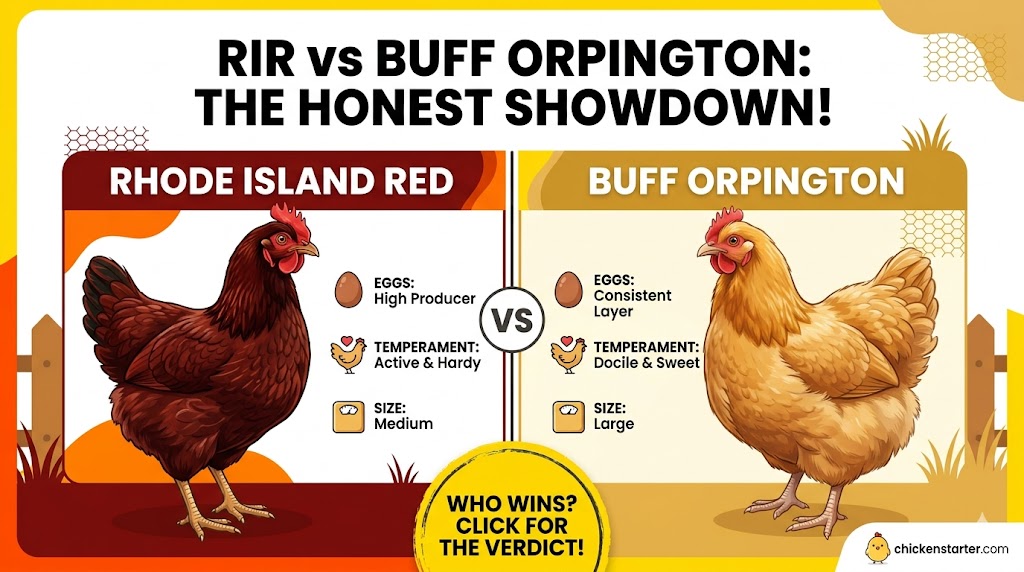
The Rhode Island Red vs Buff Orpington comparison comes down to what you actually need from your flock. Rhode Island Reds lay more eggs, with production strains reaching 250 to 300 per year, and they are more independent, better foragers, and more heat tolerant. Buff Orpingtons are friendlier, better with children, heavier for meat at 8 to 10 lbs, and more cold hardy thanks to their dense, fluffy feathering. But this simple answer hides the single most important factor most comparison guides completely ignore: the strain you buy changes everything.
A heritage Rhode Island Red from a dedicated breeder is a completely different bird than the production-strain “RIR” from your local feed store. The same is true for Buff Orpingtons. Exhibition lines and utility lines look different, lay different numbers of eggs, and behave differently. This guide compares both strains where the distinction matters.
| Category | Rhode Island Red | Buff Orpington | Winner |
|---|---|---|---|
| Egg Production | 200 to 300/year (strain-dependent) | 150 to 280/year (strain-dependent) | 🏆 RIR |
| Egg Color | Medium to dark brown | Light brown with pinkish tint | Tie (preference) |
| Egg Size | Large | Large to extra-large | 🏆 Orpington (slightly) |
| Temperament (Hens) | Independent, assertive, can bully | Docile, cuddly, family-friendly | 🏆 Orpington |
| Temperament (Roosters) | Variable, can be aggressive | Usually calm, gentle | 🏆 Orpington |
| Weight (Hens) | 6.5 lbs | 8 lbs | 🏆 Orpington |
| Weight (Roosters) | 8.5 lbs | 10 lbs | 🏆 Orpington |
| Meat Quality | Lean, moderate breast | Broad breast, tender, excellent | 🏆 Orpington |
| Cold Hardiness | Good | Excellent | 🏆 Orpington |
| Heat Tolerance | Good | Poor to moderate | 🏆 RIR |
| Foraging Ability | Excellent, active, self-sufficient | Good but less motivated | 🏆 RIR |
| Broodiness | Rarely broody | Frequently broody | Depends on goal |
| Beginner-Friendly | Moderate | Excellent | 🏆 Orpington |
| Predator Awareness | Very alert, quick | Less aware, slower | 🏆 RIR |
| Lifespan | 5 to 8 years (production); 8 to 10+ (heritage) | 5 to 8 years; up to 10 | Tie |
| Noise Level | Moderate to loud | Quiet to moderate | 🏆 Orpington |
| Feed Efficiency | Excellent (smaller body) | Moderate (larger body needs more) | 🏆 RIR |
The ONE Factor That Changes Everything: Heritage vs. Production Strains
This is the most important section of this entire guide. If you take one thing away from this Rhode Island Red vs Buff Orpington comparison, let it be this: the strain you buy matters more than the breed you choose.
Rhode Island Red: Two Very Different Birds
According to The Livestock Conservancy, since the 1940s, the Rhode Island Red has been selectively bred predominantly for egg-laying qualities. This breeding pressure created a split that fundamentally changed the breed into two distinct types.
Heritage Rhode Island Reds carry the deep, dark, lustrous mahogany plumage that the breed was originally known for. The color is so rich it can appear almost black in certain light, with a beetle-green sheen on the tail feathers. According to breed data from Oklahoma State University, the body is brick-shaped, meaning broad and long with a nearly horizontal back. Standard roosters weigh 8.5 lbs and hens 6.5 lbs. Heritage strains lay 150 to 250 eggs per year, are calmer and more docile than their production counterparts, more broody, and generally longer-lived with lifespans reaching 8 to 10 years or more. The Livestock Conservancy lists heritage strains on their priority list, making these birds of genuine conservation interest.
Production Rhode Island Reds are what most people actually get when they order “Rhode Island Reds” from a hatchery or buy them at a feed store. They are lighter in color, more of a rusty red-brown than the deep mahogany of heritage birds. The body is slimmer, less rectangular. They lay 250 to 300 eggs per year, which is impressive. But they tend to be more assertive, more flighty, and more aggressive than heritage strains. According to information from Grubbly Farms, production strain Rhode Island Reds also tend to be less hardy than heritage strains and have shorter productive lifespans of 5 to 8 years.
The difference between them is not subtle. As detailed in our complete Rhode Island Red chicken guide, the two types look different, perform differently, and have different conservation significance.
When people say “Rhode Island Reds are aggressive”, they are almost always talking about production strains. Heritage RIRs are noticeably calmer. When people say “RIRs lay 300 eggs a year,” they are talking about production strains. Heritage birds will not hit that number.
Before you compare a Rhode Island Red to anything, you need to know which type you are actually comparing.
Buff Orpington: Exhibition vs. Utility
The same strain split exists in Buff Orpingtons, though it is less dramatic.
Exhibition Buff Orpingtons are the enormous, magnificently fluffy birds you see at poultry shows. According to Wikipedia’s Orpington entry, it was once said that Orpingtons were capable of laying as many as 340 eggs per year. The decline in production was due to breeders selecting for looks over utility. Modern exhibition Orpingtons lay closer to 150 to 180 eggs per year. They are extremely broody and can spend months sitting on eggs. Some exhibition cocks exceed 12 lbs with their full plumage.
Utility or hatchery Buff Orpingtons are what most backyard keepers buy. They are still large and fluffy, but less extreme in feathering. They produce 200 to 280 eggs per year according to data from The Chick Hatchery. They are still broody, but less intensely so. These are the birds that balance the breed’s famous temperament with practical egg production.
The bottom line? When you read egg production numbers that seem wildly different across sources, this is why. A website quoting 150 eggs per year is probably talking about exhibition stock. A website quoting 280 is probably talking about utility hatchery stock. Both are correct for their respective strains.
Rhode Island Red vs Buff Orpington Egg Production: Which Lays More?
Rhode Island Reds win on egg production, and the margin is significant. But the actual numbers depend entirely on which strains you are comparing.
| Factor | RIR (Heritage) | RIR (Production) | Buff Orp (Exhibition) | Buff Orp (Utility) |
|---|---|---|---|---|
| Eggs Per Year | 150 to 250 | 250 to 300 | 150 to 180 | 200 to 280 |
| Eggs Per Week | 3 to 4 | 5 to 6 | 3 | 4 to 5 |
| Start Laying | 20 to 24 weeks | 18 to 20 weeks | 22 to 26 weeks | 20 to 24 weeks |
| Winter Laying | Good | Excellent | Good | Good |
| Broodiness Impact | Minimal | Minimal | Significant | Moderate |
| Strong Production Years | 3 to 4 years | 2 to 3 years | 3 to 4 years | 3 years |
According to information from Heritage Acres Market, the heritage type Rhode Island Red is a good layer of between 150 to 250 eggs a year, while the production birds will lay more, around 250 to 300 eggs per year. They start laying from around 18 to 22 weeks of age. On the Orpington side, Backyard Poultry and other breed references consistently place utility Buff Orpington production at 200 to 280 eggs per year.
Egg Color Differences
Both breeds lay brown eggs, but the shade is noticeably different.
Rhode Island Red eggs are typically a medium to dark brown. According to data from My Pet Chicken, the eggshells are usually a medium brown color, though the exact shade varies among individual hens. Heritage RIRs tend to produce a slightly richer brown than production strains.
Buff Orpington eggs are light brown, sometimes with a subtle pinkish tint that makes them distinctive. Several breed profiles describe the color as “pinkish-brown” or “tinted brown.”
If you want the darkest brown eggs between these two breeds, Rhode Island Reds produce noticeably darker shells.
Egg Size
Both lay large eggs. However, mature Buff Orpingtons tend to produce slightly larger eggs over time due to their bigger body size. According to The Chick Hatchery, Buff Orpingtons produce large brown eggs, and the Livestock Conservancy lists the Orpington’s egg size as large to extra-large.
For the full picture on maximizing your flock’s egg output, see our guide on eggs from backyard chickens. And if production drops off, our article on why chickens stop laying eggs covers the most common causes.
Winner: Rhode Island Red, decisively. A production RIR will out-lay a Buff Orpington by 50 to 100+ eggs per year. Even comparing heritage RIR to utility Orpington, the RIR typically edges ahead. For dedicated egg production, our guide on Buff Orpington egg production gives the complete picture.
Rhode Island Red vs Buff Orpington Temperament: Are RIRs Really Mean?
Buff Orpingtons win on temperament. This is not close. But the full story is more nuanced than “Orpingtons are nice, RIRs are mean.”
Rhode Island Red Temperament: The Full Truth
Rhode Island Reds are independent, confident, and assertive. In a mixed flock, they typically rank near the top of the pecking order. They are not lap chickens for most people.
According to information from Oklahoma State University, some “Red” males may be quite aggressive. That is a breed-authority source using careful language to describe what many owners experience more bluntly. According to The Livestock Conservancy, some roosters may be aggressive at times, though most hens are peaceful.
Here is the nuance that matters. As documented by Grubbly Farms, if you want calm, docile, and friendly Rhode Island Reds, seek out heritage or standard-bred birds. Production-strain RIRs tend to be more flighty, more assertive, and more prone to human-directed aggression, particularly in roosters.
Rhode Island Red hens, especially production strains, will assert themselves strongly over gentler breeds. As described in our Rhode Island Red chicken guide, dominance in mixed flocks can become a real management problem. RIR hens will follow docile breeds away from feeders repeatedly, creating a situation where the gentle birds lose condition despite adequate food being available.
Are they “mean”? Not inherently. Are production-strain RIRs more assertive and sometimes aggressive than the average backyard breed? Yes.
Buff Orpington Temperament: The Golden Retriever of Chickens
Buff Orpingtons are basically the golden retriever of the chicken world. They are calm, gentle, curious, and genuinely enjoy human company.
According to Tractor Supply’s breed guide, Orpingtons are known for their calm, docile personalities, making them ideal for mixed flocks. They are excellent with children and handle social interactions with ease. Owner reports from BackYard Chickens consistently describe them as birds that hop onto laps, purr when rubbed behind the ears, and fall asleep in their keeper’s arms.
The downside of their docility is real. According to Tractor Supply, Orpingtons might not be able to defend themselves against dominant breeds. In a mixed flock with RIRs, the Orpingtons will almost always be lower in the pecking order.
What Chickens Get Along With Rhode Island Reds?
If you already have RIRs or plan to get them, the best companions are other assertive but non-aggressive breeds. Plymouth Rocks, Wyandottes, Australorps, and Sussex are excellent matches. As discussed in our guide to the Australorp chicken, that breed has a similar confident temperament without the aggression.
Breeds to avoid mixing with RIRs include Silkies, Polish, Faverolles, and most bantams. Any breed that is very docile or has vision-impeding feathering will struggle.
Can you mix RIRs and Buff Orpingtons? Yes. But it requires management. More on that in the mixed flock section below. For strategies, see our guide on pecking order problems.
Winner: Buff Orpington, overwhelmingly. If you have children, want lap chickens, or value a calm flock, Orpingtons are the clear choice. RIRs are better if you want independent, no-nonsense foragers that can hold their own. See our Orpington chicken pros and cons guide for more detail.
Rhode Island Red vs Buff Orpington Size: How Big Do They Get?
Buff Orpingtons are significantly larger than Rhode Island Reds. They outweigh RIRs by 1.5 to 2 lbs in every category.
| Measurement | Rhode Island Red | Buff Orpington |
|---|---|---|
| Rooster (Standard) | 8.5 lbs | 10 lbs |
| Hen (Standard) | 6.5 lbs | 8 lbs |
| Cockerel | 7.5 lbs | 8.5 lbs |
| Pullet | 5.5 lbs | 7 lbs |
| Body Shape | Rectangular, athletic, lean | Broad, round, fluffy |
| Visual Impression | Medium-large, muscular | Large, soft, pillowy |
| Skin Color | Yellow | White |
| Leg Color | Yellow | Pinkish-white |
According to APA standards documented by The Chick Hatchery, Buff Orpington roosters reach 10 lbs with hens at 8 lbs, while Rhode Island Red roosters reach 8.5 lbs and hens 6.5 lbs.
Orpingtons appear even larger than they actually are because of their profuse, fluffy feathering. According to The Chick Hatchery’s breed profile, they are sometimes called “Big Buffs” because they are loosely feathered and appear to be heavier than their true weight. Underneath the fluff, the actual body is not as massive as it looks, but it is still significantly larger than an RIR.
Rhode Island Reds have a completely different visual profile. Their body is brick-shaped and rectangular with dense, tight feathering. They look athletic and purposeful where Orpingtons look soft and round.
Winner: Buff Orpington. They are 1.5 to 2 lbs heavier across the board, with a broader, meatier frame. For more on size and what it means for housing, see our guide on how big should a chicken coop be.
Buff Orpington Rooster vs Rhode Island Red Rooster: Which Is Safer Around Families?
This is one of the most searched comparisons in the backyard chicken world, and the answer is clear.
Rhode Island Red Rooster Profile
The Rhode Island Red rooster is a strikingly handsome bird. Deep mahogany plumage with iridescent green-black tail feathers, a proud single or rose comb, and a confident bearing. He weighs approximately 8.5 lbs at maturity.
According to multiple breed authorities including Oklahoma State University and The Livestock Conservancy, RIR roosters have a documented tendency toward aggression. Not all are aggressive. Some are perfectly calm and manageable. But the breed has a higher percentage of aggressive roosters than most popular backyard breeds. The Chick Hatchery’s profile states simply: “Roosters may become aggressive.”
This is especially true for production strains. As noted in our Rhode Island Red guide, heritage-bred roosters tend to have more measured temperaments. But with any individual RIR rooster, you are rolling dice that are slightly weighted toward assertive behavior.
Buff Orpington Rooster Profile
The Buff Orpington rooster is an impressive bird purely on size. At 10 lbs with full golden-buff plumage and a broad, solid build, he has genuine physical presence.
But he is usually a gentle giant. Orpington roosters are frequently described as among the calmest roosters of any breed. According to Cackle Hatchery’s exhibition Orpington listing, these massive chickens in general have a calm disposition. Owner reports from BackYard Chickens consistently describe Buff Orpington roosters as protective without being aggressive toward humans.
They will step between a hen and a perceived threat. They will alarm-call when a hawk flies over. But they rarely chase children or attack their keepers.
The Family Safety Verdict
If you have young children and want a rooster, a Buff Orpington rooster is the safer choice by a significant margin. This is not to say every RIR rooster will attack your kids. But the statistical likelihood of rooster aggression is meaningfully higher in Rhode Island Reds.
If you are unsure whether you even need a rooster, our guide on whether you need a rooster to get eggs covers that question. And for other calm rooster options, see our Brahma chicken rooster and Ameraucana rooster temperament guides.
Can You Keep Buff Orpingtons and Rhode Island Reds Together?
Yes, you can keep them together successfully. But you need to manage the dynamic intentionally.
What to Expect
Rhode Island Reds will almost certainly rank above Orpingtons in the pecking order. This is normal. Orpingtons typically accept a lower rank without much fuss.
The risk is that RIRs can cross the line from normal pecking-order enforcement to sustained bullying. Feather-pulling on Orpingtons’ fluffy backs is the most common problem. In serious cases, RIRs can prevent Orpingtons from eating, drinking, or accessing the coop.
Six Rules for a Successful Mixed Flock
Space is everything. Provide a minimum of 4 square feet per bird inside the coop and 10+ square feet per bird in the run. Cramped conditions amplify aggression. See our guide on how much space chickens really need for detailed calculations.
Multiple feeding and watering stations. Install at least two of each, placed far enough apart that a dominant RIR cannot guard both simultaneously. This ensures your Orpingtons can always eat without confrontation.
Introduce simultaneously if possible. Bringing both breeds home at the same age as chicks is the smoothest integration method. Adding one breed to an established flock of the other creates more conflict.
Watch closely for two weeks. Monitor the flock during the first 14 days of integration. Normal pecking-order scuffles involve brief chasing and posturing. Separate any bird drawing blood immediately.
Provide hiding spots and visual barriers. Orpingtons need escape routes when RIRs get pushy. Pallets leaned against walls, bushes in the run, and multiple shelters create line-of-sight breaks that reduce confrontation.
Avoid keeping a single Orpington with multiple RIRs. One Orpington in a flock of Rhode Island Reds will be relentlessly targeted. Keep at least three Orpingtons so the attention gets distributed.
For comprehensive integration strategies, see our complete guide on pecking order problems and how to stop bully hens.
Rhode Island Red × Buff Orpington Cross: What Do You Get?
This is the section no other Rhode Island Red vs Buff Orpington comparison covers, despite significant search demand. People cross these two breeds all the time, and the results are genuinely interesting.
The Sex-Link Genetics Connection
Both the Rhode Island Red and the Buff Orpington carry what geneticists call “gold” plumage genes. According to information from Backyard Poultry magazine, sex-linked hybrid chickens are created by crossing a gold-plumage rooster with a silver-plumage hen. Both RIRs and Buff Orpingtons are gold-based, meaning crossing them with each other does not produce true sex-linked offspring.
However, Rhode Island Reds are a foundation breed for many commercial sex-link hybrids. According to the same source, red sex-links result from crossing a Rhode Island Red or New Hampshire Red male over White Plymouth Rock, Rhode Island White, Silver Laced Wyandotte, or Delaware females. These crosses produce the popular Golden Comet, Golden Buff, Red Star, and Cinnamon Queen hybrids sold at hatcheries nationwide.
Per Wikipedia’s Golden Comet entry, the Golden Comet specifically is a cross between a female White Rock or Rhode Island White and a male New Hampshire Red chicken. These hybrids can lay an astonishing 250 to 330 eggs per year.
What an RIR × Buff Orpington Cross Actually Produces
When you cross a Rhode Island Red rooster directly with a Buff Orpington hen, you get first-generation (F1) hybrid offspring with these general characteristics:
Appearance. Hens are typically golden-red, somewhere between the parents in color. They are larger than Rhode Island Reds but leaner than Orpingtons.
Egg production. F1 crosses often exhibit hybrid vigor, producing 250 to 300+ eggs per year with excellent consistency.
Temperament. The Orpington influence generally mellows the RIR assertiveness. These crosses are usually calmer than production RIRs but more active and alert than purebred Orpingtons.
Egg color. Medium brown.
Why People Cross Them
Hybrid vigor. F1 crosses often out-produce both parents in eggs per year.
Temperament blend. You get the RIR’s foraging drive and hardiness with the Orpington’s calmer disposition.
Best of both worlds. Better egg production than a purebred Orpington, friendlier than a production RIR.
The Important Catch
F1 crosses do not breed true. If you cross two F1 hybrids together, the offspring will be genetically unpredictable. Some will look and perform like one grandparent, some like the other, some like neither.
Hybrid vigor is strongest in the first generation only. It diminishes in subsequent crosses.
Production longevity is also shorter. Hybrids that produce at high rates often burn out faster than purebreds. Expect 2 to 3 years of heavy production versus 4+ years for heritage birds.
If you are interested in hatching your own, see our guides on the best chicken egg incubators for beginners and how to tell if an egg is fertile.
Are Rhode Island Reds or Buff Orpingtons Better for Meat?
Buff Orpingtons win for meat production, and it is not close. The breed was literally designed for the table.
According to Wikipedia, the original Black Orpington was created by William Cook in the 1880s in Orpington, Kent, England. He crossed Minorcas, Langshans, and Plymouth Rocks to create a new dual-purpose bird. Cook specifically chose black as a colour that would not show the soot and grime of London. But the breed’s primary selling point was its outstanding table qualities.
According to the Livestock Conservancy, Cook wanted to create a practical, dual-purpose bird that could produce both quality meat and a steady supply of eggs while thriving in England’s damp, cool climate. Farmers of the midwestern United States favored the Buff Orpington for its generally superior table qualities and its unique golden color.
Rhode Island Reds, by contrast, were developed primarily as egg layers in Rhode Island and Massachusetts. According to The Livestock Conservancy, the originators wanted a bird that could lay a good number of eggs and dress out nicely, but the emphasis was always on egg production.
| Factor | Rhode Island Red | Buff Orpington |
|---|---|---|
| Dressed Weight (Rooster) | ~5.5 to 6.5 lbs | ~7 to 8 lbs |
| Time to Table Weight | 16 to 20 weeks | 18 to 22 weeks |
| Breast Meat | Moderate | Abundant, broad |
| Meat Texture | Lean, slightly firm | Tender, juicy |
| Skin Color | Yellow | White |
| Ease of Plucking | Standard | Easier (looser feathering) |
Winner: Buff Orpington, clearly. They are heavier, broader-breasted, and were literally created to be a premium table bird. RIRs produce respectable meat but were bred as egg specialists first. For more on the Orpington’s meat qualities, see our guide on whether Buff Orpingtons are good for meat.
Cold Hardy vs. Heat Tolerant: Which Breed Suits Your Climate?
Cold Hardiness
Buff Orpingtons are one of the most cold-hardy breeds available. Their dense, fluffy feathering provides outstanding insulation. According to The Chick Hatchery, they are very cold hardy and do well in northern climates. Owners in Connecticut, Wisconsin, Minnesota, and throughout Canada consistently report Orpingtons handling brutal winters without issue, provided the coop is dry and ventilated.
Rhode Island Reds are good in cold weather, but not exceptional. According to data from Grubbly Farms, heritage strains with their thicker feathering are more cold hardy, while production strains with smaller body frames and lighter feathering are less insulated.
Both breeds have single combs that can be vulnerable to frostbite in extreme cold. See our guide on preventing and treating frostbite on chicken combs.
Heat Tolerance
Rhode Island Reds handle heat better. Their leaner bodies and tighter feathering allow more efficient heat dissipation. According to multiple sources, they are hardy across a wide range of temperatures. The breed thrives in environments from below freezing to above 100°F.
Buff Orpingtons struggle in heat. Their thick, fluffy feathering that makes them excellent in cold becomes a serious liability in hot weather. According to Rural Living Today, these chickens need regular access to shade, clean drinking water, and ventilation during warmer months to keep from overheating. They can suffer heat stress above 85°F (29°C) if shade and water are not adequate.
Regional Recommendations
| Region | Better Breed | Why |
|---|---|---|
| Northern US and Canada | Buff Orpington | Superior cold insulation |
| Southern US (TX, FL, AZ, GA) | Rhode Island Red | Better heat tolerance |
| Midwest US | Either breed | Both handle seasonal extremes |
| United Kingdom | Buff Orpington | Cool, damp climate matches Orpington’s English origins |
| Australia | Rhode Island Red | Heat tolerance is critical |
| Temperate climates | Either or both | Both perform well in moderate conditions |
For climate-specific guidance, see our guides on raising chickens in cold climates, raising chickens in hot, humid climates, best heat-tolerant chicken breeds, and winterizing your chicken coop.
Which Breed Costs Less to Keep? Feed Efficiency and Foraging Compared
Rhode Island Reds are more feed-efficient. A smaller body requires less maintenance energy, and they are significantly better foragers.
Rhode Island Reds are among the most active foragers of any popular breed. According to information from Mile Four, they are the first birds out of the coop in the morning and are constantly on the move, hunting insects, scratching through mulch, and covering every inch of available range.
Buff Orpingtons forage, but with less urgency. According to Mile Four’s breed guide, Orpingtons love to eat and will beg for food if you are eating outside with the chickens. They tend toward the heavy side, which makes them lazy and prone to obesity without management.
| Factor | Rhode Island Red | Buff Orpington |
|---|---|---|
| Daily Feed (Confined) | ~1/3 lb (~120g) | ~3/8 lb (~140 to 150g) |
| Annual Feed (Confined) | ~120 lbs | ~135 to 140 lbs |
| Annual Feed (Free-Range) | ~85 to 95 lbs | ~110 to 120 lbs |
| Feed Cost Reduction w/ Foraging | 20 to 30% | 15 to 20% |
Winner: Rhode Island Red. They eat less, need less, and offset more of their diet through foraging. For detailed cost analysis, see our chicken feed calculator and cost guide and our guide on the real cost of 6 chickens.
Chickens That Look Like Rhode Island Reds
If you like the Rhode Island Red’s appearance but want a different breed, several options share that deep-red plumage:
New Hampshire Red. Lighter, more orange-red than an RIR. Originally bred directly from Rhode Island Red stock for faster maturity and earlier egg production. Slightly less productive but matures faster.
ISA Brown. A commercial hybrid that resembles a lighter RIR. Extremely high production at 300+ eggs per year but burns out in 2 to 3 years. Not a true breed.
Production Red. A generic hatchery term for RIR-type birds that may not be purebred. Often lighter in color with inconsistent body type.
Red Star and Golden Comet. Sex-link hybrids with RIR genetics. Look similar but are crosses, not breeds. Outstanding layers but short productive lifespans.
Welsummer. Similar partridge-red coloring but with gorgeous dark, speckled eggs. Different body shape and temperament.
Barnevelder. Double-laced brown pattern that can resemble darker RIRs from a distance. Dutch origin with stunning feather patterns.
Red Orpington. A rare Orpington color variety that is not the same as a Rhode Island Red. It has the Orpington’s large, fluffy body type in red plumage. They are uncommon and primarily found through specialty breeders.
For more on related breeds, see our Barred Rock chicken guide and our dedicated Rhode Island Red chicken guide.
Should YOU Get Rhode Island Reds or Buff Orpingtons?
Choose Rhode Island Reds If:
You want maximum egg production as your top priority. You prefer independent, low-maintenance birds that do not need constant attention. You free-range and want active, efficient foragers. You live in a hot climate where heat tolerance matters. You want a breed that can hold its own against minor predator threats. You want to keep feed costs low. You don’t mind assertive birds that run the flock.
Choose Buff Orpingtons If:
You have children and want a family-friendly pet chicken. Temperament matters more to you than egg count. You want a dual-purpose breed with excellent meat potential. You live in a cold climate where winter hardiness is important. You want chickens that enjoy being held and cuddled. You want a quieter flock for suburban or residential settings. You are interested in hatching eggs naturally since Orpingtons readily go broody. You are a complete beginner and want forgiving, easy-to-manage birds.
Choose Both If:
You have adequate space with 10+ square feet per bird in the run. You want both high egg production and family pets. You can provide multiple feeding stations to prevent resource guarding. You enjoy breed diversity and a colorful, interesting flock. You live in a temperate climate suitable for both breeds.
Choose the Cross If:
You want hybrid vigor producing more eggs than either purebred parent. You want sex-link capability when crossing with appropriate breeds. You want a temperament blend between the two breeds. You don’t plan to breed further generations from the offspring.
For beginners still deciding, see our guide on the easiest chicken breeds for beginners. For flock sizing, check out how many chickens you need for a family of 4. And if you need to convince a reluctant household member, we have a guide for how to convince your spouse to get chickens.
Frequently Asked Questions
How many eggs per year do Rhode Island Reds lay vs Buff Orpingtons?
Production-strain Rhode Island Reds lay 250 to 300 eggs per year, while heritage strains produce 150 to 250. Utility Buff Orpingtons lay 200 to 280 per year, with exhibition strains closer to 150 to 180. Rhode Island Reds consistently out-produce Buff Orpingtons by 50 to 100+ eggs annually, especially in production strains.
Are Rhode Island Red chickens mean?
Not inherently, but production-strain RIRs are more assertive and can bully docile breeds in mixed flocks. Heritage RIRs are calmer. RIR roosters have a higher incidence of human-directed aggression than most popular breeds, according to multiple breed authorities. Buff Orpingtons, by contrast, are among the most docile chickens available.
Do Buff Orpingtons and Rhode Island Reds get along?
Yes, they can live together successfully with adequate space (10+ square feet per bird in the run), multiple feeding stations, and at least three Orpingtons to prevent any single bird from being singled out. RIRs will rank higher in the pecking order. Monitor closely during the first two weeks of integration and separate any bird drawing blood.
What happens when you cross a Rhode Island Red with a Buff Orpington?
An RIR rooster crossed with a Buff Orpington hen produces first-generation hybrid offspring that often exhibit hybrid vigor with 250 to 300+ eggs per year and a temperament blend between both parents. However, this specific cross does not produce sex-linked chicks because both breeds carry gold-plumage genetics. F1 crosses do not breed true in subsequent generations.
Which is better for beginners?
Buff Orpingtons are better for beginners, especially families with children. Their docile temperament, tolerance for handling, and calm nature make them more forgiving of beginner mistakes. Rhode Island Reds are better for keepers who prioritize egg production and want independent, low-maintenance birds.
What color eggs do Rhode Island Reds lay vs Buff Orpingtons?
Both lay brown eggs, but RIR eggs are typically a richer, darker brown while Orpington eggs are lighter brown, sometimes with a subtle pinkish tint. Neither breed lays white, blue, or green eggs.
Are Rhode Island Red chickens good for meat?
They produce respectable meat but are bred primarily as egg layers. Buff Orpingtons are the better meat bird, being 1.5 to 2 lbs heavier at maturity with broader breasts and more tender meat. The Orpington was specifically created by William Cook in 1886 as a premium dual-purpose table bird.
What is a Red Orpington?
A Red Orpington is a rare color variety of the Orpington breed. It is not a Rhode Island Red. It has the Orpington’s large, fluffy body type in red plumage with white skin and a calm temperament. Red Orpingtons are uncommon and primarily found through specialty breeders. Do not confuse them with Rhode Island Reds, as they are genetically and physically different breeds.
The Final Verdict
| Your Priority | Get This Breed |
|---|---|
| Most eggs possible | Rhode Island Red (production strain) |
| Family-friendly pets | Buff Orpington |
| Best meat bird | Buff Orpington |
| Hottest climates | Rhode Island Red |
| Coldest climates | Buff Orpington |
| Lowest feed costs | Rhode Island Red |
| Quietest flock | Buff Orpington |
| Safest rooster | Buff Orpington |
| Best forager | Rhode Island Red |
| Heritage conservation | Either (heritage strains of both) |
| Best of both worlds | RIR × Buff Orp cross |
| Can’t decide | Get both (with adequate space) |
Both of these breeds have earned their place among the most popular chickens in the world. The Rhode Island Red is America’s ultimate production bird, a tough, independent, prolific layer that thrives on minimal fuss. The Buff Orpington is the breed that turns non-chicken people into chicken people, a warm, cuddly, golden bird that lays well, produces excellent meat, and makes every visitor to your coop smile.
The best flocks often contain both. Just give them enough space, manage the pecking order, and enjoy the best of two remarkable breeds.
Want the complete deep-dive on each breed individually? Check out our dedicated Rhode Island Red Complete Guide and Buff Orpington Complete Guide. Ready to start your flock? See our guide on the cost to raise chickens for the first year.
Note: Individual bird temperament varies regardless of breed. The descriptions in this guide reflect breed tendencies documented across multiple sources and owner reports, not guarantees for any specific bird. Always source birds from reputable breeders or hatcheries.

Oladepo Babatunde is the founder of ChickenStarter.com. He is a backyard chicken keeper and educator who specializes in helping beginners raise healthy flocks, particularly in warm climates. His expertise comes from years of hands-on experience building coops, treating common chicken ailments, and solving flock management issues. His own happy hens are a testament to his methods, laying 25-30 eggs weekly.