If you are here because your chicken just ate some avocado, skip straight to the Emergency Response section below.
For everyone else, this is the one treat article where my answer is fundamentally different from every other food I have covered on this site.
Every other treat guide I have written, including blueberries, apples, corn, carrots, cheese, and celery, has been some variation of “yes, with these caveats.” Avocado is the exception. It contains a toxin called persin that can damage a chicken’s heart muscle and cause death within 24 to 48 hours.
But the full story is more complicated than “never feed avocado.” The concentration of persin varies dramatically between the skin, pit, leaves, and flesh. Some experienced keepers feed ripe flesh without incident. Published studies primarily used leaf extract, not flesh. And commercially processed avocado oil may have persin removed entirely.
This guide covers all of it. Honestly, with sources, and without false guarantees.
Can Chickens Eat Avocado? The Safest Answer Is No
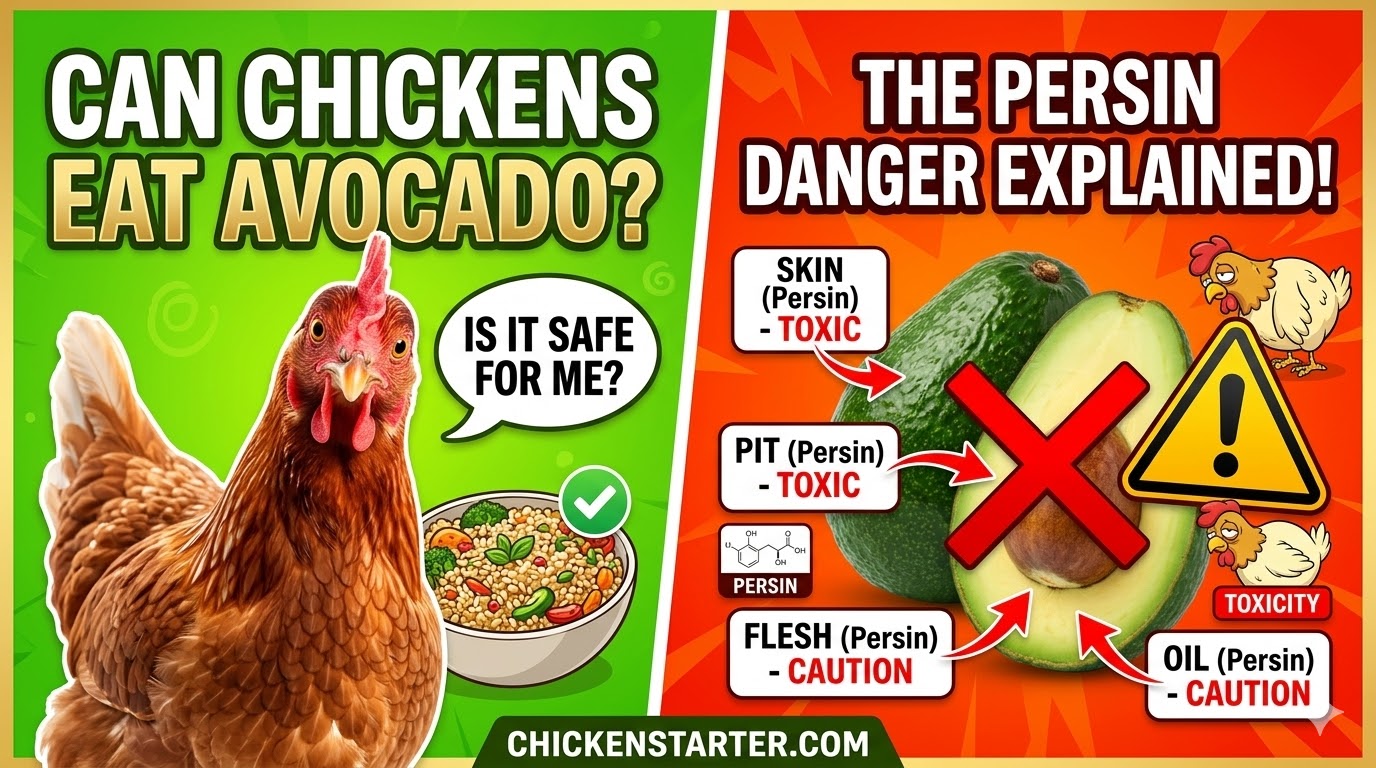
⚠️ Quick Answer: The safest recommendation is no, do not feed avocado to your chickens. Avocado contains a fungicidal toxin called persin that is toxic to birds. According to the Merck Veterinary Manual, ingestion of avocado fruit, leaves, stems, and seeds has been associated with toxicosis in animals, and leaves are the most toxic part. The Guatemalan varieties of avocado have been most commonly associated with toxicosis.
In birds, persin causes myocardial necrosis (death of heart muscle cells), respiratory distress, subcutaneous edema, and death. Symptoms can develop as quickly as 15 to 30 minutes after ingestion or be delayed up to 30 hours. The flesh contains lower concentrations than the skin, pit, or leaves, and some keepers report feeding small amounts without incident, but no amount of avocado is guaranteed safe for chickens. There are dozens of safer, more nutritious treats available. When in doubt, do not risk it.
What Is Persin? The Toxin That Makes Avocado Dangerous
Persin is a natural fungicidal toxin produced by the avocado tree (Persea americana) as a defense mechanism against fungal pathogens. According to Wikipedia’s well-sourced entry on persin, it is an oil-soluble compound structurally similar to a fatty acid, and it leaches into the body of the fruit from the seeds. Its chemical classification is an acetogenin, derived from the biosynthesis of long-chain fatty acids.
How Persin Damages a Chicken’s Body
According to the Merck Veterinary Manual, when purified persin is administered to animals, it causes mastitis (mammary gland inflammation) in lactating mice at 60 to 100 mg/kg, and doses greater than 100 mg/kg result in myocardial necrosis, the death of heart muscle cells.
In birds, persin targets the heart and respiratory system. The heart essentially loses its ability to pump effectively. Fluid accumulates around the heart (hydropericardium), in the lungs (pulmonary edema), and in the abdominal cavity. Death follows from respiratory failure as fluid fills the chest.
According to ChickenDVM, a veterinary resource specializing in poultry health, clinical signs of toxicity vary widely and may develop as quickly as 15 to 30 minutes after ingestion of the fruit, but may also be delayed up to 30 hours. Once respiratory signs develop, death will usually follow quickly.
Are Chickens More or Less Sensitive Than Other Birds?
This is an important nuance. According to the Merck Veterinary Manual, caged birds seem more susceptible to the effects of avocado, whereas chickens and turkeys seem more resistant. This does not mean chickens are immune. It means they may tolerate slightly more than a budgerigar or canary before showing symptoms. They are still susceptible to toxicity.
Which Parts of the Avocado Are Toxic? A Part-by-Part Breakdown
Not all parts of the avocado contain the same amount of persin. The concentration follows a clear gradient, from extremely dangerous to relatively low.
| Part | Persin Level | Safe for Chickens? | Details |
|---|---|---|---|
| Leaves | Highest | ❌ Never | The leaves are the most dangerous part of the avocado plant, containing between 0.9 and 1% persin according to Nutri.it. Studies feeding avocado leaves to birds caused severe cardiac damage and death |
| Bark and stems | Very high | ❌ Never | Contains high persin. Relevant if you have avocado trees and free-ranging chickens |
| Skin/peel | Very high | ❌ Never | The skin contains significantly higher concentrations than the flesh. Never feed avocado skin to chickens |
| Pit/seed | High | ❌ Never | Contains significant persin. Also a choking hazard and hard enough to damage the crop |
| Unripe flesh | Moderate to high | ❌ Never | Persin concentration is highest in unripe fruit and decreases as the fruit ripens |
| Ripe flesh | Low (but present) | ⚠️ Debated. See below | The flesh has lower concentrations. Some keepers feed small amounts without incident. No amount is guaranteed safe |
| Avocado oil (refined) | Negligible or none | ✅ Likely safe | Processing removes persin. Published research on processed avocado meal shows no clinical signs of toxicity |
| Guacamole | Low (flesh) + harmful additives | ❌ Never | Even if flesh persin were not a concern, guacamole contains salt, onion, and garlic, all harmful to chickens |
The persin concentration gradient, from highest to lowest: Leaves > Bark > Skin/Peel > Pit > Unripe Flesh > Ripe Flesh > Refined Oil.
Variety Matters
According to the Merck Veterinary Manual, the Guatemalan varieties of avocado have been most commonly associated with toxicosis. The Hass avocado, which is the most common commercial variety in the United States, Canada, and Australia, is a Guatemalan-Mexican hybrid. Since most consumers cannot easily identify the variety of every avocado they purchase, the safest approach is to avoid all avocado for chickens.
The Great Flesh Debate: Can Chickens Eat Ripe Avocado Flesh?
This is the most controversial question in poultry feeding, and the internet is violently split. I want to present both sides fairly because your E-E-A-T trust depends on honesty, not oversimplification.
The “Absolutely Not” Perspective
According to the PangoVet veterinary team, the prevailing consensus in veterinary literature and poison control literature is to avoid avocado for all animals kept as pets, including chickens. There is no justifiable reason to feed your chickens avocado when there are other healthy, safe treats with plenty of helpful vitamins, minerals, and no toxicity concerns.
The flesh does contain persin, just at lower concentrations. As New Life on a Homestead explains, even if you are careful to remove all the skin and pits, there is still a risk of cross-contamination, and avocado flesh does contain trace amounts of the harmful compound. Though avocado flesh does not contain as much persin as the other parts of the fruit, there is still enough to potentially cause serious problems.
The risk-reward ratio is terrible. Avocado provides nothing chickens cannot get from safer treats.
The “Small Amounts of Ripe Flesh Are Fine” Perspective
On BackYardChickens.com, the largest chicken-keeping forum in the world, numerous experienced keepers report feeding ripe avocado flesh for years without incident. One member in Hawaii notes that wild chickens gobble up avocados that fall from trees with seemingly no ill effects. Another reports sharing one avocado among 20+ birds with no problems.
The studies that documented severe toxicity and death in birds almost exclusively used avocado leaves, bark, skin, and pit extract at high doses, not small amounts of ripe flesh in isolation. Persin concentration in the flesh is significantly lower than in other parts and decreases further as the fruit ripens.
The Scientific Middle Ground
Individual bird sensitivity varies. What one chicken tolerates may be toxic to another. Chicks and older or immunocompromised birds are especially vulnerable. There is no published study that specifically tests small amounts of ripe flesh (center only, away from the skin) in chickens and declares it “safe.”
My Personal Recommendation
My recommendation is simple: do not feed avocado to your chickens. Not because I am certain a tiny bit of ripe flesh will kill them, but because there are dozens of safer treats that provide better nutrition. Strawberries, blueberries, cucumbers, watermelon, carrots, corn. Your chickens will not miss avocado. The risk, however small, is not worth it when the alternatives are so abundant.
I have never intentionally fed avocado to my flock, and I never will. But I will be honest: my chickens free-range near my compost bin, and I have caught them pecking at avocado scraps twice. Both times, I removed the avocado immediately and watched them closely for 48 hours. Nothing happened. But I now keep a secure lid on the compost. The point is not that “nothing happened means it is safe.” The point is that I was lucky, and luck is not a feeding strategy.
What About Avocado Oil? The Surprising Exception
Here is the genuinely interesting nuance in the avocado story.
According to Heritage Acres Market, while all parts of the avocado are toxic due to persin, avocado oil does not contain persin. Several sources confirm that commercially refined avocado oil has persin removed during the extraction and refining process.
A PMC-published study (van Ryssen et al., 2013) on processed avocado meal in broiler chickens, referenced in a 2022 PMC analysis, found that studies testing avocado meal or defatted avocado pulp have found that it is a suitable fiber source and can affect blood cholesterol levels, digestibility of nutrients, and feed efficiency. No clinical signs of persin toxicity were exhibited in the study using processed avocado meal.
However, there is no practical reason to add avocado oil to your chickens’ diet. They get adequate fats from their layer feed. If you use avocado oil for cooking and have a trace amount left on a pan, it is unlikely to cause harm. But do not pour cold-pressed or unrefined avocado oil on their feed. Stick to refined only, and even then, question why you would bother when safer fat sources exist.
Avocado Trees and Free-Range Chickens: The Backyard Danger
This section is critical for readers in avocado-growing regions including California, Texas, Florida, parts of Australia, and tropical areas worldwide.
If you have an avocado tree in your yard and free-ranging chickens, you have a genuine risk that goes beyond kitchen scraps.
Fallen leaves are the highest persin source, and they accumulate under the tree continuously. According to data compiled by Nutri.it, avocado leaves contain between 0.9 and 1% persin, making them the most toxic part of the plant. Fallen or overripe fruit can split open on the ground, exposing the skin and pit. Chickens are naturally curious and will peck at anything on the ground.
How to Protect Your Flock
Fence off the area under your avocado tree. This is the simplest and most effective solution. A basic chicken wire barrier around the tree’s drip line keeps birds out of the danger zone.
Regularly clean fallen leaves and fruit before letting chickens into the area. Be especially vigilant after storms, which knock down leaves and unripe fruit.
If fencing is not possible, supervise free-range time and keep chickens away from the tree area. Consider limiting free-range access to areas you can control.
Educate everyone who interacts with your flock. Family members, neighbors, and visitors should know never to toss avocado scraps to the chickens.
What to Do If Your Chicken Ate Avocado (Emergency Response)
⚠️ Important: This section provides general information only and is not a substitute for professional veterinary advice. If your chicken has consumed avocado and is showing symptoms, contact a poultry veterinarian immediately.
Step 1: Do Not Panic. Assess What Was Eaten
Determine what part was consumed (flesh only versus skin, pit, or leaves). Estimate how much was eaten and how long ago it happened. If the bird only pecked at a small amount of ripe flesh, the risk is lower. If it consumed skin, pit, or leaves, the risk is significantly higher.
Step 2: Remove All Remaining Avocado Immediately
Take the avocado away from the flock. Check the area for other avocado scraps, including compost bins and trash.
Step 3: Isolate and Observe
Separate the chicken that ate avocado for easier monitoring. Provide fresh, clean water. Offer their regular layer feed.
Step 4: Monitor for Symptoms Over 48 Hours
| Timeframe | What to Watch For | Severity |
|---|---|---|
| 0 to 12 hours | May appear completely normal | Monitoring phase |
| 12 to 24 hours | Lethargy, fluffed feathers, loss of appetite | ⚠️ Early warning |
| 24 to 36 hours | Respiratory distress (open-mouth breathing, tail bobbing), weakness, inability to perch | 🚨 Urgent. Contact vet |
| 36 to 48 hours | Swollen abdomen (fluid accumulation), blue/purple comb (cyanosis), collapse | 🚨 Critical. Vet immediately |
According to ChickenDVM, some of the most common symptoms seen in birds include weakness, depression, reluctance to perch, ruffled feathers, and difficulty breathing.
Step 5: When to Call a Veterinarian
Call immediately if you observe any respiratory distress (labored breathing, open-mouth panting when the bird is not hot). Call if the chicken becomes noticeably lethargic or refuses all food and water. Call if the comb turns blue or purple. Call if the abdomen appears swollen. Call if the chicken consumed skin, pit, or leaves. See our guide on when to call the vet for a backyard chicken and how to tell if a chicken is sick.
Step 6: What NOT to Do
Do not try to induce vomiting. Chickens cannot vomit.
Do not give home remedies (charcoal, oil, etc.) without veterinary guidance. According to ChickenDVM, if avocado toxicity is recognized early enough after exposure (within 2 hours and before clinical signs develop), crop lavage followed by activated charcoal might be helpful, but this must be done by a veterinarian.
Do not assume “they look fine” means they are out of danger. Symptoms can be delayed 24 hours or more.
Do not Google for DIY treatments. According to the Merck Veterinary Manual, treatment is supportive and focused on managing clinical signs. There is no antidote for persin poisoning.
The hard truth: there is no antidote for persin toxicosis. Treatment is supportive, meaning fluids, warmth, quiet rest, and the chicken either recovers or does not. This is why prevention is so much more important than treatment.
Can Baby Chickens Eat Avocado?
Absolutely not. This is the one question where there is zero debate. Baby chicks are smaller, have underdeveloped organs, and are far more susceptible to toxins. The toxic threshold is proportional to body weight, meaning a chick weighing just a few ounces would need an incredibly tiny amount to reach toxicity.
Never allow chicks access to avocado in any form. See our must-haves for new chicks for safe chick-rearing guidance.
Why Avocado Is Not Worth the Risk: Better Alternatives
The core argument is simple: anything avocado provides, safer treats provide better.
| Nutrient | Avocado Provides | Safer Alternatives That Provide More |
|---|---|---|
| Healthy fats | 15g/100g | Sunflower seeds (51g), flaxseed (42g). Zero toxicity risk |
| Potassium | 485mg/100g | Bananas (358mg), sweet potato (337mg). Zero risk |
| Vitamin K | 21µg | Celery leaves (29µg), leafy greens (100+µg). Zero risk |
| Vitamin C | 10mg | Strawberries (59mg), bell peppers (80mg). Zero risk |
| Fiber | 6.7g | Pumpkin (3.5g + deworming seeds), apples (2.4g + pectin). Zero risk |
| Protein | 2g | Mealworms (20g), scrambled eggs (13g). Zero risk |
For every nutrient avocado provides, there is a safer treat that provides more of it with zero toxicity risk. See our complete guide to treats that boost egg laying and what chickens can eat from your kitchen for dozens of safe options.
Other Foods That Are Toxic to Chickens
Avocado is not the only dangerous food. Here is how it fits within the full spectrum of toxic foods:
| Toxic Food | Toxin | Effect on Chickens |
|---|---|---|
| Avocado (skin, pit, leaves) | Persin | Heart muscle damage, respiratory failure, death |
| Raw/dried beans | Phytohaemagglutinin | Can be fatal even in small amounts |
| Green/raw potatoes and skins | Solanine | Digestive and neurological damage |
| Apple/cherry/peach seeds and pits | Amygdalin (releases cyanide) | Cyanide poisoning. Requires large quantities. See our apple guide |
| Chocolate | Theobromine | Cardiac and respiratory failure |
| Onions (large amounts) | Thiosulphates | Destroys red blood cells (hemolytic anemia) |
| Rhubarb leaves | Oxalic acid | Kidney damage |
| Green tomatoes, leaves, vines | Solanine | Same as green potatoes |
| Moldy food (any kind) | Mycotoxins | Liver damage, immune suppression, death |
| Caffeine | Caffeine | Cardiac arrhythmia |
| Alcohol | Ethanol | Organ damage, death |
Note the spectrum: avocado and raw beans are the most dangerous items on this list because small amounts can be lethal. Apple seeds require enormous quantities (66 to 264 crushed seeds for a single hen) to reach toxicity. Context matters enormously. For the full breakdown, see our comprehensive feeding guide and what chickens eat.
Frequently Asked Questions
Is avocado okay for chickens to eat?
The safest answer is no. Avocado contains persin, a fungicidal toxin that damages the heart muscle of birds. According to the Merck Veterinary Manual, ingestion of avocado has been associated with toxicosis in chickens, turkeys, budgerigars, canaries, cockatiels, and ostriches. The skin, pit, and leaves contain the highest concentrations and should never be fed. The flesh contains lower levels, but no amount is guaranteed safe.
What will happen if my chicken eats avocado?
It depends on what part and how much. Small amounts of ripe flesh may cause no visible symptoms. Larger amounts, or any skin, pit, or leaf material, can cause avocado toxicosis. According to ChickenDVM, symptoms include weakness, depression, reluctance to perch, ruffled feathers, and difficulty breathing. Death can follow within 12 to 48 hours of ingestion.
Is avocado skin toxic to chickens?
Yes. Avocado skin contains very high concentrations of persin, second only to the leaves. Never feed avocado skin or peel to chickens under any circumstances.
Are avocado pits dangerous for chickens?
Yes. Avocado pits contain high persin levels and pose a physical choking and crop impaction hazard. Never allow chickens access to avocado pits.
Can chickens eat avocado oil?
Commercially refined avocado oil appears to have persin removed during processing and is likely safe based on available research. According to Heritage Acres Market, avocado oil does not contain persin. However, there is no practical reason to supplement chickens’ diets with avocado oil. Cold-pressed or unrefined avocado oil may retain trace persin and should be avoided.
What should I do if my chicken already ate avocado?
Remove any remaining avocado immediately. Isolate and observe the chicken for 48 hours. Watch for lethargy, respiratory distress (open-mouth breathing), loss of appetite, or swollen abdomen. If any symptoms appear, contact a poultry veterinarian immediately. There is no at-home antidote for persin poisoning. Treatment is supportive care only.
My chicken pecked at avocado and seems fine. Is it safe?
Not necessarily. Symptoms of persin toxicosis can be delayed 12 to 48 hours after ingestion. “Looking fine” in the first few hours does not mean the chicken is out of danger. Continue monitoring for a full 48 hours. Additionally, sub-lethal doses may cause heart damage that does not show obvious external symptoms but could affect long-term health.
Can Silkie chickens eat avocado?
No. Silkies are smaller than standard breeds, meaning the toxic threshold is reached with a smaller amount. Avocado is even more dangerous for small bantam breeds.
I have an avocado tree. How do I protect my free-range chickens?
Fence off the area under the tree. Regularly remove fallen leaves (highest persin concentration), fallen fruit, and dropped branches. Be especially vigilant after storms. If fencing is not possible, supervise free-range time and keep chickens away from the tree area.
Are there any birds that can safely eat avocado?
Toucans and some other tropical bird species have developed tolerance to persin, likely due to co-evolution with avocado trees in Central and South America. However, most domesticated birds, including chickens, ducks, turkeys, parrots, budgerigars, and canaries, are susceptible to persin toxicosis. Chickens and turkeys appear somewhat more resistant than caged pet birds, but they are still vulnerable.
The Bottom Line on Avocado and Chickens
Avocado is the one treat where the answer is genuinely “no.” The skin, pit, and leaves contain persin, a fungicidal toxin that damages the heart muscle of birds and can cause death within 24 to 48 hours.
The flesh debate exists, and I have presented both sides honestly. Some keepers feed ripe flesh without incident. But the risk-reward ratio is terrible when strawberries, blueberries, watermelon, corn, and dozens of other treats provide better nutrition with zero toxicity risk.
Refined avocado oil is the one exception with published safety data, but there is no practical reason to use it.
If your chicken ate avocado, remove it immediately, isolate and monitor for 48 hours, and contact a veterinarian if any symptoms appear. There is no antidote. Prevention is everything.
Secure your compost bins. Fence your avocado trees. Educate your family. And rest easy knowing your chickens have an enormous list of safe, nutritious treats they will love just as much.
For dozens of safe options, check out our complete guide to what chickens can eat from your kitchen, our complete diet guide, and our comprehensive feeding guide.

Oladepo Babatunde is the founder of ChickenStarter.com. He is a backyard chicken keeper and educator who specializes in helping beginners raise healthy flocks, particularly in warm climates. His expertise comes from years of hands-on experience building coops, treating common chicken ailments, and solving flock management issues. His own happy hens are a testament to his methods, laying 25-30 eggs weekly.