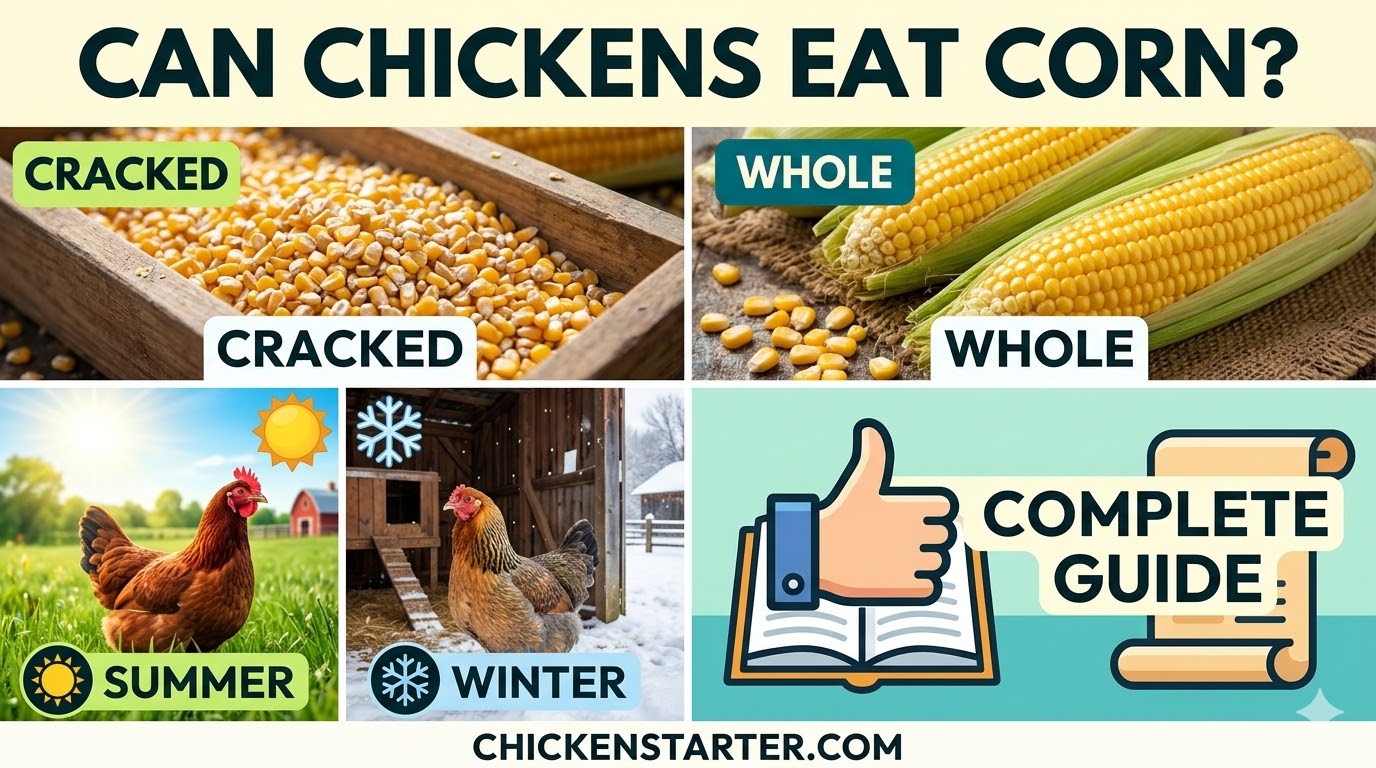
I was standing in Tractor Supply last November, staring at 50-pound bags of cracked corn and whole corn, completely confused. A fellow chicken keeper told me, “Only feed cracked. Whole corn will choke them.” The guy behind him said, “Cracked corn is trash. All the nutrients leach out.” Then a third person chimed in: “Never feed corn in summer. It will overheat your birds.” Three people, three completely different opinions. I bought both bags and spent the next year testing them side by side. What I discovered about nutrient retention, egg yolk color science, and the summer overheating myth changed how I feed my flock year-round.
But here is the fact that surprised me the most: your chickens are already eating corn every single day. According to poultry nutritional data published by Extension.org, corn is typically the cereal grain of choice for poultry feeds in the United States, making up 55 to 63% of most commercial formulations. When you toss extra corn into the run, you are adding on top of a diet that is already majority corn.
Can Chickens Eat Corn? Yes, and It Is Already the #1 Ingredient in Their Feed
Yes, chickens can eat corn in virtually every form: fresh kernels, corn on the cob, whole dried kernels, cracked corn, cornmeal, and even frozen corn. Corn is safe, non-toxic, and one of the most palatable treats you can offer a backyard flock.
Quick Answer: Chickens can safely eat corn in all common forms. According to data from Extension.org, corn provides approximately 3,350 kcal/kg of metabolizable energy and roughly 7.5% crude protein. It is already the #1 ingredient in most commercial chicken feeds, comprising 55 to 63% of the total formulation. As a supplemental treat, keep extra corn under 10% of total diet on top of their regular feed. All parts of the corn plant are safe, including kernels, cobs, husks, silk, and stalks. Fresh or frozen corn works best in summer. Dried or cracked corn is ideal as a late afternoon winter treat. Never feed moldy corn. Baby chicks can start with finely cracked corn at 3 to 4 weeks old, but starter feed must remain their primary nutrition.
My flock goes absolutely wild for corn, regardless of the form. Whole ears of corn on the cob generate the most excitement because they create a competition, a foraging challenge, and entertainment all in one. But understanding how much extra corn is appropriate requires knowing what is already in their feed, which most chicken keepers never think about. For a complete breakdown of everything chickens eat, see our comprehensive feeding guide.
Why Corn Is Already 60%+ of Your Chicken’s Feed (And Why That Matters)
This is the single most important fact most chicken owners do not know, and it changes the entire conversation about feeding supplemental corn.
According to the poultry nutrition experts at Extension.org, yellow dent corn is the variety typically used in poultry feed. Nutrient content varies from variety to variety and year to year, but recent averages suggest corn has about 1,520 kcal/lb (3,350 kcal/kg) of energy for poultry. It also has, on average, 7.5% crude protein. Corn protein is low in the amino acid methionine, so in the United States, corn is typically combined with soybean meal that is higher in methionine.
When I read the ingredient label on my Purina Layena bag, I was genuinely surprised: ground corn is listed as the #1 ingredient. A standard commercial layer feed formula looks something like this: roughly 62% maize (corn), 31% soybean meal, and the remaining 7% divided among calcium, phosphorus, vitamins, minerals, and additives. According to a 2024 analysis from Veterinaria Digital, corn grain constitutes between 50 and 70% of the diets of monogastric animals, primarily poultry and pigs, and between 70 to 80% of global corn production is used as a feed ingredient.
Why this matters for you: Your chickens are already eating a corn-based diet. When you add cracked corn or whole kernels as a “treat” on top of that, you are meaningfully increasing their total corn intake. This is precisely why the 10% treat rule is so important. They are already getting plenty of corn from their balanced feed. Supplemental corn is extra calories with minimal additional nutritional benefit. For a deeper look at how feed and scratch grains interact, see our guide to feed vs. scratch and our feed cost calculator.
How Corn Makes Your Egg Yolks Golden: The Xanthophyll Science
If you have ever noticed that your hens’ egg yolks look a bit pale, adding more corn to their diet can shift them to a beautiful, deep golden-orange. This color comes from natural pigments called xanthophylls, a type of carotenoid found in yellow corn. These pigments are deposited directly into the fat of the egg yolk. The more xanthophylls a hen consumes, the richer the color of her yolks.
What the Research Shows
A 2021 study published in Poultry Science (Ortiz et al.) and indexed on PubMed tested three corn types on 360 laying hens over 31 days: white corn, standard yellow corn, and biofortified orange corn bred to contain significantly higher carotenoid levels (45 to 55 µg/g compared to 15 to 20 µg/g in conventional yellow corn).
The results were striking. Yolks from hens fed the orange corn diet produced eggs with DSM yolk color scores of 6 to 10 and total xanthophylls of 23.5 to 35.3 µg/g of egg yolk, compared to the yellow corn diet (scores of 5 to 6, xanthophylls of 12.3 to 17.7 µg/g) and the white corn diet (scores of just 1 to 2, xanthophylls of only 2.5 to 3.0 µg/g). Egg yolks reached a maximum xanthophyll accumulation with the orange corn diet after just twelve days of treatment and maintained steady levels at subsequent time points. Xanthophyll levels from the orange corn were 30 to 61% higher than any of the commercial egg brands tested in the study.
Why This Matters Beyond Appearance
This is not just a cosmetic effect. As early poultry science established and modern research confirms, the two major natural sources of xanthophylls in poultry diets are yellow corn and alfalfa. Since hens are unable to synthesize xanthophylls on their own, the maintenance of uniform yolk color is entirely dependent on the quantity and coloring capacity of the dietary carotenoids they consume. According to data reviewed by Poultry Producer, yellow and orange egg yolks are good sources of xanthophyll carotenoids, consumption of which is associated with health benefits for humans, including cancer prevention, eye health (particularly protection against age-related macular degeneration), and bone health.
When I started feeding supplemental corn alongside my hens’ regular layer feed, I noticed my egg yolks shifted from medium-yellow to deep golden-orange within about two weeks. The science says 12 days for maximum accumulation, and my observation matches exactly. See our guide on treats that boost egg laying for more on improving egg quality.
Cracked Corn vs. Whole Corn: The Great Chicken Debate (Settled)
This is the most debated corn question in poultry forums, and after a full year of testing both forms with my flock, I can present a balanced, fact-based answer.
| Factor | Cracked Corn | Whole Corn | Winner |
|---|---|---|---|
| Digestibility | Easier, already broken down | Harder, gizzard must grind | Cracked |
| Nutrient retention | Degrades once hull is cracked | Full nutrients intact | Whole |
| Mold risk | Higher, more surface area exposed | Lower, intact hull protects | Whole |
| Shelf life | Shorter | Longer | Whole |
| Best for chicks | ✅ Yes, easier to eat | ❌ Too large for young birds | Cracked |
| Best for adults | ✅ Fine | ✅ Preferred by most hens | Both |
| Energy release | Quick energy (fast digestion) | Sustained energy (slow digestion) | Depends on season |
| Cost | Usually slightly more expensive | Usually cheaper in bulk | Whole |
| Enrichment value | Low, eaten quickly | Higher, takes longer to eat | Whole |
| Crop impaction risk | Low | Requires adequate grit | Cracked (safer) |
The Case for Whole Corn
As experienced keepers on BackYardChickens.com consistently point out, whole corn has more nutrients available than cracked or meal. Grain starts to leach out nutrients as soon as the hull is cracked. Fresh whole grain has all the nutrients still intact, so in essence, it is better nutritionally. Full-size chickens have no problem with whole kernels. If they have grit available, there is very little their gizzards cannot process.
The Case for Cracked Corn
Cracked corn is easier to digest, making it ideal for all chickens, while whole corn is better for mature chickens specifically. The real advantage of cracked corn is accessibility for smaller or younger birds. It is also the safer option if your flock is confined and may not have access to natural grit from foraging. However, cracked corn is more susceptible to mold and fungus than whole corn because of the increased surface area, and nutrient degradation begins immediately upon cracking.
My Balanced Recommendation
Whole corn is nutritionally superior for adult chickens, provided they have access to grit. Cracked corn is better for chicks, smaller bantam breeds like Silkies, elderly hens, or confined birds. If you want the best of both worlds, buy whole corn in bulk (it is cheaper and stores longer) and crack it yourself in small batches as needed.
I tested both for a full year. My hens preferred whole corn, spent more time on each kernel (providing better enrichment), and I had zero crop issues because they free-range and pick up plenty of grit. Cracked corn shines in winter when I scatter it into the deep litter for “scratch therapy.” My verdict: whole corn for daily treats, cracked corn mixed into bedding for winter entertainment.
Can Chickens Eat Corn in Summer? The Overheating Myth Debunked
Believe it or not, corn has become a controversial topic when it comes to chicken keeping. You might have been told not to feed corn to your chickens in the summer because it will raise their body temperature and they will overheat. This claim has circulated in Facebook groups, chicken forums, and even some poultry blogs for years. Let me break down what is actually going on.
What the Experts Say
According to Dr. Jacquie Jacob of the University of Kentucky, writing for USDA-supported Extension: “Corn itself does not raise a chicken’s body temperature. It is a carbohydrate source providing energy to the chicken’s body.” She explains that there is an increased energy need during the winter, and adding cracked corn or scratch grains provides extra energy the chicken’s body needs to keep warm.
As Backyard Poultry magazine explains, corn is considered a “hot” food, but this “heat” is a caloric measure, not temperature. Eating high-calorie foods keeps chickens warm in the winter because it fuels their metabolisms, the same way that comfort food gives us energy to shovel snow. Providing corn for chickens in the summer does not overheat them any more than cupcakes will overheat humans.
The Nuanced Truth
All digestion creates metabolic heat, not just corn digestion. This process is called the thermic effect of food or heat increment of feeding. Corn generates slightly more metabolic heat than lower-calorie foods due to its calorie density, but the difference is marginal. The real danger of overheating comes from environmental factors like high ambient temperature and humidity, not from moderate consumption of corn.
That said, there is a practical reason to adjust how you feed corn seasonally. In summer, chickens naturally eat less. If they fill up on corn treats instead of their balanced layer feed, they miss out on essential protein, calcium, and vitamins during a time when heat stress already reduces feed intake. See our heatwave feeding guide and tips for keeping chickens cool in summer in Australia.
My Seasonal Recommendation
Summer: Feed fresh corn on the cob or frozen corn kernels. Frozen corn is actually an excellent cooling treat. Scatter frozen kernels in the run and watch your hens chase them as they thaw. Limit quantities and always ensure plenty of cool water is available.
Winter: Feed dried whole corn or cracked corn as a late afternoon treat, about 30 to 60 minutes before roosting. Digestion takes longer for dried corn, and the metabolic process does help fuel their bodies through cold nights. This is the time-honored practice that has genuine practical value. For complete cold-weather nutrition strategies, see our winter feeding guide and winterizing your chicken coop.
Can Chickens Eat Every Part of Corn? Kernels, Cobs, Husks, Silk, and Stalks
One of the great things about corn is that virtually every part of the plant is safe for chickens. Here is a complete breakdown:
| Part | Safe? | Nutritional Value | Notes |
|---|---|---|---|
| Kernels (fresh) | ✅ Best part | High energy, xanthophylls, B vitamins | Raw or cooked, both are fine |
| Kernels (dried) | ✅ Excellent | Same as fresh, more concentrated energy | Winter staple; requires grit for whole kernels |
| Corn on the cob | ✅ Excellent | Kernels + built-in entertainment | Hang in the run for extended enrichment |
| Cob (stripped) | ✅ Safe | Very low nutrition, mostly fiber | Good boredom buster; chickens will peck it clean |
| Husks | ✅ Safe (low value) | Very little nutrition | Safe to consume but chickens often ignore them. Chop for easier eating |
| Silk | ✅ Beneficial | Antioxidant, anti-inflammatory, contains Vitamin K | Hidden gem. Most people discard it (see below) |
| Stalks | ⚠️ Limited | Very fibrous, minimal nutrition | Chickens may peck but rarely eat much |
| Corn worms | ✅ Bonus protein | High protein | Chickens love them. Free protein treat |
| Moldy corn | ❌ Never | Not applicable | Mycotoxins are potentially fatal. If it smells off, looks clumpy, or shows mold, discard immediately |
The Corn Silk Surprise: Peer-Reviewed Benefits
Most people strip the silk off an ear of corn and throw it straight in the trash. After reading the research, I stopped doing that. Corn silk meal (CSM), the outer thread-like material found under corn husks, has been documented as a traditional medicine with multiple benefits for human health, including antioxidant and anti-inflammatory properties.
A 2021 study published in Animals (Basel) and indexed on PubMed tested corn silk meal in broiler diets using 270 broiler chickens divided into six experimental groups. The results showed that body weight gain, feed conversion ratio, protein retention, and fiber digestibility were synergistically improved when fed corn silk meal supplemented with NSP enzyme. Moreover, a synergistic decrease in serum glucose and total cholesterol was found.
Now, tossing a few strands of fresh corn silk into the run is not going to replicate a controlled study. But the science confirms that corn silk contains vitamins E and K, flavonoids, minerals including calcium, potassium, and iron, and genuinely beneficial bioactive compounds. After reading this research, I now toss husks, silk, and cobs into the run together. My hens eat the silk, pick the cob clean, and mostly ignore the husks, which is exactly what I expected.
Can Chickens Eat Corn on the Cob?
Absolutely. Corn on the cob is one of the best enrichment treats you can offer your flock. If you give your chickens an ear of corn on the cob, they are going to be more than happy. It is genuinely fun to watch them strip a cob and eat it by pecking away, kernel by kernel. Raw or cooked, both are perfectly fine.
For maximum entertainment, hang a cob on sturdy twine at beak height in the run. It swings when pecked, turning snack time into a game that keeps your hens active and engaged. This is especially useful for flocks that cannot free-range or for days when bad weather keeps birds confined. See our DIY treat dispenser guide for more enrichment ideas and our guide to encouraging natural foraging in chickens.
Can Chickens Have Corn Daily?
No. Daily corn treats are not recommended. Corn is a great supplemental menu item for chickens, but it should not be a major component of their diet beyond what is already in their commercial feed. Small servings of corn two or, perhaps, three times per week are more than adequate.
Here is why excessive corn causes problems:
Obesity. Corn is high in carbohydrates (approximately 70 to 75% of the grain) and relatively low in protein (7.5% vs. the 16 to 18% laying hens need). Too much corn makes chickens fat, and excess internal fat in hens specifically deposits around the reproductive organs, leading to reduced egg production and increased risk of fatty liver hemorrhagic syndrome.
Nutritional displacement. Chickens tend to prefer corn over their layer feed. If they fill up on corn, they eat less of the balanced feed that provides the precise protein, calcium, and micronutrient ratios they need. As information from Purina Mills consistently emphasizes, treats should not exceed 10% of total diet.
Reduced egg production. Too much corn dilutes overall nutrition and can lead to fewer eggs over time. Balanced layer feed first keeps your flock’s nutrition on track. Occasional corn as a treat will not hurt healthy hens, but daily corn absolutely will.
Remember: their feed already contains 55 to 63% corn. Any extra corn you provide is surplus carbohydrate that displaces more nutritionally complete food. For more on structuring treat timing, see our best feeding schedule for backyard chickens and our guide on whether chickens should have feed all the time.
Corn in Winter: The Ultimate Cold-Weather Chicken Treat
Winter is where corn truly earns its reputation. Late afternoon is the sweet spot for offering corn during cold months, especially about 30 to 60 minutes before roost time. Chickens digest corn slowly compared to some other treats, and the metabolic process of digestion creates internal warmth. Corn is a good fuel source because it is mostly carbohydrates, and birds are especially dependent on food to raise their metabolisms to stay warm in cold weather.
Much of what is in scratch grains is corn. It is important to remember that scratch grains are a treat, not a complete feed. That said, a small handful of corn per bird scattered into the run or deep litter bedding at the end of the day gives your flock something productive to do during those long winter evenings, generates a modest amount of metabolic warmth as they digest, and provides needed extra calories during the season when energy demands are highest.
My winter routine: I scatter cracked corn into the deep litter about an hour before sunset. The birds scratch through the bedding to find every kernel, which turns the litter (improving composting) and keeps them active instead of huddling on the roost. It is a win-win. For more cold-weather strategies, see our guides on what to feed chickens in winter, cold weather chicken coops, and raising chickens in cold climates.
Corn Products: What Is Safe and What Is Not
| Product | Safe? | Notes |
|---|---|---|
| Fresh raw corn | ✅ Best option | Maximum nutrition and hydration |
| Cooked corn (plain) | ✅ Good | Safe but may reduce some heat-sensitive vitamins |
| Frozen corn | ✅ Great summer treat | Excellent cooling enrichment on hot days |
| Cracked corn | ✅ Good | Best for winter, chicks, or mixing into feed |
| Whole dried corn | ✅ Good for adults | Requires grit access; excellent nutrient retention |
| Cornmeal | ✅ OK | Easy to mix into feed; low enrichment value |
| Plain air-popped popcorn | ✅ Occasional | No salt, butter, or toppings. Let it cool before serving |
| Cornbread (plain, no sugar) | ⚠️ Sparingly | Sugar and butter content are concerning |
| Corn tortillas (plain) | ⚠️ Sparingly | Processed; some salt; very low nutrition |
| Corn flakes (plain) | ⚠️ Very sparingly | Heavily processed, typically contains added sugar and salt |
| Canned corn | ⚠️ Drain and rinse | Salt is added to tinned sweetcorn. Limit to a teaspoon per chicken twice a week |
| Canned creamed corn | ❌ Avoid | High salt, high carbohydrate, low protein, higher fiber that can cause digestive issues |
| Corn chips | ❌ Avoid | High salt, fried in oil |
| Buttered or salted popcorn | ❌ Never | High sodium and fat |
| Moldy corn of any type | ❌ Never | Mycotoxins can cause severe illness or death |
For a complete guide to safe and unsafe foods, see what chickens eat and what chickens can eat from your kitchen.
At What Age Can Chickens Eat Corn?
| Age | Type of Corn | How to Serve | Notes |
|---|---|---|---|
| 0 to 3 weeks | ❌ None | Not applicable | Starter feed only (18 to 22% protein). See must-haves for new chicks |
| 3 to 4 weeks | ⚠️ Finely cracked only | Very small amounts mixed with feed | Must have chick grit available; treats should be minimal |
| 4 to 8 weeks | ✅ Cracked corn | Small portions scattered or mixed | Grower feed = 90%+ of diet. See when to switch from starter to grower feed |
| 8 to 16 weeks | ✅ Cracked or small kernels | Scattered or mixed with other treats | Gradually increasing treat amounts |
| 16+ weeks (adult) | ✅ Any form | Whole, cracked, on the cob, fresh, dried | Layer feed = 90% of diet; treats = 10% maximum |
Baby chicks have very specific nutritional needs met by high-protein starter feed (typically 20 to 24% protein). Filling their tiny crops with corn can displace essential nutrients needed for rapid growth, feather development, and immune system maturation. Whole corn should never be fed to chicks younger than six weeks.
What to Mix with Corn for Chickens: Best Combinations
Corn on its own is essentially pure carbohydrate energy. Mixing it with complementary ingredients creates a more balanced supplemental treat:
| Combination | Why It Works |
|---|---|
| Corn + sunflower seeds (BOSS) | Adds protein and healthy fats that corn lacks; great for feather quality |
| Corn + oats + wheat | Classic scratch grain mix; balanced energy from multiple grain types |
| Corn + mealworms | Protein boost; excellent for molting hens who need extra protein |
| Corn + crushed oyster shell | Adds the calcium that layer hens need for strong eggshells |
| Corn + pumpkin seeds | Energy + cucurbitacin for natural parasite support |
| Corn + leafy greens | Balances carb-heavy corn with vitamins and minerals |
A balanced homemade scratch mix might be approximately 30% corn (whole or cracked), with the remainder being wheat, oats, sunflower seeds, and protein sources. For detailed recipes and ratios, see our homemade chicken feed recipe and our guide on how to make your own chicken feed.
Can Broilers Eat Maize? A Note for Commercial and International Keepers
For readers in the UK, Australia, Africa, and Asia where “maize” is the standard term for corn: yes, maize is the dominant grain used globally as the main energy source in broiler and layer diets. According to information from Veterinaria Digital, corn grain constitutes between 50 and 70% of the diets of monogastric animals (primarily poultry and pigs). The inclusion rate for corn can reach a maximum of 62 to 65% in grower diets and 66 to 70% in finisher diets.
For backyard broiler operations, corn is essential for weight gain, but it must be balanced with adequate protein. Broiler starter feeds require 20 to 24% protein, and corn alone at 7.5% protein cannot meet that need. It must be paired with soybean meal or other protein sources. For more on commercial broiler nutrition, see our guides on starting profitable broiler farming, how many bags of feed for broilers, and the difference between Cobb 500 and Ross 308 broilers.
Frequently Asked Questions
Is raw corn OK for chickens?
Yes, chickens can eat raw corn, and it will probably be their preferred way to eat it. As separate fresh kernels or left as corn on the cob, they will love it. Chickens can also eat cooked corn, but cooking is not necessary and may reduce some heat-sensitive vitamins.
Can chickens eat corn husks?
Yes, corn husks are safe for chickens to consume. They do not contain much nutritional value, but they are not harmful. Chickens may peck at them and eat some, but most hens prefer the kernels and silk. Chopping husks into smaller pieces makes them easier to eat.
Does corn make chickens overheat in summer?
This is largely a myth. According to Extension.org, corn itself does not raise a chicken’s body temperature. It is a carbohydrate source providing energy, not heat. All digestion generates some metabolic warmth, and corn is not unique in this regard. Feed fresh or frozen corn in summer and dried corn in winter. Frozen corn kernels are actually an excellent cooling treat.
Does corn affect egg yolk color?
Yes, significantly. The xanthophyll pigments in yellow corn are deposited directly into egg yolks. According to research published in Poultry Science, egg yolks reached maximum xanthophyll accumulation after twelve days of feeding a corn-rich diet. More corn with higher carotenoid content equals deeper golden-orange yolks.
How much corn can I give my chickens?
Chickens should receive 90% of their food from commercial feed, and the remaining 10% should be left for treats like cracked corn, fruits, vegetables, and other supplemental foods. A small handful per bird, 2 to 3 times per week, is appropriate.
Can chickens eat deer corn?
Deer corn is typically whole dried corn kernels, often sold for wildlife feeding. It is safe but may not be the best option because it is not processed for poultry feed, may have higher moisture content leading to mold growth, and is not enriched with additional nutrients. If feeding deer corn, ensure it is clean, mold-free, and dry.
When should I feed corn: morning or evening?
Late afternoon is the sweet spot, especially during winter. Many keepers offer a small amount before roost time when nights are cold. In summer, fresh or frozen corn can be offered mid-morning after they have eaten their layer feed first.
Can Silkie chickens eat corn?
Yes, but use cracked corn or fresh kernels rather than whole dried corn, as Silkies are a bantam breed and may have more difficulty with large, hard dried kernels. Adjust portion sizes downward accordingly.
The Bottom Line on Corn for Chickens
After a full year of testing cracked corn vs. whole corn, feeding corn across all four seasons, and diving into the peer-reviewed research, here are the four things I want you to remember:
First, corn is safe and already makes up 55 to 63% of your flock’s commercial feed. Any supplemental corn is “extra” on top of an already corn-heavy diet. Respect the 10% treat limit.
Second, xanthophylls in yellow corn create rich golden-orange egg yolks. This is proven by peer-reviewed research published in Poultry Science, with maximum color change occurring within 12 days of increased corn feeding.
Third, whole corn retains more nutrients than cracked corn, but cracked corn is easier to digest and safer for younger or smaller birds. Both are perfectly fine for adult chickens with grit access.
Fourth, the summer overheating myth is largely debunked by Extension experts. Feed fresh or frozen corn in summer for a cooling treat, and save dried or cracked corn for a late afternoon winter treat that helps fuel your birds through cold nights.
Want to learn more about scratch grains and feed options? Check out our guides to feed vs. scratch, homemade chicken feed, and what your chickens can eat from your kitchen.

Oladepo Babatunde is the founder of ChickenStarter.com. He is a backyard chicken keeper and educator who specializes in helping beginners raise healthy flocks, particularly in warm climates. His expertise comes from years of hands-on experience building coops, treating common chicken ailments, and solving flock management issues. His own happy hens are a testament to his methods, laying 25-30 eggs weekly.