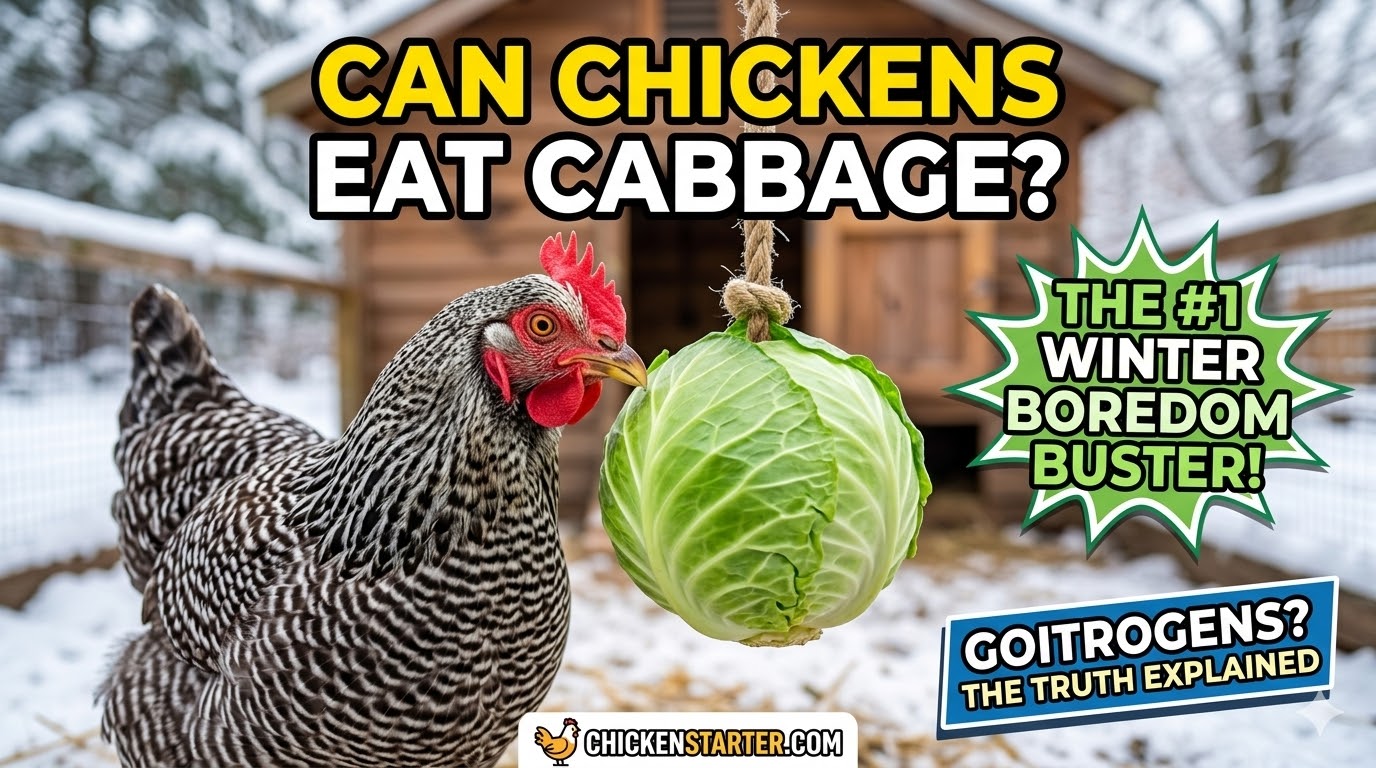
It was January, 15°F outside, and my 12 hens had been cooped up for three straight days during a snowstorm. By day two, I noticed bare patches appearing on the backs of three hens. Feather pecking had started, the classic sign of winter boredom.
That evening, I hung a whole cabbage from a piece of twine in the middle of the coop. Within seconds, every hen in the flock was gathered around it. Pecking, pushing, jumping, and chasing the swinging green ball.
By day four, the pecking behavior had stopped entirely.
Cabbage is not just safe for chickens. It is arguably the single best enrichment treat you can offer, especially in winter. But there is a science concern most sites ignore: cabbage contains goitrogens that can affect thyroid function at high doses. After three winters of hanging cabbage heads in my coop, reading the actual poultry welfare research on enrichment, and discovering that cabbage worms are a brilliant bonus protein source, here is the complete guide.
Can Chickens Eat Cabbage? Yes, Every Part Is Safe
Yes, chickens can safely eat all parts of cabbage, including the outer wrapper leaves, inner leaves, and the core. Cabbage is non-toxic, universally enjoyed by chickens, and one of the most practical treats available year-round.
Quick Answer: Chickens can eat cabbage raw, cooked, or frozen. According to USDA FoodData Central, 100 grams of raw green cabbage provides approximately 25 calories, 5.8g carbohydrates, 3.2g sugar, 2.5g fiber, 1.28g protein, 36.6mg vitamin C (41% DV), 76µg vitamin K (63% DV), 43µg folate (11% DV), 170mg potassium, 40mg calcium, and 92% water. Cabbage is universally considered the #1 chicken enrichment treat. Hang a whole head from a string for hours of physical and mental stimulation. Cabbage is a Brassica vegetable that contains goitrogens, but at normal treat quantities (10% of diet or less), this is not a concern. Cabbage ranks on the 2025 EWG Clean Fifteen for low pesticide residues. Feed 2 to 4 times per week. A whole cabbage head can serve a flock of 8 to 12 hens for a full day of enrichment. Baby chicks can start with finely chopped leaves at 4 to 6 weeks.
Why Cabbage Is the #1 Enrichment Treat for Chickens (Backed by Welfare Science)
This is the section that makes cabbage unique among every treat article on this site. No other food serves double-duty as both nutrition and behavioral enrichment the way cabbage does.
The Boredom-Pecking-Enrichment Connection
Boredom and lack of stimulation are leading causes of feather pecking and cannibalism in confined flocks. According to a 2021 meta-analysis published in Poultry Science (van Staaveren et al.) and indexed on PubMed, a higher frequency of feather pecking was observed in flocks lacking enrichment, with increased age, and in cage housing systems. The meta-analysis confirmed the effectiveness of environmental enrichment in reducing feather pecking and feather damage.
A study published in Animal Welfare (Dixon et al., 2010) at the University of Guelph tested four types of enrichment on laying hens housed in barren environments. The results showed that feather pecking was highest when no enrichment was present and lowest when forages were present. The researchers concluded that forage enrichments are most effective at alleviating feather pecking and that attempts should be made to develop poultry housing that allows for natural foraging behavior.
Why Cabbage Is the Perfect Enrichment Tool
The tough outer leaves resist instant destruction. A whole head lasts hours, not minutes. When hung on a string, it swings when pecked, creating a moving target that keeps chickens engaged far longer than stationary objects.
Multiple hens can peck simultaneously, which reduces competition and aggression. The swinging motion forces physical exercise: jumping, stretching, and lunging. It provides genuine mental stimulation as hens work to tear pieces off.
It is cheap. A whole cabbage head costs $1 to $3 at most grocery stores and entertains a flock of 8 to 12 hens for 4 to 8 hours. It naturally shreds as they peck, creating scattered pieces on the floor for secondary foraging, giving you double enrichment from a single item.
The hanging cabbage changed my winter routine completely. Before, I was dealing with feather pecking every year by January. Now, I hang a new cabbage head every 2 to 3 days from November through March. The difference in my flock’s behavior is night and day. They are active, engaged, and nobody is missing feathers. At $1.50 per cabbage, it is the cheapest welfare improvement I have ever made. For more on managing flock dynamics, see our guide on stopping feather pecking.
The Goitrogen Concern: Should You Worry? The Science Nobody Explains
This is the section that builds trust by handling a legitimate concern transparently, rather than ignoring it or panic-mongering.
What Are Goitrogens?
Cabbage belongs to the Brassica family (Brassica oleracea), the same family as broccoli, kale, Brussels sprouts, cauliflower, and rapeseed. According to ScienceDirect, cruciferous plants (genus Brassica) are goitrogenic because they contain glucosinolates, sulfur-containing glucosides that are converted in the intestine to by-products such as isothiocyanates by the enzyme myrosinase. These by-products can interfere with thyroid function by inhibiting iodine uptake.
As Healthline explains, goitrogens are compounds that interfere with the normal function of the thyroid gland. They make it more difficult for the thyroid to produce the hormones your body needs for normal metabolic function. The thyroid regulates metabolism, growth, and in laying hens, egg production.
What Does the Research Actually Show?
Here is the critical context that competitors miss entirely.
A comprehensive 2024 systematic review published in the International Journal of Molecular Sciences (Szyling et al.) and indexed on PubMed analyzed 123 articles of in vitro, animal, and human studies on the impact of Brassica plants on thyroid function. The conclusion was striking: “The vast majority of the results cast doubt on previous assumptions claiming that brassica plants have antithyroid effects.” The researchers found that including Brassica vegetables in the daily diet, “particularly when accompanied by adequate iodine intake, poses no adverse effects on thyroid function.”
The studies that did document thyroid enlargement in poultry used rapeseed meal at 10 to 30% of the total diet, levels far higher than occasional cabbage treats. Rapeseed contains approximately 30 to 150 µmol/g of glucosinolates, while cabbage contains roughly 10 to 20 µmol/g, significantly less.
According to NutritionFacts.org, the enzyme that creates iodine-blocking compounds from Brassica vegetables “is rapidly deactivated by cooking.” Boiling and steaming reduce glucosinolate levels by roughly 30 to 60% depending on cooking time. Additionally, commercial layer feeds are fortified with iodine, which directly counteracts goitrogen effects.
My Balanced Recommendation
At normal treat quantities (a cabbage head for a flock of 8 to 12 hens, 2 to 4 times per week), the goitrogen concern is not a practical issue. Do not feed cabbage (or any single Brassica) as a major portion of the diet. If you feed multiple Brassicas regularly, including cabbage, broccoli, kale, and Brussels sprouts, be aware of the cumulative goitrogen load. Cooking cabbage before feeding reduces goitrogens if you are particularly concerned.
I feed cabbage 3 to 4 times per week all winter, and I have never seen an egg production drop I could attribute to goitrogens. My hens’ layer feed contains supplemental iodine, and the cabbage amounts are well within the 10% treat rule. The goitrogen concern is real in laboratory settings but negligible in practice at normal treat quantities.
Can Chickens Eat Cabbage Worms and Caterpillars? The Brilliant Bonus
This is one of the most fascinating angles in the entire treat series.
Cabbage worms, specifically the imported cabbageworm (Pieris rapae), the cabbage looper (Trichoplusia ni), and the diamondback moth (Plutella xylostella), are the number one pest of cabbage and all Brassica crops. According to Planet Natural, the imported cabbage worm does great damage to cabbage-family crops in fields and gardens where it gains a foothold.
And chickens are their number one natural predator.
According to Gardening Know How, chickens will efficiently cut down the population of annoying cabbage worms, who turn vegetable crop leaves into Swiss cheese. As Mother Earth News confirms, chickens consider all types of cabbage worms to be great delicacies.
This creates a beautiful symbiotic relationship: you grow cabbage for your chickens, and your chickens eat the worms that attack your cabbage. Many organic gardeners use chickens as their primary cabbage pest control.
Every summer I grow cabbage in my garden, and every summer the cabbage whites find it. Instead of pesticides, I check the plants every other morning and pick off any caterpillars I find. I bring them to the run in a small container, and my hens go absolutely wild. It is free, it is organic pest control, and it is genuinely fun to watch. The caterpillars are completely safe, high in protein (insect protein ranges from 40 to 60% crude protein), and chickens will hunt them enthusiastically. For more on natural parasite prevention using natural methods, see our dedicated guide.
Nutritional Breakdown: Cabbage by Variety
Not all cabbages are created equal. Here is how the common varieties compare:
| Variety | Calories/100g | Vitamin C | Vitamin K | Unique Benefit | Best For |
|---|---|---|---|---|---|
| Green cabbage | 25 | 36.6mg (41% DV) | 76µg (63% DV) | Most common, cheapest, stores well | 🏆 Best all-round |
| Red/purple cabbage | 31 | 57mg (63% DV) | 38.2µg (32% DV) | 6 to 8x more anthocyanins than green | Best antioxidants |
| Savoy cabbage | 27 | 31mg (34% DV) | 68.8µg (57% DV) | Higher vitamin A, softer leaves | Best for baby chicks |
| Napa/Chinese cabbage | 13 | 27mg (30% DV) | 42.9µg (36% DV) | Lowest calorie, highest water content | Best for summer hydration |
Red/purple cabbage deserves special attention. It contains the same anthocyanin antioxidants found in blueberries. In our blueberry article, we covered research published in Frontiers in Veterinary Science showing that anthocyanins in laying hen diets can enhance both egg production and quality. Feeding red cabbage combines the enrichment benefits of green cabbage with the anthocyanin benefits that make blueberries so valuable.
Can Chickens Eat Every Part of Cabbage? Leaves, Core, Outer Leaves, Seeds, and Plants
| Part | Safe? | Notes |
|---|---|---|
| Outer wrapper leaves | ✅ Excellent | The leaves your grocery store would discard. Chickens love them. Wash first |
| Inner leaves | ✅ Best eating | Softer, sweeter, universally loved |
| Core/stem | ✅ Safe (hard) | Very dense and hard. Most chickens will peck at it but cannot eat much. Good for extended enrichment since it lasts longest |
| Seeds | ✅ Safe | Tiny and nutritious. If your cabbage has bolted and gone to seed, the seeds and flowers are safe |
| Cabbage plants (leaves from garden) | ✅ Safe | If growing cabbage, the outer leaves you thin can go straight to the flock. Ensure no pesticides were used |
| Cabbage flowers (bolted) | ✅ Safe | Yellow Brassica flowers are edible and safe |
| Cabbage worms/caterpillars | ✅ Bonus protein | Free high-protein treat. See dedicated section above |
| Moldy/slimy cabbage | ❌ Never | Mycotoxins are potentially fatal |
Raw vs. Cooked Cabbage: Which Is Better?
| Factor | Raw Cabbage | Cooked Cabbage (Steamed/Boiled) | Winner |
|---|---|---|---|
| Vitamin C | Higher. Heat destroys vitamin C | Lower. 30 to 50% loss | Raw |
| Goitrogens | Higher. Active goitrogens present | Lower. Cooking reduces by 30 to 60% | Cooked |
| Texture | Crunchy, tough. Great for enrichment | Soft, easy to eat | Depends |
| Enrichment value | Highest. Takes longer to eat | Lower. Consumed quickly | Raw |
| Digestibility | Good | Slightly better (softer fiber) | Cooked |
| Best season | Year-round (especially for hanging) | Winter (warm mash component) | Both |
Raw for enrichment. The whole point of the hanging cabbage is that it is tough enough to last hours. Cooked for winter mashes. Add chopped steamed cabbage to a warm oatmeal mash for a comforting cold-weather treat. Cooked if goitrogens concern you, though at treat levels, this is unnecessary.
I feed raw 95% of the time because the enrichment value is the primary purpose. The only time I cook cabbage for my flock is when I am making a warm winter mash on below-zero mornings. I steam some chopped cabbage and mix it with oats, warm water, and a handful of grated carrot.
How to Prepare and Serve Cabbage to Chickens (4 Methods)
Method 1: The Hanging Cabbage (Best Method)
Wash the whole cabbage head. Rinse under running water and remove any outer leaves that look wilted or dirty. Drill or poke a hole through the center of the core, using a long screw, bolt, or sturdy skewer to create an attachment point. Thread twine or rope through the hole and secure with a knot or washer. Hang at chicken head height, about 12 to 18 inches off the ground. Low enough they can reach it, high enough it swings freely when they peck. A fresh cabbage head can keep 8 to 12 hens entertained for 4 to 8 hours.
Method 2: Chopped and Scattered
Quarter the cabbage head, chop into bite-sized pieces (roughly 1-inch squares), and scatter across the run. This encourages foraging behavior and prevents dominant hens from hoarding.
Method 3: The Cabbage Half (Simplest)
Cut the cabbage in half. Place cut-side up on the ground. Chickens will peck the exposed inner surface. The outer leaves act as a natural “bowl,” keeping the inner leaves off the dirty ground.
Method 4: Winter Warm Mash
Steam or boil chopped cabbage for 3 to 4 minutes (this also reduces goitrogens). Mix with warm cooked oats, grated carrots, and warm water. Serve warm (not hot) in a shallow dish. Perfect for sub-freezing mornings.
Can Chickens Eat Cabbage Every Day?
Occasional daily feeding is fine, especially in winter for enrichment purposes, but variety is always better. As with all treats, cabbage should be an addition to their diet, not a replacement for their feed. Treats like cabbage should make up no more than 10% of daily food intake. The rest should consist of balanced layer feed.
Feed cabbage 3 to 4 times per week as the ideal frequency. Daily feeding is acceptable during winter confinement when the enrichment value is the primary goal, but monitor egg production. The goitrogen concern only becomes relevant if cabbage dominates the diet over extended periods at levels far exceeding normal treat amounts.
Can Chickens Eat Cabbage in Winter? The #1 Winter Treat
Winter is where cabbage truly shines. It is arguably more valuable in winter than any other season.
Storage champion. Whole cabbage heads store for 1 to 3 months in a cool, dark place (40 to 50°F). You can buy them in bulk in fall and feed through winter. See our winter feeding guide for more seasonal strategies.
Boredom prevention. Winter confinement causes feather pecking, aggression, and general stress. A hanging cabbage provides hours of physical and mental enrichment, the very thing welfare science confirms is most effective at reducing feather pecking.
Cost-effective. At $1 to $3 per head, cabbage is cheaper than any commercial enrichment product or flock block.
My winter enrichment schedule: hang a fresh cabbage every 2 to 3 days. Alternate with other enrichment like frozen fruit blocks, a DIY treat dispenser, or compost pile scratch. Ensure layer feed remains the primary food source. For complete cold-weather strategies, see our guides on winterizing your chicken coop and raising chickens in cold climates.
What Age Can Chickens Eat Cabbage?
| Age | Can They Eat Cabbage? | How to Serve | Notes |
|---|---|---|---|
| 0 to 4 weeks | ❌ No | Not applicable | Starter feed only. See must-haves for new chicks |
| 4 to 6 weeks | ⚠️ Very small amounts | Finely chopped soft inner leaves only | Must have chick grit available |
| 6 to 12 weeks | ✅ Small amounts | Chopped leaves, small pieces | Great early enrichment. Hang a small piece at chick height |
| 12 to 16 weeks | ✅ Moderate | Chopped or hung pieces | Grower feed still 90%+. See when to switch from starter to grower |
| 16+ weeks (adult) | ✅ Full amounts | Whole hung head, halved, scattered | Layer feed = 90% of diet; treats = 10% maximum |
Savoy cabbage has the softest leaves of any variety, making it ideal for first introduction to baby chicks.
The Pesticide Good News: Cabbage Is on the 2025 Clean Fifteen
Here is another refreshing positive pesticide story for your flock.
According to the Environmental Working Group’s 2025 Shopper’s Guide to Pesticides in Produce, cabbage is on the Clean Fifteen list. As reported by CNN, pineapple was the least contaminated produce tested, followed by sweet corn, avocados, papaya, onions, frozen sweet peas, asparagus, cabbage, watermelon, cauliflower, bananas, mangos, carrots, mushrooms, and kiwi. According to the EWG, almost 60 percent of samples on the Clean Fifteen had no detectable pesticide residues.
This means conventional store-bought cabbage is safe for your flock without needing to buy organic. The thick outer wrapper leaves actually provide an additional layer of protection for the inner leaves.
| Treat | 2025 EWG Status | Recommendation |
|---|---|---|
| Strawberries | #2 Dirty Dozen (worst) | Buy organic or homegrown |
| Apples | #9 Dirty Dozen | Buy organic or wash/peel |
| Blueberries | #11 Dirty Dozen | Buy organic or frozen organic |
| Celery | Off Dirty Dozen (improved) | Wash thoroughly |
| Cabbage | Clean Fifteen ✅ | Conventional is fine |
| Carrots | Clean Fifteen ✅ | Conventional is fine |
| Cucumbers | Middle | Wash and scrub |
Cabbage vs. Other Winter Treats: How It Compares
| Treat | Cost/Serving | Enrichment Value | Nutrition | Storage Life | Winter Rating |
|---|---|---|---|---|---|
| Cabbage (hung) | $0.15 to $0.25 | ⭐⭐⭐⭐⭐ | Vitamin C, K, fiber | 1 to 3 months | 🏆 Best overall |
| Pumpkin (halved) | $0.50 to $1.00 | ⭐⭐⭐⭐ | Vitamin A, seeds for deworming | 2 to 3 months | Excellent |
| Corn (dried/cracked) | $0.10 to $0.20 | ⭐⭐ | Energy, xanthophylls | 6+ months | Great for warmth |
| Oats (warm mash) | $0.05 to $0.10 | ⭐⭐ | B vitamins, fiber | 12+ months | Great morning treat |
| Flock block (commercial) | $5 to $15 per block | ⭐⭐⭐⭐ | Fortified | Months | Expensive but effective |
For more on winter nutrition, see our winter feeding guide and treats that boost egg laying.
Vegetables Chickens Should NEVER Eat
| Dangerous Vegetable | Why It Is Toxic |
|---|---|
| Green/raw potatoes and skins | Solanine, a toxic glycoalkaloid |
| Raw/dried beans | Phytohaemagglutinin can be fatal |
| Rhubarb leaves | Oxalic acid at levels toxic to poultry |
| Onions (large amounts) | Thiosulphates destroy red blood cells |
| Green tomatoes, leaves, and vines | Solanine. Only ripe red tomatoes are safe |
| Avocado (skin, pit, leaves) | Persin damages heart muscle. Potentially fatal |
| Moldy vegetables | Mycotoxins can cause severe illness or death |
For a full breakdown, see our comprehensive feeding guide and what chickens eat.
Frequently Asked Questions
Can I feed chickens raw cabbage?
Yes, raw cabbage is perfectly safe and is the preferred method for most keepers. Raw cabbage retains maximum vitamin C and provides the best enrichment value, especially when hung on a string. The goitrogens in raw cabbage are only a concern if cabbage dominates the diet at levels far exceeding normal treat amounts.
How do you prepare cabbage for chickens?
The most popular method is to hang a whole head from twine at chicken head height. You can also cut it in half (cut-side up), chop and scatter, or add steamed pieces to a warm winter mash. For baby chicks, finely chop soft inner leaves only.
Can chickens eat cabbage worms?
Yes, and they love them. According to Mother Earth News, chickens consider all types of cabbage worms to be great delicacies. They are high in protein and completely safe. Many organic gardeners use chickens as natural pest control for their cabbage crop.
Can chickens eat red or purple cabbage?
Yes, and red cabbage is even more nutritious than green. It contains 6 to 8 times more anthocyanins (the same antioxidants found in blueberries), more vitamin C (57mg vs. 36.6mg per 100g), and the same enrichment value.
Will cabbage affect my chickens’ thyroid?
At normal treat quantities (10% of diet or less), cabbage’s goitrogen content is not a practical concern. According to a 2024 systematic review of 123 studies published in the International Journal of Molecular Sciences, the vast majority of results indicate that including Brassica vegetables in the daily diet, when accompanied by adequate iodine intake, poses no adverse effects on thyroid function. Commercial layer feeds are fortified with iodine.
Can Silkie chickens eat cabbage?
Yes, Silkies can eat cabbage safely. For the hanging method, hang the cabbage slightly lower to accommodate their shorter stature. Chopped inner leaves are easiest for their smaller beaks.
How long does a hung cabbage last?
A whole cabbage head typically lasts 4 to 8 hours for a flock of 8 to 12 hens. Larger heads and cooler temperatures extend the duration. The stripped core can be left for additional pecking entertainment.
Can chickens eat cabbage and carrots together?
Yes, this is an excellent combination. Cabbage provides vitamin C, vitamin K, and enrichment. Carrots provide beta-carotene, vitamin A, and prebiotic fiber. Chop both and scatter, or hang a cabbage and scatter grated carrots below it for dual enrichment.
The Bottom Line on Cabbage for Chickens
After three winters of hanging cabbage heads in my coop, here are the four things to remember:
First, cabbage is one of the safest and most beneficial treats you can offer. It is the #1 enrichment tool for reducing boredom, feather pecking, and aggression. Published welfare research confirms that forage enrichments are the most effective way to alleviate feather pecking in laying hens.
Second, the goitrogen concern is real in laboratory science but negligible at normal treat quantities. A 2024 systematic review of 123 studies concluded that Brassica vegetables pose no adverse effects on thyroid function when iodine intake is adequate. Your commercial layer feed provides that iodine.
Third, the leaves are the best part, red/purple cabbage adds valuable anthocyanin antioxidants, and cabbage worms from your garden are a free, high-protein bonus treat your flock will love.
Fourth, in winter, hang a cabbage head every 2 to 3 days. At $1 to $3 per head, it is the cheapest, most effective welfare tool available for backyard flocks.
Ready to level up your flock’s enrichment? Check out our guides to what to feed chickens in winter, stopping feather pecking, or explore what your chickens can eat from your kitchen.

Oladepo Babatunde is the founder of ChickenStarter.com. He is a backyard chicken keeper and educator who specializes in helping beginners raise healthy flocks, particularly in warm climates. His expertise comes from years of hands-on experience building coops, treating common chicken ailments, and solving flock management issues. His own happy hens are a testament to his methods, laying 25-30 eggs weekly.