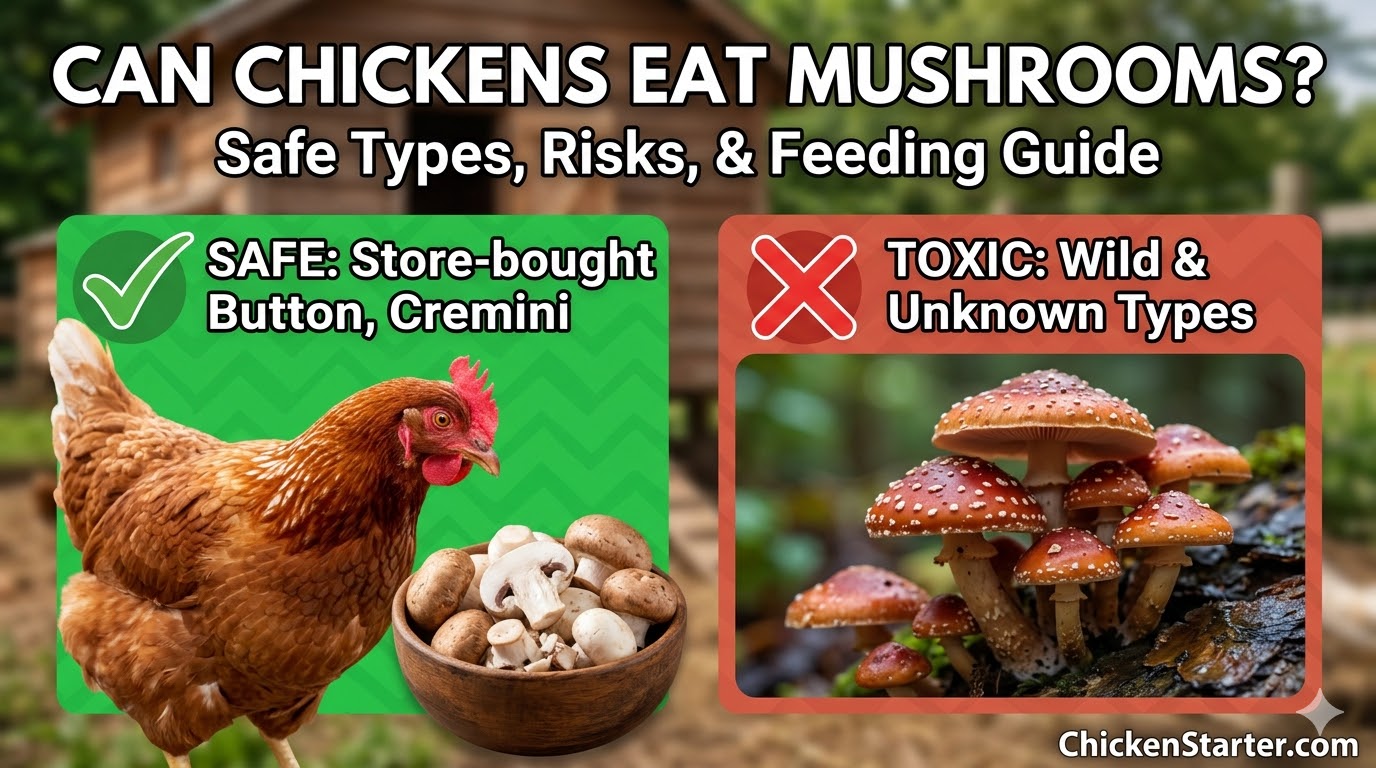
Yes, chickens can eat certain store-bought mushrooms, including button, oyster, shiitake, portobello, and cremini, but wild mushrooms growing in your yard can be toxic or even fatal. I have been feeding my flock small amounts of cooked button mushrooms for over three years with zero issues. But last spring, after a stretch of heavy rain, I found pale green-gilled mushrooms popping up along the fence line of my run. That experience taught me that knowing which mushrooms are safe and which ones can kill is not optional for any chicken keeper.
This guide covers every safe variety, every dangerous species, how to prepare mushrooms properly, how much to feed, what the actual peer-reviewed science says, and what to do if your chicken eats a wild mushroom.
Quick Answer: Chickens can safely eat store-bought mushrooms (button, cremini, portobello, oyster, shiitake) that are cooked, unseasoned, and chopped into small pieces. Never feed chickens wild mushrooms from your yard. Many species are toxic and potentially fatal. All treats, including mushrooms, should follow the 90/10 rule: no more than 10% of daily intake.
Which Mushrooms Can Chickens Safely Eat? A Complete Variety Guide
Not all mushrooms are created equal, and chickens cannot eat just any mushroom they find. The safest approach is simple: if you bought it from a grocery store for your own dinner, it is safe for your chickens. Here is a variety-by-variety breakdown with the specific details that actually matter.
Button Mushrooms (Agaricus bisporus)
Button mushrooms are safe for chickens and are the easiest, most affordable variety to start with. The scientific name is Agaricus bisporus, and this is the same species as cremini and portobello mushrooms, just harvested at different stages of maturity.
According to USDA FoodData Central, raw white button mushrooms contain approximately 22 calories per 100 grams, 3.09 grams of protein, 3.26 grams of carbohydrate, and just 0.34 grams of fat. They are rich in B vitamins including riboflavin and pantothenic acid, and contain meaningful amounts of selenium (8.9 mcg per 100g) and potassium (318 mg per 100g).
My ISA Browns will eat chopped cooked button mushrooms mixed into their layer feed every time I offer them. On their own, some hens ignore them. Mixed in, they disappear in minutes.
Be sure to chop them to roughly pea-sized pieces to prevent choking, especially for smaller breeds. The button mushroom’s firm texture can be a challenge for chickens to break down when served whole.
Portobello Mushrooms
Portobello mushrooms are safe for chickens. They are the exact same species as button mushrooms, Agaricus bisporus, just allowed to grow to full maturity. The nutritional profile is virtually identical.
The main concern with portobellos is their size. A full portobello cap is large and thick. Always chop them into small, peck-sized pieces before offering them to your flock. Large mushroom caps or whole mushrooms pose a choking hazard, especially for younger chickens or smaller breeds.
Oyster Mushrooms (Pleurotus ostreatus)
Oyster mushrooms are safe and are arguably the most nutritionally interesting variety you can offer your flock. They carry just 33 calories per 100 grams but are loaded with natural bioactive compounds, antioxidants, minerals, and vitamins.
Oyster mushrooms are particularly notable because they contain a compound called lovastatin, a natural HMG-CoA reductase enzyme inhibitor. While this is primarily of interest in human nutrition for cholesterol management, it underscores the biological complexity of this mushroom.
A 2024 review published in the journal Animals found that mushroom species including Pleurotus ostreatus, Agaricus bisporus, and Flammulina velutipes have demonstrated improvements in growth rate, feed conversion, carcass traits, meat quality, and egg production when included in poultry diets.
Oyster mushrooms are also one of the easiest mushroom varieties to grow at home on straw or coffee grounds. If you are looking for an enrichment project that doubles as a treat source, growing your own eliminates any identification risk entirely.
Shiitake Mushrooms (Lentinula edodes)
Shiitake mushrooms are safe for chickens and offer some unique immune-supporting properties. They contain polysaccharide chemicals including lentinan and beta-glucans that help boost the immune system, support white blood cell production, and provide cellular protection.
Based on USDA data, raw shiitake mushrooms contain approximately 34 calories per 100 grams with 2.24 grams of protein.
Shiitake are more expensive than button or cremini mushrooms, so they are best offered as an occasional treat rather than a regular supplement. I keep them for my flock only when I happen to have leftovers from cooking for my own family. My Australorps showed zero interest in raw shiitake pieces but accepted them readily once I steamed and chopped them.
Chestnut Mushrooms
Chestnut mushrooms are safe for chickens. They are commonly listed among the edible varieties suitable for poultry and have a firm, slightly nutty texture. Chop them well before serving, as their density makes them harder for chickens to break apart than button mushrooms.
Enoki Mushrooms (Flammulina velutipes)
Enoki mushrooms are safe for chickens. Research published in the journal Animals found that feeding Flammulina velutipes mushroom stem waste at a 2% inclusion level improved immunity in broiler chickens, specifically by increasing levels of key immunoglobulins and interleukins.
The one thing to watch for with enoki is their long, thin, stringy shape. Chop them into short pieces before offering to prevent tangling and potential crop issues. Their delicate structure means they break down easily once chopped.
Cremini Mushrooms
Cremini mushrooms are safe for chickens. They are the same species as button mushrooms, Agaricus bisporus, just the brown-skinned variety harvested at a slightly more mature stage. Everything that applies to button mushrooms applies equally here.
Can Chickens Eat Mushrooms Raw or Cooked?
This is where most chicken blogs get it wrong. Some say raw is fine. Others insist you must always cook. The truth, based on the actual science, is more nuanced.
Why Cooking Is Recommended
Raw mushrooms contain a compound called agaritine, which is naturally present in Agaricus bisporus species (button, cremini, portobello). Cooking significantly reduces agaritine levels, making the mushrooms safer for consumption.
Beyond the chemistry, cooking softens the texture. Raw mushrooms have a rubbery consistency that most chickens dislike and find difficult to eat. Information from BackYard Chickens forum members consistently reports that most birds reject raw mushrooms outright but accept them readily once cooked.
Cooking also improves digestibility. Chickens have relatively simple digestive systems compared to ruminants, and the softened cell walls of cooked mushrooms release nutrients more effectively.
How to Cook Mushrooms for Chickens
The method I use takes five minutes. Chop your mushrooms into roughly pea-sized pieces. Steam or boil them for three to five minutes with just water. No oil, no salt, no butter, no garlic, no seasoning of any kind. Seasonings, especially salt and garlic, can disrupt a chicken’s electrolyte balance and cause toxicity.
Let them cool completely to room temperature. Mix into your flock’s regular layer feed or scatter in a bowl. Mixing into feed increases the likelihood your chickens will actually eat them.
An even easier method: place mushrooms in a microwave-safe bowl with a splash of water, cover loosely, and microwave for two to three minutes. Chop, cool, serve. Total prep time from fridge to feed bowl is under five minutes.
Can Chickens Eat Raw Mushrooms From the Store?
Raw store-bought mushrooms are not toxic, but they are not ideal either. The firm, rubbery texture poses a higher choking risk than cooked mushrooms, especially for bantam breeds and younger birds. Digestibility is also lower.
If you do offer them raw, chop extra small, remove any dirt, and make sure pieces are appropriate for a chicken’s throat size. But honestly, the two minutes of steaming makes them safer, softer, and more palatable. There is no real reason to skip that step.
Toxic Mushrooms That Can Kill Your Chickens
This is the section that matters most. While store-bought mushrooms are perfectly safe, wild mushrooms are a completely different story. Several species commonly found in North American, Australian, and European yards contain toxins that can cause organ failure and death.
Death Cap (Amanita phalloides)
The death cap is the single most dangerous mushroom your chickens could encounter. According to the CDC, Amanita phalloides is responsible for the majority of mushroom poisoning deaths worldwide. As little as half a mushroom contains enough toxin to kill an adult human.
The principal toxic compound is alpha-amanitin, which halts protein synthesis by inhibiting RNA polymerase II. This leads to liver and kidney failure. There is no antidote. The toxin is heat-stable, meaning cooking does not destroy it.
Death caps are found in North America, Europe, the UK, and parts of Australia. They fruit in summer and autumn near broadleaf trees, particularly oaks and beeches. They can appear in suburban yards, not just forests.
The most dangerous thing about death caps is that they closely resemble several edible species. They can be mistaken for common paddy straw mushrooms or even young button mushrooms at the “button stage.”
Fly Agaric (Amanita muscaria)
The fly agaric is the classic fairy-tale mushroom with its red cap and white spots. It is poisonous and contains ibotenic acid and muscimol, which cause neurological symptoms. While less commonly fatal than the death cap, it is still dangerous to chickens given their small body weight.
Green-Spored Parasol (Chlorophyllum molybdites)
According to the University of Florida’s Institute of Food and Agricultural Sciences, the green-spored parasol is the most common cause of mushroom poisoning in the United States. It grows abundantly in lawns, parks, and grassy areas, often forming fairy rings.
It is easily confused with edible parasol mushrooms. Symptoms in humans include severe vomiting, diarrhea (sometimes with bleeding from the gut), and significant fluid loss. In small animals and chickens, the effects can be even more severe due to lower body weight.
This is probably the mushroom most likely to appear in your chicken run after rain, especially in the southeastern United States and in parts of Australia.
False Morels (Gyromitra species)
False morels contain gyromitrin, a compound that converts to a toxic hydrazine in the body. They cause liver damage and can be fatal. They resemble true morels but have irregularly wrinkled, brain-like caps rather than the honeycomb pattern of true morels.
Can Chickens Eat Mushrooms That Grow in the Yard?
No. Never allow your chickens to eat wild mushrooms from your yard, garden, run, or pasture. Accurately identifying which species of fungi are fruiting in your backyard is extremely difficult, even for experienced foragers. Many deadly species closely resemble safe edible ones, and some have no distinctive taste or smell to warn against eating them.
There is a persistent myth in chicken-keeping circles that chickens instinctively know to avoid toxic mushrooms. This is dangerous misinformation. While chickens do have some natural caution around unfamiliar foods, this instinct is not foolproof. As noted by experienced keepers on BackYard Chickens, the instinct does not always kick in, and sometimes chickens will eat something even if it can make them sick.
Do not rely on your chickens’ instincts to protect them from toxic mushrooms. The stakes are too high.
How to Remove Wild Mushrooms From Your Chicken Run
The best protection is prevention. Make this part of your morning coop routine:
Walk the entire run and free-range area each morning, especially after rain. Mushrooms can appear literally overnight. Wear gloves and pull mushrooms out at the base, including any visible root structure. Dispose of them in a sealed bag in the trash. Do not add them to compost that your chickens might access.
Improving drainage in your run reduces mushroom growth. A well-drained surface of sand, gravel, or hardwood chips creates less favorable conditions for fungal fruiting. Our guide to the best materials for the bottom of your chicken run covers options that help with both mud and fungal growth.
Can Chickens Eat Mushroom Stems, Caps, and Scraps?
All parts of an edible mushroom are safe for chickens. Caps, stems, and cooking scraps are all fine as long as the mushroom itself is an edible variety and has not been seasoned.
Stems are tougher and chewier than caps. Chop them finely or cook them a bit longer to soften the texture. Many chickens actually seem to enjoy the chewy texture of a well-chopped stem.
Plain kitchen scraps from mushroom preparation are perfectly fine for your flock. Just set them aside before you add any oil, butter, salt, or seasonings.
Can Chickens Eat Mushrooms and Onions?
No. Never feed onions to chickens. Onions contain a toxin called thiosulphate that destroys red blood cells, causing hemolytic anemia. This applies to all onion varieties, raw or cooked.
If you are cooking a mushroom and onion dish for yourself, set the mushroom pieces aside before adding onions. The mushrooms alone are fine. Anything that has been cooked with onion is not.
Can Chickens Eat Mushrooms and Tomatoes?
Yes, with conditions. Cooked mushrooms (safe varieties) and ripe red tomatoes can be offered together. However, green tomatoes, tomato leaves, and tomato stems contain solanine, which is toxic to chickens.
As long as both ingredients are individually safe, the combination is perfectly fine. For more details on tomato safety, see our guide on whether chickens can eat tomatoes.
Can Baby Chickens Eat Mushrooms?
No, not until at least eight to ten weeks old. Young chicks need specialized starter feed to support their rapid growth and development. Introducing treats too early can disrupt the precise nutritional balance that starter feed provides.
After eight weeks, you can introduce tiny amounts of cooked, finely chopped mushrooms. Start with just a few small pieces per chick. Make sure chicks have access to grit before offering any treats, as they need it to mechanically break down food in the gizzard.
Their diet should still consist primarily of their age-appropriate feed. Treats including mushrooms should remain a very small percentage. For everything you need to know about bringing new chicks home, see our 15 must-haves for new chicks.
Can Ducks Eat Mushrooms?
Yes, the same rules apply. Safe store-bought varieties only, cooked, chopped, offered in moderation. Ducks are generally less selective eaters than chickens, meaning they may be more likely to eat wild mushrooms they encounter in the yard.
If you keep a mixed flock of chickens and ducks, be especially vigilant about removing wild mushrooms from any shared pasture or run. What a cautious hen might ignore, an enthusiastic duck might gobble up without hesitation.
Can Silkie Chickens Eat Mushrooms?
Yes, the same rules apply to all chicken breeds, including Silkies. However, there are two specific considerations for Silkies.
First, Silkies are smaller than standard breeds. Chop mushroom pieces even smaller than you would for full-sized hens. What looks like a pea-sized piece to a Rhode Island Red might be a choking hazard for a Silkie bantam.
Second, Silkies have restricted vision due to their characteristic crest feathers. This means they are less able to identify and avoid wild mushrooms while foraging. If your Silkies free-range, your morning mushroom inspection becomes even more critical.
How Much Mushroom Can You Feed Chickens? The 90/10 Rule Explained
All treats, including mushrooms, should not exceed 10% of a chicken’s total daily food intake. This is the 90/10 rule that every backyard keeper should follow to maintain proper nutrition.
Here is the math. An average laying hen eats roughly 120 to 150 grams (about a quarter to a third of a pound) of feed per day. Ten percent of that is 12 to 15 grams of total treats. If mushrooms are one of several treats that day, give roughly 5 to 8 grams per chicken, which works out to about one to two small button mushrooms worth.
For my flock of six hens, I cook about four to five button mushrooms (roughly 80 grams total), chop them, and scatter them in the run once or twice per week. That works out to about 13 grams per chicken, right within the 10% guideline.
Mushrooms should be considered a supplemental treat, not a staple. They complement a complete feeding schedule built around quality layer feed. For ideas on other treats that support egg production, check out our guide to the best chicken treats that boost egg laying.
Are Mushrooms Good for Chickens? What Peer-Reviewed Research Actually Shows
This is where this guide differs from every other article on the internet. Most chicken blogs make vague claims about mushroom nutrition. Here is what published, peer-reviewed poultry science research actually found.
The Nutritional Profile: Real USDA Numbers
Based on USDA data, here is how the most common varieties compare per 100 grams raw:
Button mushrooms: 22 calories, 3.1g protein, rich in vitamin B5 (pantothenic acid), riboflavin, selenium (8.9 mcg), and potassium (318 mg). Glycemic index of 32.
Oyster mushrooms: 33 calories, 3.3g protein, rich in vitamin D, folate, copper, potassium, and iron. Notable for lovastatin content.
Shiitake mushrooms: 34 calories, 2.2g protein, rich in vitamin B6, zinc, and manganese. Notable for lentinan and beta-glucan content.
Mushrooms are also the only vegan, non-fortified dietary source of vitamin D, which is significant for poultry bone health and eggshell quality.
What Poultry Science Research Says
A comprehensive review published on PubMed concluded that mushroom polysaccharides can play important roles in poultry production. The key findings included that polysaccharides may act as immune enhancers or immunomodulators with antibacterial, antiviral, and antiparasitic properties. Phenolic compounds in mushrooms act as antioxidants. Mushrooms in broiler diets may serve as growth promoters as an alternative to antibiotics. And mushroom supplementation may improve egg production and quality.
A separate study published in the journal Poultry Science found that dietary Agaricus bisporus mushroom supplementation improved both growth performance and feed efficiency in broiler chickens at 42 days of age, while also reducing oxidative stress markers in liver, breast, and thigh tissues and elevating glutathione peroxidase levels. This suggests mushrooms provide both growth-promoting and tissue-protective antioxidant activity.
A 2024 review published in Animals confirmed that mushroom use in poultry nutrition represents a major stride toward finding alternatives to antibiotics, noting that multiple mushroom species increase growth performance, modulate immune response, improve gut health, and influence lipid profiles.
None of this means you should replace your chickens’ feed with mushrooms. But it does mean that the occasional mushroom treat is more than just a snack. In moderation, mushrooms offer genuine nutritional and immune-supporting value for your flock.
My Chicken Ate a Wild Mushroom: Emergency Steps
If you discover or suspect that your chicken has eaten a wild mushroom, act immediately. Do not wait for symptoms to appear. Some toxic mushrooms have a latency period of six to 24 hours before symptoms develop, and by then organ damage may already be occurring.
Step 1: Remove any remaining mushrooms from the area immediately.
Step 2: Isolate the affected bird from the rest of the flock.
Step 3: Take a clear photo of the mushroom, including the cap, gills, and base. This helps with identification.
Step 4: Call an avian veterinarian or animal poison control immediately. Do not wait for symptoms. The ASPCA Animal Poison Control Center can be reached at (888) 426-4435.
Step 5: Watch for lethargy, diarrhea, drooling, tremors, difficulty breathing, loss of coordination, or refusal to eat.
Step 6: Keep the bird hydrated with clean, fresh water.
Step 7: Do not try to induce vomiting. Chickens cannot vomit in the traditional sense, and attempting to force regurgitation can cause aspiration.
Toxic mushrooms can cause kidney failure, neurological damage, digestive hemorrhaging, and death. According to accounts shared by poultry keepers on established forums, lingering side effects from mushroom poisoning can last weeks or months, and organ damage can be permanent.
For general guidance on when to seek veterinary help, see our article on when to call the vet for a backyard chicken. Having a chicken first aid kit ready before emergencies happen is always a smart move.
This information is for educational purposes only and does not replace professional veterinary advice. If you suspect mushroom poisoning, contact a licensed avian veterinarian or animal poison control immediately.
What Other Foods Should You Never Feed Chickens?
Mushrooms are just one item on a long list of foods that require careful consideration. Here is a quick reference of common kitchen items and their safety status.
Never feed: Onions (thiosulphate destroys red blood cells). Avocado flesh, pit, or skin (contains persin, which is toxic). Chocolate, especially dark varieties (contains theobromine, which can be fatal). Raw or dried beans (contain phytohemagglutinin). Green potatoes or potato skins (contain solanine). Rhubarb leaves (contain oxalic acid).
Feed with caution: Citrus can interfere with calcium absorption, potentially contributing to thin-shelled or fewer eggs. Best offered rarely or avoided.
Safe and enjoyed: Strawberries, blueberries, watermelon, cucumbers, grapes (halved), apples (no seeds), carrots, cabbage, corn, rice (cooked), lettuce, pumpkin, and celery.
For the complete breakdown, see our guide to what chickens can eat from your kitchen and our full list of what chickens eat.
Frequently Asked Questions About Chickens and Mushrooms
Can chickens eat mushrooms from the store?
Yes. Store-bought mushrooms including button, cremini, portobello, oyster, and shiitake are safe. Cook them without seasoning, chop to pea-sized pieces, and feed in moderation following the 90/10 treat rule.
Can chickens eat mushrooms raw?
Cooked is recommended over raw. While raw store-bought mushrooms are not toxic, cooking reduces agaritine, softens the tough rubbery texture, and makes mushrooms easier to digest. The choking risk is also lower with cooked mushrooms.
Can chickens eat mushrooms that grow in the yard?
No. Never. Many wild mushroom species that grow in lawns are toxic, and accurate identification is extremely difficult even for experienced mycologists. Remove all wild mushrooms from your chicken’s area immediately, especially after rain.
Can baby chicks eat mushrooms?
Not until at least eight to ten weeks old. Chicks need specialized starter feed to support rapid growth. After eight weeks, tiny amounts of cooked, finely chopped mushrooms can be introduced alongside appropriate grit.
Can ducks eat mushrooms?
Yes, the same rules apply. Safe store-bought varieties only, cooked and chopped. Ducks tend to be less discriminating eaters than chickens, so extra vigilance about wild mushroom removal is important in mixed flocks.
Is mushroom good for poultry?
In moderation, yes. Peer-reviewed research published in Poultry Science has shown that mushroom polysaccharides can boost immunity, provide antioxidant protection, serve as natural growth promoters, and even support improved egg production.
Can chickens eat mushrooms and onions together?
Do not feed onions to chickens under any circumstances. Onions contain thiosulphate, which destroys red blood cells and causes hemolytic anemia. Mushrooms alone (cooked, unseasoned) are perfectly fine, but never combined with onions or cooked alongside them.
Can Silkie chickens eat mushrooms?
Yes, same rules as any breed. Chop pieces smaller for Silkies due to their smaller body size, and monitor foraging areas more carefully since their crest feathers restrict their vision.
The Bottom Line
As someone who has raised backyard chickens for several years across different breeds, I keep it simple. Store-bought mushrooms, cooked, chopped, one to two times per week. If it grows in the yard, I pull it. If there is any doubt, I skip it entirely. There are plenty of other treats your flock will love just as much without any risk.
The science genuinely supports mushrooms as a beneficial occasional treat. The immune-boosting beta-glucans, the antioxidant activity, the broad vitamin and mineral profile. These are real, published benefits, not speculation.
But the safety rules are non-negotiable. Store-bought only. Cooked and unseasoned. Chopped small. In moderation. And never, ever trust a wild mushroom around your flock.
Want to know what else your chickens can safely eat from your kitchen? Check out our complete guide: What Can Chickens Eat From Your Kitchen?
This article is for educational purposes only and does not replace professional veterinary advice. For questions about your flock’s specific dietary needs, consult a licensed avian veterinarian.

Oladepo Babatunde is the founder of ChickenStarter.com. He is a backyard chicken keeper and educator who specializes in helping beginners raise healthy flocks, particularly in warm climates. His expertise comes from years of hands-on experience building coops, treating common chicken ailments, and solving flock management issues. His own happy hens are a testament to his methods, laying 25-30 eggs weekly.