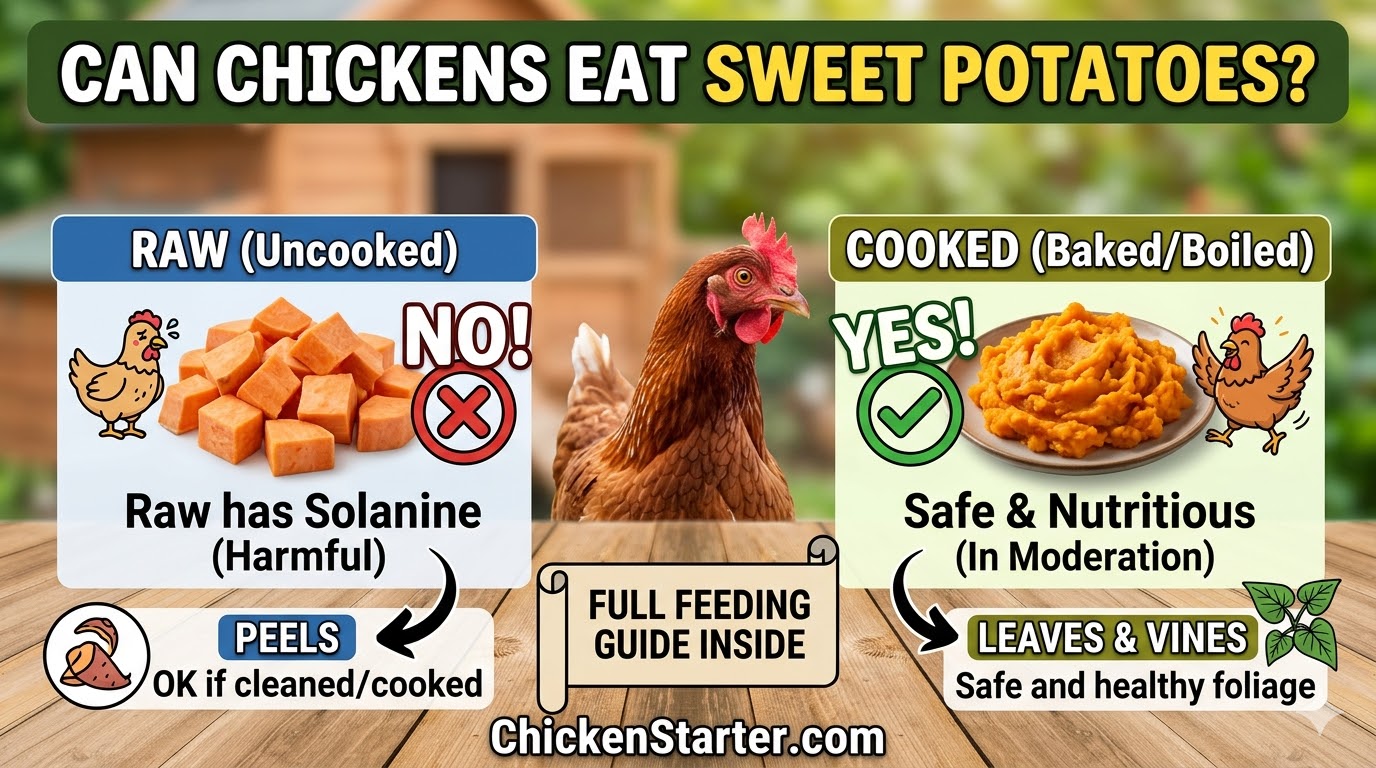
Yes, chickens can safely eat sweet potatoes, and unlike regular white potatoes, sweet potatoes are not part of the nightshade family and contain absolutely zero solanine. This makes them one of the safest vegetable treats you can offer your flock.
I have been feeding cooked sweet potato to my hens every winter for three years now, and it has become their absolute favorite cold-weather treat. Within about a week of regular feeding, their egg yolks turn noticeably more vibrant orange. But there are important rules about preparation, portion size, and one hidden danger most chicken keepers have never heard of.
Quick Answer: Chickens can safely eat sweet potatoes, and cooked is best. Raw is safe but hard to digest. Unlike regular white potatoes (nightshade family), sweet potatoes (morning glory family) contain zero solanine. Peels, leaves, vines, stems, and flesh are all safe. Always serve plain with no salt, butter, or seasoning. Chop into small pieces and limit to 10% of daily diet. Especially beneficial as a winter treat and during molting season due to high beta-carotene and vitamin A content.
Sweet Potatoes vs. White Potatoes: Why One Is Safe and the Other Can Harm Your Chickens
This is the single most important distinction every chicken keeper needs to understand. Dozens of articles online get this wrong, and the confusion puts flocks at risk.
You may have read that sweet potato peels contain solanine and are toxic to chickens. That is incorrect. Sweet potatoes do not produce solanine in any part of the plant. This myth comes from people assuming sweet potatoes are related to white potatoes. They are not. They belong to completely different plant families with completely different chemistry.
According to NC State University’s Extension program, the sweetpotato (Ipomoea batatas) is a vigorous vine in the morning glory family (Convolvulaceae). It is only distantly related to the common potato (Solanum tuberosum), which belongs to the nightshade family (Solanaceae). As Britannica confirms, these are two botanically unrelated plants that simply share a name.
Here is what this means for your chickens:
Sweet potato (Ipomoea batatas) belongs to the Convolvulaceae (Morning Glory) family. It contains zero solanine. The raw flesh is safe but tough to digest. Peels and skins are safe and nutritious. Leaves and vines are safe and rich in protein. Cooked flesh is an excellent treat. The key nutrient is beta-carotene (vitamin A precursor).
White potato (Solanum tuberosum) belongs to the Solanaceae (Nightshade) family. It does contain solanine, especially in green skin, sprouts, and eyes. Raw flesh contains glycoalkaloids and is risky. Peels carry the highest solanine concentration. Leaves and vines are toxic with high solanine content. Cooked flesh is safe only if all green parts are removed.
When I first got chickens, I was terrified to feed them any potato at all. I had read so many conflicting articles online. Once I understood the actual botany, the morning glory family versus the nightshade family, the confusion evaporated. If you remember nothing else from this article, remember this: sweet potatoes and white potatoes are not related. Period.
For more on nightshade safety, see our guide to whether chickens can eat tomatoes, since tomatoes are another nightshade family member with their own safety rules.
Can Chickens Eat Sweet Potatoes Raw or Cooked?
Cooked is always the recommended method, though raw sweet potatoes from the store are not toxic. The reasons for cooking go beyond just preference.
Why Cooked Is Always Better
Sweet potatoes contain natural trypsin inhibitors that interfere with protein digestion. According to a technical paper published by the FAO, cooking sweet potatoes is necessary because it reduces these trypsin inhibitors while making the starch significantly easier to digest. The FAO data shows that easily digestible starch in sweet potato increases from just 4% when raw to 55% after cooking.
Cooking also softens the flesh. Raw sweet potatoes are extremely hard and dense. Chickens will struggle to break pieces apart, and the tough texture increases the risk of choking and crop impaction. Cooked sweet potato practically falls apart, making it easy for even bantam breeds to eat.
Additionally, cooking makes the beta-carotene more bioavailable. According to nutrition research, your chickens’ bodies can convert more of the beta-carotene into usable vitamin A from cooked sweet potato than from raw.
How to Cook Sweet Potatoes for Chickens
My go-to method takes about 20 minutes of active time and provides treats for most of the week.
Boiling (easiest and recommended): Wash the sweet potato thoroughly under running water. Peel if you want, though the skin is perfectly safe to leave on. Cut into one-inch cubes. Boil in plain water for 15 to 20 minutes until fork-tender. Drain and cool completely to room temperature. Mash or dice into pea-sized pieces. Serve plain with absolutely no salt, butter, oil, sugar, or seasoning.
Baking: Wash and pierce with a fork. Bake at 400°F (200°C) for 45 to 50 minutes. Let cool completely. Scoop the flesh, mash, and serve. One important note: baking activates an enzyme called beta-amylase that converts starch into maltose sugar. Research shows total sugars in sweet potato increase from roughly 4.5 to 8.4% when raw to 15 to 19% after baking. If the sweet potato caramelizes, set those sticky pieces aside rather than feeding them, as the concentrated sugar can be too much for your chickens.
Never serve: Fried sweet potatoes (too much fat, usually salted). Thanksgiving leftovers with marshmallows, brown sugar, or spices. Anything with added dairy, as chickens are lactose intolerant.
I boil two to three sweet potatoes on Sunday, mash them plain, store them in a glass container in the fridge, and portion out about one tablespoon per hen throughout the week. Total weekly prep time is about 20 minutes.
Can Chickens Eat Raw Sweet Potatoes?
Raw sweet potatoes are not toxic, but they are not ideal. They are extremely tough for chickens to break apart. If feeding raw, use only fresh, undamaged, properly stored tubers and grate or dice them very finely to pea-sized pieces at most.
If you want to mix sweet potato into fermented feed, cook it first. The softened texture blends much more easily and your flock gets more nutritional value from the effort.
Can Chickens Eat Sweet Potato Peels? The Truth vs. Internet Myths
Yes, sweet potato peels are safe for chickens. They contain zero solanine because sweet potatoes are not nightshades.
The myth that sweet potato peels are dangerous comes entirely from confusing them with white potato skins. As established by multiple botanical authorities, sweet potatoes belong to the Convolvulaceae family. Their vines, leaves, flowers, and tubers, including peels, lack nightshade alkaloids entirely.
Not only are the peels safe, they are actually nutritious. Sweet potato skin contains concentrated fiber and prebiotic compounds that support gut health. Research published in Poultry Science found that ground sweet potato skin increased beneficial short-chain fatty acid concentrations in poultry digestive systems by 28%, indicating healthy prebiotic fermentation.
I always cook sweet potatoes with the skin on for my flock. After boiling, the skin practically falls apart and is easy for them to eat. The one caveat: raw peels from fresh tubers are tougher to digest. Cook them alongside the flesh. And always avoid peels from damaged, cracked, or old sweet potatoes due to the ipomeamarone concern covered later in this article.
Can Chickens Eat Sweet Potato Leaves, Vines, and Stems?
This is another area where online sources wildly contradict each other. Here is the fact-checked truth.
Sweet Potato Leaves Are Safe
According to Lisa Steele of Fresh Eggs Daily, one of the most respected voices in backyard poultry, all parts of the sweet potato plant, including leaves, stems, vines, flowers, peels, and flesh (cooked or raw), are perfectly safe to feed your chickens.
This is consistent with the broader scientific literature. Sweet potato leaves are eaten as greens by humans in many cultures across Africa, Asia, and the Caribbean. Research from the FAO confirms that dehydrated sweet potato vine meal has been evaluated as both a protein source and a xanthophyll pigment source for poultry. The xanthophyll from sweet potato vines is an effective pigmentation agent for egg yolks and broiler skins.
The vines and leaves are a good source of protein and other nutrients. Many homesteaders let their flocks forage on the sweet potato patch after harvest is done.
Fresh Only, With Conditions
While the leaves and vines are safe from healthy, fresh plants, there are some practical guidelines. Offer only fresh, green leaves from healthy plants. Avoid wilted, dried, or frost-damaged foliage, as these can cause digestive upset. If you use synthetic fertilizers on your sweet potato patch, avoid feeding those leaves to your flock, as they can accumulate nitrates.
I grow sweet potatoes in my garden every year. After harvest in late September, I let my hens into the sweet potato patch to forage on the remaining vines and leaves. They love it, and it clears the bed for me. A true win-win. But I only do this with plants I have grown myself without synthetic fertilizers. For more on safe foraging, see our guide to encouraging natural foraging in chickens.
Can Chickens Eat Sweet Potatoes Every Day?
Not recommended. Sweet potatoes should be an occasional treat offered two to three times per week maximum.
Here is the math. An average laying hen eats roughly 120 to 150 grams (about a quarter to a third of a pound) of complete feed per day. The 90/10 treat rule means that no more than 10% of that daily intake should come from treats, which works out to about 12 to 15 grams total, roughly one to two tablespoons of mashed sweet potato per hen.
For a flock of six hens, one medium sweet potato (about 130 grams of cooked flesh) covers three to four days of treats.
Sweet potatoes are high in carbohydrates and sugar but low in protein. Based on USDA data, raw sweet potato contains only 1.57 grams of protein per 100 grams and zero methionine, which is the first limiting amino acid in poultry diets. Daily feeding can lead to weight gain, reduced layer feed intake, and nutritional imbalance.
A good rule of thumb: offer sweet potatoes no more than twice a week in small quantities. Balance with protein-rich treats like mealworms for optimal health. For a complete feeding plan, check out our best feeding schedule for backyard chickens and our chicken feed calculator.
Can Chickens Eat Sweet Potatoes in Winter? The Perfect Cold-Weather Treat
Winter is actually the best time to feed sweet potatoes to your chickens. There are four specific reasons.
Energy for warmth. Chickens burn extra calories maintaining body temperature in cold weather. Sweet potatoes provide easy-to-digest complex carbohydrates for sustained energy. The main components are starches, which make up 53% of the carb content, along with simple sugars making up about 32%.
Vitamin A when foraging is limited. Winter means less access to green plants and bugs. Vitamin A is essential for immune function, reproductive health, and epithelial cell maintenance. Vitamin A deficiency has been directly linked to reduced egg production in laying hens. Sweet potatoes are one of the richest natural sources of beta-carotene, the precursor your chickens’ bodies convert into vitamin A.
Warm mash for morale. Serving slightly warm (never hot) mashed sweet potato on cold mornings is a genuine morale booster for your flock. My hens come running for it on cold mornings.
Immune support through beta-carotene. The high beta-carotene content in orange-fleshed sweet potatoes enhances egg yolk pigmentation, resulting in richer, deeper orange yolks. This is a natural effect that indicates increased antioxidant intake.
One important seasonal note: avoid feeding sweet potatoes during summer heat waves. High-carb treats generate metabolic heat during digestion. That is beneficial in January but harmful during heat stress in July. For summer feeding advice, see our guide on what to feed chickens during a heatwave.
For US and Canadian keepers: Prime sweet potato feeding season runs October through March. For Australian keepers: Remember your seasons are reversed. Sweet potato works great May through August. Avoid during December through February heat. For more winter feeding strategies, check our complete winter chicken feeding guide and our winterizing your coop guide.
Nutritional Benefits of Sweet Potatoes for Chickens
Most chicken blogs make vague claims about sweet potato nutrition. Here are the actual numbers from USDA FoodData Central.
Per 100 grams of raw sweet potato: 86 calories, 20.12g carbohydrate, 1.57g protein, 0.05g fat, 3.0g dietary fiber. The standout nutrient is vitamin A as beta-carotene, with orange-fleshed varieties containing approximately 14,187 IU per 100 grams, which is over 7,000 times more than white potatoes (just 2 IU per 100g). Sweet potatoes also deliver 337mg potassium, 30mg calcium, and meaningful amounts of manganese and B vitamins.
For comparison, a baked sweet potato provides 961 mcg RAE of vitamin A per 100 grams, which is 107% of the human daily value. Orange-fleshed varieties like Beauregard (the dominant commercial variety in Australia, making up about 90% of production there) and Jewel contain the highest beta-carotene levels. White or cream-fleshed varieties like Hannah and O’Henry are lower in carotenoids but still rich in fiber and complex carbs. Purple sweet potatoes contain anthocyanins instead, providing a different antioxidant profile.
Published research in poultry nutrition confirms that sweet potato roots are rich in beta-carotene while the foliage is rich in xanthophyll, making sweet potato not only an important food for humans but also for poultry. Studies using orange-fleshed sweet potato in laying hen diets have shown measurable yolk color deepening, from roughly score 9 to score 12 on the Roche Yolk Color Fan within five weeks of regular feeding.
Sweet Potatoes vs. Yams: They Are Not the Same
If you are in the United States and bought “yams” at the grocery store, you almost certainly bought orange-fleshed sweet potatoes that have been mislabeled. True yams are rare in American supermarkets.
Sweet potatoes (Ipomoea batatas) belong to the morning glory family. Safe raw or cooked. All plant parts are edible.
True yams (Dioscorea species) belong to an entirely different plant family. They must be peeled and cooked before feeding to chickens. They contain a natural plant protein that is toxic when raw. Yams also contain oxalic acid, which in excess can cause hens to lay soft-shelled eggs by interfering with calcium absorption.
If you are unsure whether you have a sweet potato or a true yam, look at the flesh. Sweet potatoes typically have orange, white, or purple flesh with relatively thin skin. True yams have white or purple flesh with thick, bark-like skin.
The One Sweet Potato Danger Most Chicken Keepers Do Not Know About
Here is where this guide goes beyond every other article on the internet. While sweet potatoes do not produce solanine, they do produce a different compound under specific stress conditions that can harm your flock.
Ipomeamarone is a furanoterpenoid toxin that sweet potatoes synthesize as a natural defense when the tuber is damaged, infected with mold, or improperly stored. Research published in the Journal of Agricultural and Food Chemistry confirmed that ipomeamarone accumulates at toxic levels even in healthy-looking parts of sweet potato roots that have been infected by common fungi like Rhizopus stolonifer.
According to the veterinary reference Vetlexicon, the toxic compounds in sweet potato are ipomeanols, which are generated when damaged tuber tissue is metabolized by certain fungi, particularly Fusarium solani and Fusarium oxysporum. Critically, cooking does not destroy these toxins. And tubers that appear relatively undamaged can still cause poisoning.
The toxicity of moldy sweet potato tubers has been recognized for several decades, with significant livestock losses documented in the United States, Japan, Australia, Brazil, and the UK.
How to avoid this risk completely:
Use only fresh, firm, clean sweet potatoes with no cracks, soft spots, or visible mold. Store sweet potatoes in a cool, dark place at 55 to 60°F with good airflow. Never refrigerate them, as cold temperatures increase susceptibility to decay. Peel deeply (at least 3mm) and cut away all blemished tissue before cooking. Boil until fork-tender (minimum 15 minutes) or bake until the internal temperature reaches 205°F.
The simplest rule: If a sweet potato has any soft spots, cracks, mold, discoloration, or smells “off,” throw it away. Do not feed it to your chickens. Do not compost it where your flock can access it.
The good news? Avoiding this risk is incredibly simple. Just use fresh, clean, properly stored sweet potatoes and inspect them before serving. That is it.
Can Baby Chickens Eat Sweet Potatoes?
Not until at least six to eight weeks old. Young chicks require starter feed with precise protein ratios of 18 to 20% to support their rapid growth. Their digestive systems are not equipped to process fibrous vegetables, and they lack fully developed amylase enzymes before three to four weeks of age.
Under six weeks: no sweet potato at all. Starter feed only. Six to eight weeks: you can introduce a tiny amount, roughly a quarter teaspoon, of thoroughly cooked, mashed sweet potato in a soft, almost paste-like consistency. Eight weeks and older: small amounts of cooked, diced sweet potato are fine as an occasional treat.
Always provide grit when introducing any food beyond starter feed. Never feed raw sweet potato to chicks of any age. For everything you need for new chicks, see our 15 must-haves for bringing chicks home.
Can Ducks and Chickens Eat Sweet Potatoes Together?
Yes, the same rules apply. Cooked, unseasoned, chopped, and in moderation. Sweet potatoes are safe for ducks, geese, and other poultry.
Ducks have slightly different nutritional needs (they require more niacin) but sweet potatoes pose no special risk for them. If you are feeding a mixed flock, make sure all pieces are small enough for the smallest bird present.
What Foods Should You Never Feed Chickens?
While sweet potatoes are safe, many common foods are not. Here is a quick reference.
Never feed: Raw or green white potatoes (solanine is toxic, causing gastrointestinal and neurological issues). Avocado flesh, pit, or skin (contains persin). Raw or dried beans (contain phytohemagglutinin). Onions in significant amounts (thiosulphate destroys red blood cells). Chocolate, especially dark varieties (contains theobromine). Rhubarb leaves (contain oxalic acid, which impairs calcium absorption and can cause kidney failure). Salty or processed foods (excess sodium causes dehydration and kidney damage).
Use caution with: Citrus, which may interfere with calcium absorption and irritate the digestive system if fed frequently.
Safe and enjoyed: Strawberries, blueberries, watermelon, cucumbers, grapes (halved), apples (no seeds), carrots, cabbage, corn, rice (cooked), lettuce, pumpkin, bread (sparingly), celery, cheese (small amounts), and bananas.
For the complete breakdown, see our guide to what chickens can eat from your kitchen and our full guide on what chickens eat.
Frequently Asked Questions About Feeding Sweet Potatoes to Chickens
Can chickens eat sweet potatoes raw?
Yes, raw sweet potatoes are not toxic, but cooked is strongly recommended. Raw sweet potatoes are extremely hard and tough to digest, posing choking and crop impaction risks. Cooking reduces trypsin inhibitors, improves starch digestibility from 4% to 55%, and softens the texture. If feeding raw, grate or dice very finely and use only fresh, undamaged tubers.
Can chickens eat sweet potato peels?
Yes. Unlike regular potato skins, sweet potato peels contain zero solanine because sweet potatoes are not nightshades. Cooked peels are easiest to digest. Research in Poultry Science found sweet potato skin actually increased beneficial short-chain fatty acid production in poultry by 28%.
Can chickens eat sweet potatoes every day?
Not recommended. Sweet potatoes should be an occasional treat, two to three times per week maximum, making up no more than 10% of daily diet. That works out to about one to two tablespoons per hen. Daily feeding can cause weight gain and nutritional imbalance due to low protein and high carbohydrate content.
Can chickens eat sweet potatoes in winter?
Yes, and winter is the best time. The complex carbohydrates provide extra energy for maintaining body temperature. The high beta-carotene supports immune function when natural foraging is limited. Serve slightly warm (not hot) mashed sweet potato for maximum benefit.
Can chickens eat sweet potato leaves and vines?
Yes, fresh sweet potato leaves and vines from healthy, organically grown plants are safe in moderation. Research published by the FAO shows sweet potato vine meal is a valuable source of xanthophyll pigments and protein for poultry. Avoid wilted, dried, frost-damaged, or chemically treated foliage.
Is sweet potato good for poultry?
In moderation, yes. Sweet potatoes offer genuine nutritional benefits including beta-carotene for immune function and vitamin A conversion, complex carbohydrates for energy, dietary fiber for gut health, and xanthophyll pigments that enhance egg yolk color.
How should I prepare sweet potatoes for chickens?
Wash thoroughly. Optionally peel. Cut into chunks. Boil for 15 to 20 minutes until fork-tender. Cool completely. Mash or dice into pea-sized pieces. Never add salt, butter, oil, sugar, or any seasoning. Serve at room temperature or slightly warm.
Can baby chicks eat sweet potatoes?
Not until at least six to eight weeks old. Chicks lack fully developed digestive enzymes and need the precise protein ratios in starter feed for proper growth. After six weeks, introduce tiny amounts of thoroughly cooked, mashed sweet potato only.
Can ducks eat sweet potatoes?
Yes. The same rules apply. Cooked, unseasoned, chopped, and in moderation. Sweet potatoes are safe for ducks, geese, and other poultry. Ensure pieces are size-appropriate for each bird.
What is the difference between sweet potatoes and regular potatoes for chickens?
They are completely different plants. Sweet potatoes (morning glory family) contain zero solanine and are safe raw or cooked, with all plant parts edible. Regular white potatoes (nightshade family) contain toxic solanine in green skins, sprouts, and leaves. White potatoes must always be cooked with all green parts removed before feeding to chickens.
The Bottom Line
As someone who has raised backyard chickens for several years, I keep sweet potato feeding simple. Cooked, plain, chopped small, one to two times per week. Peels stay on. Leaves go to the flock after harvest. If the tuber looks damaged, cracked, or moldy, it goes in the trash rather than the feed bowl.
The science genuinely supports sweet potatoes as one of the best vegetable treats you can give your flock. The beta-carotene, the vitamin A, the fiber, the yolk color enhancement. These are real, measurable benefits backed by USDA data and published poultry nutrition research.
But the key facts are non-negotiable. Sweet potatoes are not nightshades and contain no solanine. Cooked is always better than raw. Never feed damaged or moldy tubers. Follow the 10% treat rule. And enjoy watching your hens devour their favorite winter mash.
Want to know what else your chickens can safely eat from your kitchen? Check out our complete guide: What Can Chickens Eat From Your Kitchen?
This article is for educational purposes only and does not replace professional veterinary advice. For questions about your flock’s specific dietary needs, consult a licensed avian veterinarian.

Oladepo Babatunde is the founder of ChickenStarter.com. He is a backyard chicken keeper and educator who specializes in helping beginners raise healthy flocks, particularly in warm climates. His expertise comes from years of hands-on experience building coops, treating common chicken ailments, and solving flock management issues. His own happy hens are a testament to his methods, laying 25-30 eggs weekly.