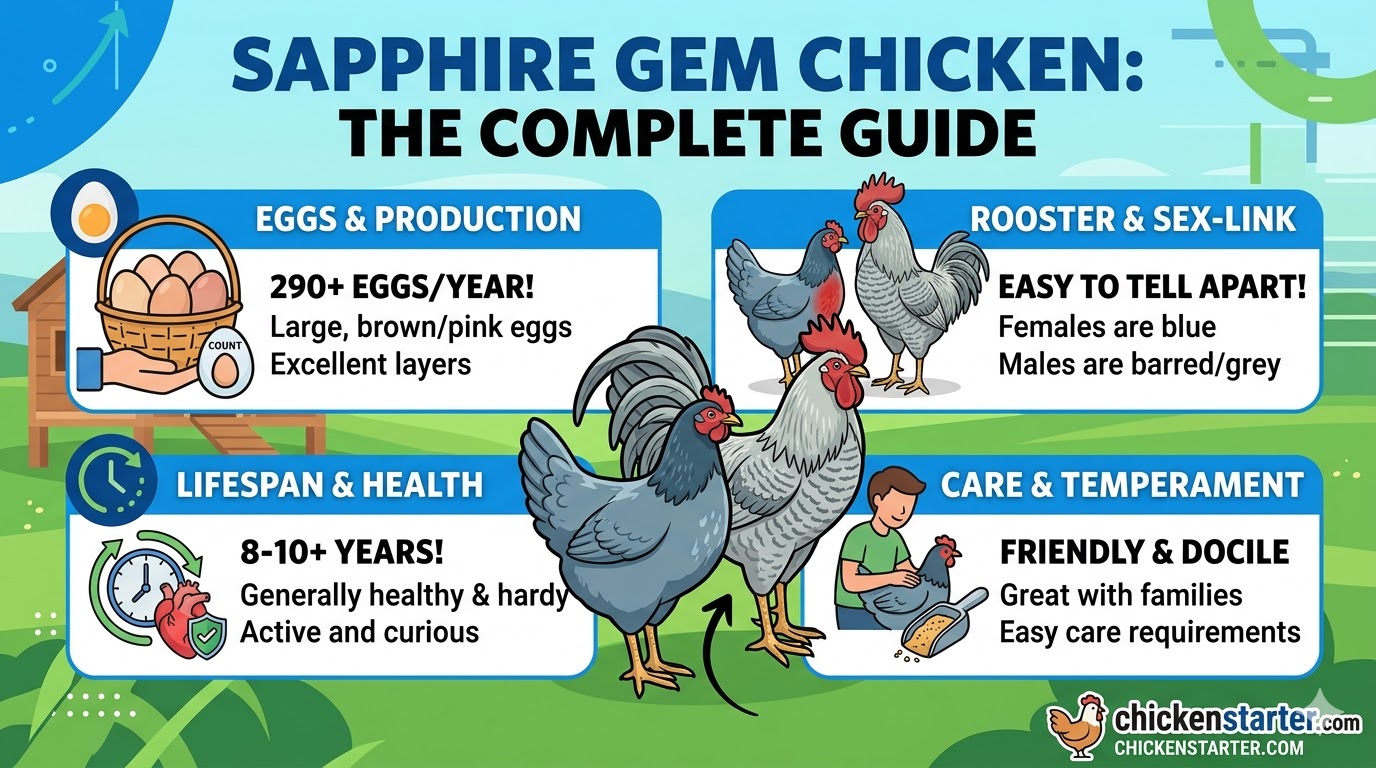
The Sapphire Gem is a sex-linked hybrid chicken, not an APA-recognized breed, developed in the Czech Republic by crossing a Blue Plymouth Rock with a Barred Plymouth Rock. It is prized for its stunning blue-lavender plumage and exceptional egg production of 260 to 290 large brown eggs per year.
I added two Sapphire Gem hens to my flock two years ago, and they quickly became two of my most reliable layers and friendliest birds. But finding honest, accurate information about this hybrid is surprisingly difficult. There are more contradictions online about Sapphire Gems than almost any other chicken. One source says they weigh four pounds, another says seven. One says they lay blue eggs, another says brown. This guide exists to settle all of that confusion with fact-checked data, real owner experience, and information sourced directly from Hoover’s Hatchery, the company that trademarked the name.
Quick Breed Snapshot
Type: Sex-linked hybrid (not an APA-recognized breed). Origin: Czech Republic (likely Dominant Blue D107 line). Parent breeds: Blue Plymouth Rock crossed with Barred Plymouth Rock. Egg color: Brown (not blue; this is a common misconception). Egg size: Large to extra-large. Egg production: 260 to 290 per year (four to five per week). Weight: Hens 6 lbs, roosters 7 lbs (per Hoover’s Hatchery). Lifespan: 4 to 8 years (varies; see detailed section below). Temperament: Docile, calm, friendly, curious, quiet. Climate hardiness: Cold-hardy and heat-tolerant. Broodiness: Occasionally broody. Comb type: Single comb (frostbite caution in extreme cold). APA recognized: No. Breeds true: No; offspring of two Sapphire Gems will not be Sapphire Gems.
Sapphire Gem Chicken Origin: The Full Story Behind This Mysterious Hybrid
The Sapphire Gem has one of the most confusing backgrounds of any chicken you can buy. Here is what we actually know versus what is speculation.
What Is Confirmed
The Sapphire Gem is not an actual breed of chicken and is not recognized by the American Poultry Association. According to Hoover’s Hatchery product listings on Tractor Supply, the name “Sapphire Gem” is a trademark of Hoover’s Hatchery. They do not breed true. If you breed two Sapphire Gems together, you will not necessarily get another Sapphire Gem.
The cross involves a Blue Plymouth Rock father and a Barred Plymouth Rock mother. This specific pairing produces sex-linked offspring, meaning you can determine gender at hatch based on down color and markings.
The Dominant Blue D107 Connection
According to Dominant CZ, a Czech poultry genetics company founded in 1989, the Dominant Blue D107 is one of their most popular programs. It is described as the result of crossing a synthetic original paternal stock Blue Plymouth Rock with a Barred Plymouth Rock maternal stock. Day-old chicks are color-sexed. Cockerel chicks are barred with a white spot on the head. Hen chicks are dark without a spot.
The D107 produces about 300 brown-shelled eggs under intensive testing conditions. It is used in free-range and small-scale farming across Switzerland, Italy, the United Kingdom, Germany, Austria, and many other countries. Dominant CZ also notes that this layer is very similar to the old Andalusian native breed.
While there is no official public confirmation from Hoover’s Hatchery that their Sapphire Gem is derived from the D107 program, the characteristics match almost perfectly: same parent breeds, same sex-linking method, same egg color, same plumage description, same Andalusian resemblance. Knowledgeable breeders on BackYard Chickens have noted that Hoover’s reportedly imported original parental stock eggs for their breeding program, though the U.S. hatchery versions may differ slightly from the original Czech stock.
Why There Is So Much Conflicting Information
The reason you will find wildly different statistics across websites is simple. The Sapphire Gem has no breed standard. There is no APA definition of what a Sapphire Gem should weigh, how many eggs it should produce, or what it should look like. Different hatcheries may use slightly different parent stock, leading to variation. The name itself is trademarked by one hatchery, so what Tractor Supply sells as a Sapphire Gem and what another supplier offers may not be genetically identical.
When I first started researching Sapphire Gems before buying, I was genuinely confused by the contradictory information. One site said four pounds, another said seven. One said they lay blue eggs, another said brown. This article exists because I wanted to create the resource I wish I had found back then. For more context on the Barred Rock parent breed, check our dedicated guide.
Sapphire Gem Chicken Appearance: Colors, Size and How to Identify Them
Plumage and Coloring
Do not expect a mystical, jewel-toned blue. In reality, most Sapphire Gems appear as an elegant steel gray to blue-gray, with some individuals showing more lavender undertones depending on lighting and genetics. As one experienced owner from Pampered Chicken Mama put it, the lavender and blue color most often used to describe this bird is really more of a gray.
Hens display shades of lavender, gray, and blue across the body, typically with a darker span of feathers around the neck resembling a necklace. Roosters are usually a blue-gray with white barring inherited from their Barred Plymouth Rock mother. It is common for roosters to show visible barring across their feathers as they mature.
Both males and females sport a single red comb and red wattles. Their beaks and legs lean toward black or gray. The skin around their dark eyes is a light red, and their earlobes show some white. In the chicken industry, gray to light gray plumage is referred to as “blue” feathering, which adds to the confusion for newcomers.
How to Sex Sapphire Gem Chicks at Hatch
The Sapphire Gem is a sex-linked chicken variety, which means their gender can be identified shortly after hatching by observing feather colors.
Males will have a white dot on their heads and show barring in their down. Females will be solid dark blue or gray, often with a necklace of gray or gold spots, and no white head spot.
This works because the barring gene sits on the Z chromosome. According to poultry genetics research, males are ZZ (receiving barring from the Barred Rock mother) while females are ZW (receiving only one Z without barring). This makes male chicks visually distinct from females at hatch, which is one of the key practical advantages of this hybrid.
Hoover’s Hatchery guarantees 90% accuracy on all sexed poultry. That means roughly one in ten “pullets” could turn out to be a rooster. Plan accordingly.
Size and Weight: Why Every Source Disagrees
This is one of the most confusing areas. Here is what different sources report:
Hoover’s Hatchery (the trademark holder) lists mature weight at 6 to 7 lbs. Tractor Supply’s breed guide lists hens at 4 lbs and roosters at 5 lbs. However, the actual Tractor Supply product listing for Hoover’s Sapphire Gem chicks states Male 7 lb, Female 6 lbs. Chickens And More lists roosters at about seven pounds and females at about six pounds.
The discrepancy exists because there is no APA breed standard defining weight. My best guidance, based on the trademark holder’s own data: expect hens between 5 and 6 pounds and roosters between 6 and 7 pounds from Hoover’s stock. Birds from other sources may be lighter.
Sapphire Gem Chicken Eggs: Color, Size, Production Rate and the Blue Egg Myth
Egg Color: Brown, Not Blue
This is the single most common misconception about Sapphire Gems. They lay brown eggs. They do not lay blue eggs. They do not lay gem-colored eggs.
The confusion comes from a completely different chicken. The “Sapphire chicken” or “Sapphire Jewel” is a Meyer Hatchery exclusive hybrid that is white with gray or black flecks and lays blue eggs. The Sapphire Gem and the Sapphire Jewel are two entirely different birds from two entirely different hatcheries.
Real-world egg color from Sapphire Gems ranges from a medium tan to light brown. Some owners on BackYard Chickens report a pinkish cream tint, while others see a standard brown. When my Sapphire Gems first started laying, the eggs were a light tan that gradually darkened slightly over the first two months. For more information about blue egg layers, see our dedicated guide.
Egg Size
Hoover’s Hatchery rates Sapphire Gem eggs as extra-large. When hens first start laying, their eggs will be smaller but increase in size over the first two to three months of production. One owner on The Happy Chicken Coop reported her Sapphire Gem lays “HUGE eggs, they barely fit in the egg carton.”
Egg Production: What to Realistically Expect
Hoover’s Hatchery officially rates production at 290 extra-large brown eggs per year. Tractor Supply’s breed guide lists 260 to 280 eggs per year at approximately five eggs per week. Real-world owner reports consistently cite four to five large eggs per week.
Realistically, expect four to five large brown eggs per week from a healthy Sapphire Gem hen in her first and second year. That translates to roughly 200 to 280 eggs per year. The 290 figure from Hoover’s represents peak performance under optimal conditions. Most backyard keepers will see slightly lower numbers, which is completely normal.
This breed is not known for broodiness, which makes them excellent for flock owners focused on reliable egg production. Like most chickens, production will start slowing down after year two, declining roughly 10 to 15% each year. For tips on maintaining production, see our guide on why chickens stop laying eggs.
When Do Sapphire Gems Start Laying?
Most Sapphire Gem hens begin laying between 18 and 24 weeks (approximately 4.5 to 6 months). Some early bloomers start as young as 18 weeks. Hoover’s Hatchery states hens begin to lay between 5 to 7 months of age.
Important correction: One popular website incorrectly states “Sapphire Gem chickens start laying around 18-24 months old.” This is clearly a typo. It should be weeks, not months. If your Sapphire Gem hasn’t laid by six months, check our guide on chicken behavior before the first egg for signs to watch for.
Winter Laying Performance
Sapphire Gems are notably good winter layers. Hoover’s Hatchery specifically markets them as birds that thrive in both hot and cold climates with consistent production. Multiple owners in cold-climate states confirm this. A keeper from Montana on Whitney Out West reported that during long stretches of below-zero temperatures, she never noticed any issues with her Sapphire Gem chickens.
In my first winter with Sapphire Gems, I was genuinely impressed. While my other breeds slowed to one to two eggs per week, my Sapphire Gems maintained three to four eggs per week through December and January. They barely seemed to notice the cold. For more on raising chickens in cold climates, see our dedicated guide.
Sapphire Gem Rooster: Temperament, Crowing, Appearance and What to Expect
Sapphire Gem Rooster Appearance
Sapphire Gem roosters carry the white barring from their Barred Plymouth Rock parent, combined with the blue-gray plumage. They have larger, brighter red combs and wattles than hens, more prominent hackle and saddle feathers, and are noticeably bigger overall.
As chicks, males display a white dot on their head and show barred down coloring. As they mature, barring becomes more visible across the body.
Sapphire Gem Rooster Temperament
The overwhelming consensus is that Sapphire Gem roosters are docile and calm compared to most rooster breeds. According to Backyard Farm Life, they are known for being calm, friendly, and easy-going. If you already have other roosters, a Sapphire Gem rooster likely will not challenge the status quo, as they tend to end up further down the pecking order.
However, individual temperament varies. One owner at Get Strong Animals shared that her Sapphire Gem was initially “absolutely vicious.” Since then, she has heard from others with similar experiences. The consensus remains that the breed tendency is toward docility, but individual roosters can be assertive, especially during adolescence between 16 and 24 weeks. If you get a feisty one, it usually mellows with maturity.
A keeper on BackYard Chickens shared that her Sapphire Gem rooster “died protecting them from a coyote last year,” calling him an extremely good rooster to his flock. So while they are gentle with humans, they can still be brave protectors.
Crowing and Noise Level
Sapphire Gem roosters mature between 16 and 20 weeks, and you may hear them trying to find their voice from as young as 12 weeks. They tend to be quieter than many breeds according to Tractor Supply’s breed profile. They still crow, particularly in the morning, but generally less throughout the day.
One interesting owner report from The Happy Chicken Coop: “I have a sapphire gem rooster, he turned a year old in march and he still doesn’t crow.” This is unusual but demonstrates the breed’s reputation for being quieter. For noise-sensitive living situations, see our guide to the quietest chicken breeds for backyards.
“I Got a Rooster by Accident”
Despite being sex-linked, Hoover’s only guarantees 90% accuracy. That means if you buy ten “pullets,” there is a reasonable chance one is a rooster. Your options are: keep him (maintain a ratio of one rooster per eight to ten hens), rehome him, or process him.
If you live in a suburban area, check your local chicken ordinances before deciding. Most urban and suburban chicken laws prohibit roosters entirely. Also see our guide on whether you need a rooster to get eggs.
Sapphire Gem Chicken Temperament: Why They Are Perfect for Beginners and Families
According to Tractor Supply, a calm, friendly personality makes Sapphire Gems a great choice for many environments, from small backyard flocks to large farms. They are one of the quieter chicken breeds, making them easy to keep even with neighbors nearby. They are curious, love to explore, and interact readily with their keepers.
Sapphire Gems are ideal for a mixed flock. They get along well with other breeds. One owner reported her Sapphire Gem “loves sitting on my lap and is super smart and social. We get one very large egg from her every single day without fail.”
They are natural explorers and excellent foragers. These birds are always on the lookout for insects, seeds, and other treats. One keeper from Whitney Out West described often finding her Sapphire Gems in cool ditches or in the shade of trees on hot days, noting they are quite clever at finding the best spots.
One area to watch: they do take the pecking order seriously. Because they are docile, Sapphire Gems can be bullied by more assertive breeds. In a mixed flock with Rhode Island Reds or Leghorns, keep an eye on whether the more aggressive birds are picking on your Sapphire Gems.
My Sapphire Gems are the most curious birds in my flock. They are always the first to investigate anything new in the run. A new perch, a different treat, even my boots. They are also the most eager to follow me around the yard during free-range time.
Sapphire Gem Chicken Lifespan: How Long Do They Really Live?
This is where you need an honest answer. Sources range wildly from “won’t live longer than four years” to “five to ten years.” Here is the truth.
Like all high-production hybrid chickens, Sapphire Gems tend to live shorter lives than heritage breeds. Their bodies are built for maximum egg output, which puts significant strain on their reproductive systems. According to Chicken Fans, many Sapphire Gems significantly decrease egg production after only two to three years, and many won’t live longer than four years.
Meanwhile, A-Z Animals and Mr. Animal Farm list the average lifespan at five to ten years, and multiple owners report birds living well into year five.
The realistic picture: Peak production lifespan is two to three years of heavy laying. Total lifespan as a backyard pet is four to eight years, with production declining significantly after year three. Heritage breeds for comparison often live 8 to 12+ years.
The five to ten year figure is technically possible but represents the upper range with excellent care. A BackYard Chickens member shared: “Most of mine did not make it past three years.” Another reported two remaining birds at five years old that no longer lay but are healthy.
Factors affecting lifespan include diet quality, predator protection, parasite management, and reproductive disorders. For more detail, see our guide on how long chickens live.
Sapphire Gem vs. Sapphire Splash vs. Sapphire Olive Egger: What Is the Difference?
Almost no article clearly distinguishes between these three birds. Here is the comparison, sourced directly from Hoover’s Hatchery product listings.
Sapphire Gem: Solid blue/gray/lavender plumage. Lays 290 large to extra-large brown eggs per year. Mature weight 6 to 7 lbs. Docile, easy to care for.
Sapphire Splash: Described by Hoover’s as “a rebel rendition of our Sapphire Gem, with a mix of light to medium dark gray plumage and specks of darker feathering.” A Czech breed. Lays approximately 290 large brown eggs per year. Mature weight male 7 lbs, female 6 lbs. Calm and docile.
Sapphire Olive Egger: Blue, splash, or black plumage with a tuft on the head. Lays approximately 240 large olive eggs per year (5% chance of brown). Active and docile. Dual-purpose. This bird is not related to the Sapphire Gem despite the shared “Sapphire” name.
Sapphire Jewel (Meyer Hatchery): A completely different bird. White with gray or black flecks. Lays blue eggs. A Meyer Hatchery exclusive hybrid. This is the bird that causes the “Sapphire Gems lay blue eggs” confusion.
The bottom line: if you want brown eggs, you want the Sapphire Gem or Sapphire Splash. If you want olive eggs, you want the Sapphire Olive Egger. If you want blue eggs, you are looking for the Sapphire Jewel from Meyer Hatchery, which is a different hybrid entirely. For more on blue egg layers or pink egg layers, see our dedicated guides.
Sapphire Gem Health Issues: What to Watch For
Generally speaking, Sapphire Gems are healthy, hardy birds with no breed-specific health conditions. They do need the same regular health checks as any chicken. They are prone to lice, parasites, and worms, just like every other breed.
Single Comb Frostbite Risk
As with all single-combed breeds, the Sapphire Gem’s comb is vulnerable to frostbite during extreme cold. One owner in a BYC thread shared that her Sapphire Gem had frostbite on her comb, though it was a very small spot.
You can apply petroleum jelly to the combs during sub-freezing temperatures to provide a protective moisture barrier. In my first winter, I applied petroleum jelly to my Sapphire Gems’ combs every few days during below-freezing stretches. Neither bird showed any frostbite. For complete frostbite prevention, see our dedicated guide.
Reproductive Disorders in High-Production Hybrids
This is the health section that no competitor covers honestly. Because Sapphire Gems are bred for maximum egg output, their reproductive systems work harder than heritage breeds. This means a higher risk of egg binding, egg yolk peritonitis, and internal laying after year two to three.
One BYC member noted bluntly that “Sapphire gems are production hybrids, bred to lay a lot for a few years, then either stop laying completely or get a reproductive disease and die.” While not every bird will experience this, it is important to know that high production comes with this trade-off.
Watch for lethargy, penguin-like posture, loss of appetite, or a swollen abdomen. These can signal reproductive issues. See our guide on how to tell if a chicken is sick.
The Leg Problem Reports
Multiple owners on The Happy Chicken Coop have reported leg issues. One concerned keeper asked: “Has anyone had a problem with their Sapphire gem mommas and their legs? We had one start to limp and it progressively got worse. The other is now limping on the same left leg.”
This could be related to bumblefoot (common in heavier birds on hard surfaces), Marek’s disease, or the physical toll of high production. If your Sapphire Gem develops a limp, check the bottom of their feet for bumblefoot first, then consult a vet. For more help, see our guide on when to call the vet.
Standard Preventative Care
Regular dust baths for mite and lice prevention. A consistent deworming protocol. Coccidiosis prevention especially in chicks. Annual health checks.
How to Care for Sapphire Gem Chickens: Coop, Feed and Daily Management
Coop Requirements
Each Sapphire Gem needs at least four square feet of space in the coop if they free-range during the day. If they are confined, they need about ten square feet each plus a run for exercise and stimulation. Standard nesting boxes, roosting bars, and proper ventilation apply.
As naturally curious birds, Sapphire Gems may struggle with being cooped up all day. Boredom can lead to feather picking and pecking-order problems. For coop size planning, see our guide on how big a chicken coop should be.
Feeding for Optimal Egg Production
0 to 8 weeks: Starter feed at 18 to 20% protein. 8 to 18 weeks: Grower feed at 16 to 18% protein. 18+ weeks (laying): Layer feed at 16% protein plus oyster shell offered free-choice for extra calcium.
Because these are high-production birds, consider supplementing with mealworms or black soldier fly larvae for extra protein during peak laying. The egg production requires more feed than some less productive breeds, so budget accordingly. For a complete breakdown, see our chicken feed calculator.
Free-Range vs. Confinement
Sapphire Gems are one of the few hybrids that genuinely perform well in both scenarios. Hoover’s Hatchery specifically markets them as “good winter layers that thrive in confinement or free ranged.” They are excellent foragers and have no trouble finding food while free-ranging.
However, they are happiest free-ranging. Their curious, exploratory nature means they benefit tremendously from the stimulation. For more on free-range vs. run-based setups, see our comparison guide.
Climate Hardiness
Sapphire Gems do well in hot and cold climates. One Montana-based owner on Whitney Out West reported: “We have had long stretches of below zero temperatures during our winters, and I have never noticed any issues.” In summer, they are clever at finding shade and cool spots.
US and Canada: Winter comb care is the primary concern. Apply petroleum jelly in sub-zero temperatures. Ensure coop ventilation without drafts. See our winterizing guide.
Australia: Heat management is the priority. Provide shade, cool water, and frozen treats. Sapphire Gems handle Australian heat better than many breeds. See our guide on keeping chickens cool in Australian summers.
Can You Breed Sapphire Gem Chickens?
Not effectively. Sapphire Gems do not breed true. If you breed two Sapphire Gems together, the offspring will be genetically unpredictable. As confirmed by multiple experienced breeders on BackYard Chickens, once you breed two Sapphire Gems together, they are no longer sex-linked or consistent in appearance.
To create a Sapphire Gem, you need to cross a Blue Plymouth Rock rooster with a Barred Plymouth Rock hen in the correct combination. Breeding Sapphire Gem to Sapphire Gem produces something more akin to mixed Plymouth Rocks. You may get a Sapphire Gem-looking chick with a stroke of luck, but you cannot count on it.
If you want more Sapphire Gems, you must buy them from a hatchery. This is the fundamental limitation of any first-generation hybrid. For those interested in hatching, see our guide on how to tell if an egg is fertile and our best incubators for beginners.
Where to Buy Sapphire Gem Chickens and How Much They Cost
According to Mr. Animal Farm, Sapphire Gem chickens cost around $4 to $6 as day-old chicks. Males are on the lower end at roughly $3.50 to $4. Females are on the higher end at $5 to $6.
Hoover’s Hatchery is the original trademark holder and the most authentic source. Tractor Supply Co. sells Hoover’s Hatchery Sapphire Gems seasonally during their spring chick events, both in-store and online. Local farm stores may carry them during chick season as well.
Caution: Because “Sapphire Gem” is trademarked, other hatcheries may sell similar blue hybrids under different names. If it does not come from Hoover’s Hatchery (or a retailer like Tractor Supply that sources from Hoover’s), it may not be a true Sapphire Gem. Meyer Hatchery’s Sapphire Jewel is a different bird that lays blue eggs. Do not confuse them.
For first-year cost planning, see our guides on the real cost of six chickens and cost to raise chickens for the first year.
Sapphire Gem Chicken Pros and Cons: Is This the Right Bird for You?
Pros
Exceptional egg production at 260 to 290 large brown eggs per year. Beautiful, unique blue-lavender plumage. Docile, family-friendly temperament that is great with kids. Sex-linked, making it easy to identify hens from roosters at hatch. Both cold-hardy and heat-tolerant, making them versatile for all climates. Quiet, making them ideal for suburban and urban flocks. Excellent foragers that can reduce feed costs when free-ranged. Low maintenance with no breed-specific health issues.
Cons
Not an APA-recognized breed, meaning there is no breed standard. Cannot breed true, so you must buy from a hatchery each time. Confusing marketplace where it is easy to get the wrong bird. Shorter lifespan than heritage breeds at roughly 4 to 8 years versus 8 to 12+. Higher reproductive disorder risk due to heavy production demands. Limited availability from only a few hatcheries. Single comb is vulnerable to frostbite in extreme cold. Production declines significantly after year two to three. Higher feed consumption than some less productive breeds.
My recommendation: For beginners, families with kids, suburban keepers who want reliable eggs with a beautiful bird, and anyone building a mixed flock, Sapphire Gems are an outstanding choice. I would not recommend them for breeders who want to hatch their own replacements, people seeking heritage breeds for self-sustaining flocks, or those in extreme cold without adequate coop protection.
For other beginner-friendly options, see our guide to the easiest chicken breeds for beginners.
Frequently Asked Questions About Sapphire Gem Chickens
What color eggs do Sapphire Gem chickens lay?
Sapphire Gem chickens lay large to extra-large brown eggs. Not blue. The confusion comes from a different chicken called the Sapphire Jewel, which is a white hybrid from Meyer Hatchery that lays blue eggs. Sapphire Gems and Sapphire Jewels are completely different birds.
How many eggs do Sapphire Gem chickens lay per year?
Hoover’s Hatchery rates them at 290 eggs per year. Realistically, most backyard keepers report four to five large brown eggs per week, totaling approximately 200 to 280 per year. Production decreases 10 to 15% per year after the second year.
How long do Sapphire Gem chickens live?
Typically 4 to 8 years, though sources vary. As high-production hybrids, their lifespan tends to be shorter than heritage breeds. Quality of care, diet, and predator protection significantly impact longevity.
Are Sapphire Gem roosters aggressive?
Generally no. Sapphire Gem roosters are known for being docile and calmer than most breeds. They still crow and display normal territorial behavior, but they are rarely aggressive toward humans or hens. Individual temperament can vary, especially during adolescence.
What is the difference between a Sapphire Gem and a Sapphire Splash?
Both originate from the Czech Republic and are trademarked by Hoover’s Hatchery. The Sapphire Gem has solid blue/gray/lavender plumage, while the Sapphire Splash has gray plumage with darker splash spots throughout. Both lay approximately 290 large brown eggs per year.
Can you breed Sapphire Gem chickens?
You can physically breed them, but their offspring will not be Sapphire Gems. They do not breed true because they are first-generation hybrids. To get more Sapphire Gems, you must purchase from a hatchery.
Is the Sapphire Gem an official chicken breed?
No. The Sapphire Gem is not recognized by the American Poultry Association. It is a sex-linked hybrid variety, and the name is a trademark of Hoover’s Hatchery. There is no official breed standard.
Are Sapphire Gem chickens good for beginners?
Yes. They are one of the best choices for first-time chicken keepers. Their docile temperament, low maintenance needs, climate hardiness, and reliable egg production make them ideal. They are also sex-linked, meaning you are less likely to accidentally end up with roosters.
The Bottom Line
The Sapphire Gem is a beautiful, productive, friendly hybrid that deserves its skyrocketing popularity. If you want a reliable layer of large brown eggs in a stunning blue-gray package that thrives in any climate and gets along with everyone, this is your bird.
Just go in with realistic expectations. They are hybrids, not heritage birds. They will not breed true. They will not live as long as your grandmother’s Rhode Island Reds. And they lay brown eggs, not blue ones, no matter what the name implies.
But for the three to five years of peak production, you will be rewarded with a gorgeous, friendly, quiet bird that fills your egg basket daily and follows you around the yard like a feathered puppy. I cannot imagine my flock without them.
Thinking about starting your first flock? Check out our guides to the easiest chicken breeds for beginners and the cost to raise chickens for the first year. And if you are figuring out how many chickens your family needs, we have a guide for that too.
This article is for educational purposes only and does not replace professional veterinary advice. For health concerns about your flock, consult a licensed avian veterinarian.

Oladepo Babatunde is the founder of ChickenStarter.com. He is a backyard chicken keeper and educator who specializes in helping beginners raise healthy flocks, particularly in warm climates. His expertise comes from years of hands-on experience building coops, treating common chicken ailments, and solving flock management issues. His own happy hens are a testament to his methods, laying 25-30 eggs weekly.